
AQEEK Barista Training Classes: Heritage & Modern Skills
Those searching for barista training classes often consider them skill courses. They compare price, length, maybe a certificate. They ask how to steam milk, pour latte art, or dial in espresso.
That's a narrow question.
A stronger question is this. What are you really training a barista to carry forward? A drink recipe, or a coffee civilization? In Yemeni coffee, that difference matters. If your café serves Mokha-inspired coffee but your team has no idea why Yemen matters, the bar looks polished while the story stays empty. If your team knows the history but can't run a grinder, calibrate espresso, or hold service standards, the story never survives the rush.
The best training holds both. Heritage and execution. Memory and method. That's where a Yemeni approach changes the conversation.
Beyond Latte Art The Yemeni Roots of Coffee Mastery
Coffee training often begins with the machine. It should begin earlier than that.
Long before modern espresso bars, coffee moved through Yemen's mountains, homes, markets, and port routes. The name Mokha still echoes through global coffee culture because Yemen helped turn coffee from a local agricultural product into a traded, prepared, socially meaningful drink. That isn't a side note to barista education. It's the foundation of it.
A barista who understands Yemen approaches coffee differently. They don't see a bag as a commodity alone. They see altitude, trade history, family farming, drying practices, and a cup profile shaped by place. They know that coffee isn't just extracted. It is interpreted.
Why Yemeni coffee changes the training mindset
Generic courses usually frame mastery as a sequence of tasks. Grind. Dose. Tamp. Steam. Pour. Those tasks matter, but they don't explain why guests lean in when they hear the word Mokha, or why a Yemeni-inspired café can feel distinct even before the first sip.
Yemeni coffee history gives teams three things many cafés are missing:
Context for flavor. Baristas stop describing coffee with borrowed buzzwords and start connecting taste to origin, process, and tradition.
A hospitality script with substance. Guests hear a real story, not a decorative one.
A brand identity rooted in something older than trends. That matters when every café claims “craft.”
For a deeper look at that lineage and how freshness connects to origin storytelling, AQEEK's guide on the art of Yemeni coffee is useful reading.
The barista as cultural translator
In a Yemeni coffee shop, the barista's job expands. Yes, they still need technical command. But they also become the person who translates heritage into service. That can be as simple as explaining why a coffee tastes fruit-forward and spiced, or why a signature drink draws on regional ingredients and serving customs.
Coffee service gets stronger when the person behind the bar knows what the cup means, not only how the cup is made.
That's where many founders get confused. They treat history as décor. A wall graphic. A menu paragraph. A bag design. In practice, history only becomes commercially useful when staff can speak it naturally and deliver it consistently.
What this means for a Yemeni-inspired café
A strong Yemeni bar program doesn't reject modern specialty standards. It gives them a deeper purpose. Espresso calibration becomes a way to honor coffee rather than flatten it. Menu design becomes a way to express lineage rather than imitate competitors.
A quick comparison helps:
Training focus | Generic café approach | Yemeni-inspired approach |
|---|---|---|
Coffee story | Brief origin note | Heritage woven into service |
Menu identity | Standard espresso lineup | Drinks shaped by culture and house narrative |
Guest interaction | Transactional | Educational and memorable |
Skill goal | Make drinks correctly | Make drinks correctly and meaningfully |
That's the starting point for barista training classes with depth. Not latte art as performance, but coffee mastery as stewardship.
What Modern Barista Training Classes Should Teach
Once the historical foundation is clear, technique has to get rigorous fast. Romance won't save a bad shot.
Modern barista training classes are increasingly formalized. Accredited pathways connected to the Specialty Coffee Association treat barista education as a professional credential. One published course listing shows a 1-day Barista class priced at $350 for SCA members and $400 for non-members, scheduled from 9am to 2pm, while a 1-day Barista Skills Intermediate + Exam runs 9am to 5pm. That same curriculum includes espresso preparation, milk texturing and steaming, latte art, brewing methods, cupping and tasting, grinder calibration, drink recipe knowledge, signature drinks, customer communication, health and safety, cleaning, inventory management, and troubleshooting, as detailed in this accredited barista course overview.
That list tells us something important. Training isn't just about drink making anymore. It covers the full bar.
The technical baseline every serious class should include
A serious course should teach espresso as a controlled system, not as a memorized button press. Espresso is sensitive to grind size, dose, distribution, and tamp consistency, and small changes can alter flow rate, shot time, and flavor balance, a point emphasized by Barista Hustle's technical training framework.
Here's the baseline I'd expect:
Espresso control. Learners should understand what changes when they adjust grind, dose, and puck prep.
Milk texturing. Not just foam creation, but matching texture to the drink and repeating it under pressure.
Brewing range. Teams should know more than espresso. Manual brewing and tasting sharpen judgment.
Cleaning and safety. A clean bar protects flavor, equipment, and guests.
Customer communication. The handoff matters. So does handling questions with confidence.
Why the curriculum has expanded
Many beginners assume barista work is mostly sensory and artistic. In reality, it's operational. During live service, a barista shifts constantly between equipment, recipe memory, communication, sanitation, and pacing.
That's why a modern training provider has to teach beyond aesthetics. If a student can pour a neat tulip but can't maintain a station, restock, or recover after a grinder change, they aren't ready for a real café.
Practical rule: If a class teaches pouring before process control, it's teaching performance before reliability.
For teams looking at a more structured training path tied to café operations, AQEEK's Barista Academy is one example of a program built around professional service competencies rather than hobby-level coffee skills.
The difference between exposure and competence
Founders often hear that a short course is enough. Sometimes it is enough to build a baseline vocabulary. It isn't enough by itself to create service consistency. Training works best when owners treat the class as the beginning of a system.
A useful way to judge a program is simple. Ask whether the student leaves with repeatable habits or only fresh excitement. Coffee bars need the first one more.
The AQEEK Method Fusing Heritage with High Performance
The most useful Yemeni-centered training model doesn't split culture from operations. It fuses them.
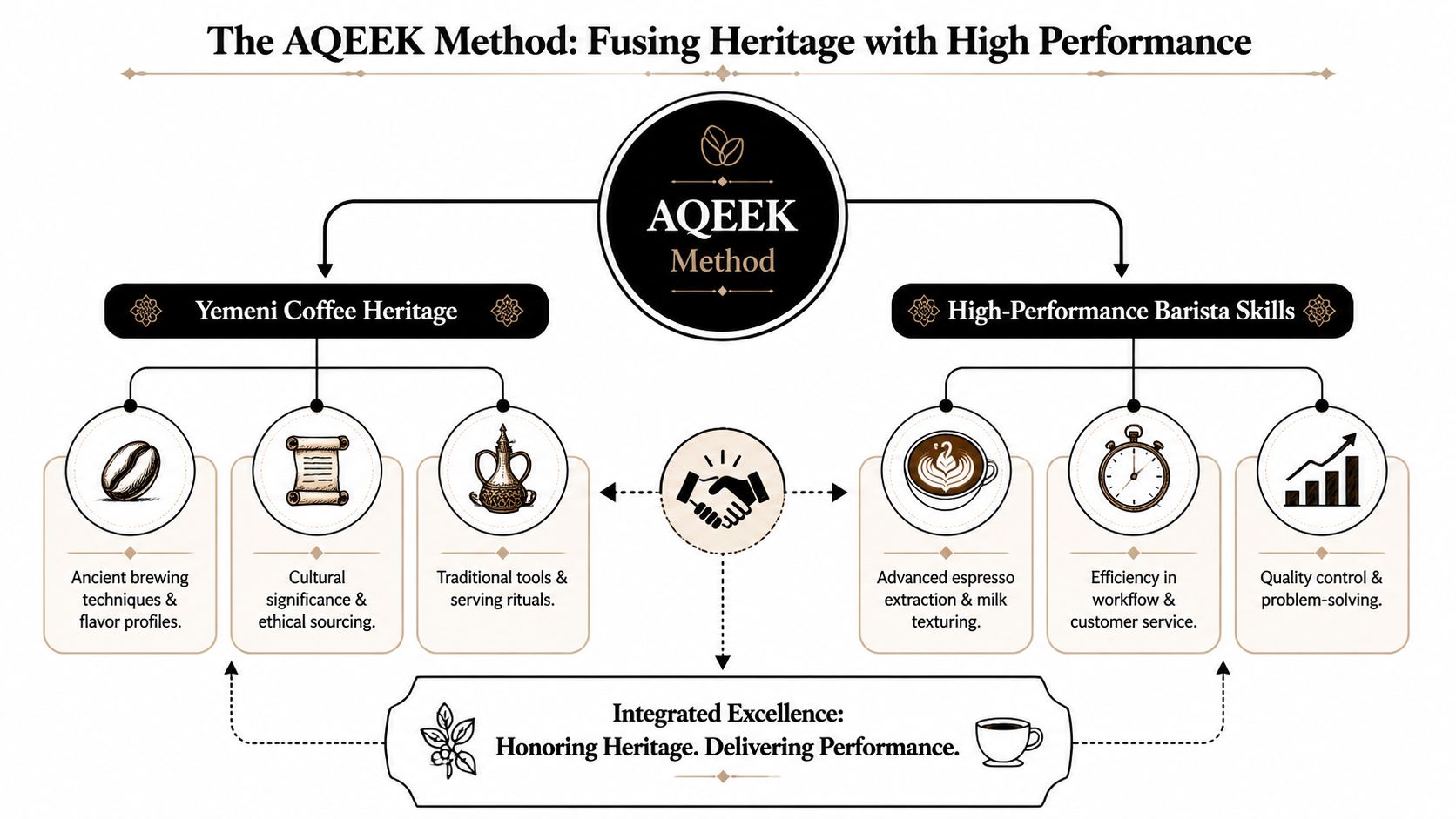
That's the core idea behind what I'd call the AQEEK method. It treats barista training as a layered discipline. The first layer is coffee heritage. The second is technical accuracy. The third is bar performance under real service pressure. When those layers stay disconnected, cafés feel uneven. The story sounds rich, but drinks drift. Or the drinks are clean, but the brand feels generic.
This visual captures that integration clearly.
Pillar one means training the palate through heritage
A Yemeni coffee program should expose baristas to more than origin names. It should teach them how heritage influences flavor expectation, menu language, and hospitality rhythm. A barista serving a Yemeni-inspired beverage needs to know whether the drink is meant to communicate depth, warmth, spice, fruit, ritual, or speed.
That changes how recipes are taught. Instead of asking only, “Did you follow the formula?” the trainer also asks, “Did the cup express the identity of the café?”
This matters especially for signature beverages. If the menu borrows from Yemeni ingredients or service traditions, staff need enough cultural literacy to present those drinks with accuracy and respect.
Pillar two means technical precision on the bar
Heritage without machine competence won't survive peak hours. For café operations, training has a direct workflow effect because staff must be competent on the espresso machine, grinder, milk steaming and frothing tools, and related preparation equipment. Programs that teach hands-on use of that equipment are designed to reduce handling errors, improve consistency, and increase throughput during busy service, as described in this barista equipment training overview.
That principle sounds obvious, but many owners still undertrain equipment fluency. They teach recipe cards and assume speed will follow. It won't. Speed follows familiarity. Familiarity follows repetition.
A strong method usually includes:
Station discipline. Staff know where tools live and how to reset the bar quickly.
Calibration habits. Espresso is checked, corrected, and rechecked instead of trusted blindly.
Milk workflow. Pitcher choice, steaming order, and pour timing are practiced as a sequence.
Pillar three means simulation, not theory alone
The smartest training environments don't stop at demonstrations. They create service simulations. That means the barista has to move through multiple drinks, changing priorities, interruptions, customer interaction, and recovery moments while still protecting quality.
A café doesn't fail because staff lack knowledge. It fails because knowledge breaks down during the rush.
That's why simulation is so valuable in a Yemeni café context. It teaches baristas how to carry a layered brand story while still operating with discipline. They learn when to explain, when to move, when to simplify, and when to protect the pace of the queue.
Why this model fits the modern Yemeni coffee shop
Independent cafés don't need one more generic training script. They need one that helps them express difference without sacrificing consistency. A Yemeni coffee shop has more narrative material than most cafés. It also has a higher burden of execution, because the brand promise is richer.
The AQEEK method works as a lens because it asks a sharper question than most programs ask. Not just “Can your team make drinks?” but “Can your team make drinks that belong to your story, at service speed, with repeatable standards?”
That is where barista training becomes a business system.
How AQEEK Training Builds Thriving Yemeni-Inspired Cafés
A Yemeni-inspired café becomes convincing when the guest can feel the concept in the menu, the pace of the bar, and the words coming from the staff. Training shapes all three.
Many public barista classes still focus on classic drinks and core mechanics, but advanced training now needs to include menu engineering, especially for cafés that differentiate through signature beverages. That means recipe standardization, bar flow, and cup sequencing, all of which are increasingly important for building a unique and consistent customer experience, as discussed in this specialty training perspective on signature drinks.
It is often at the point of service that many Yemeni cafés either become memorable or disappear into the crowd. They may have beautiful branding and excellent beans, yet the menu stalls service because drinks are too complex, too variable, or poorly sequenced.
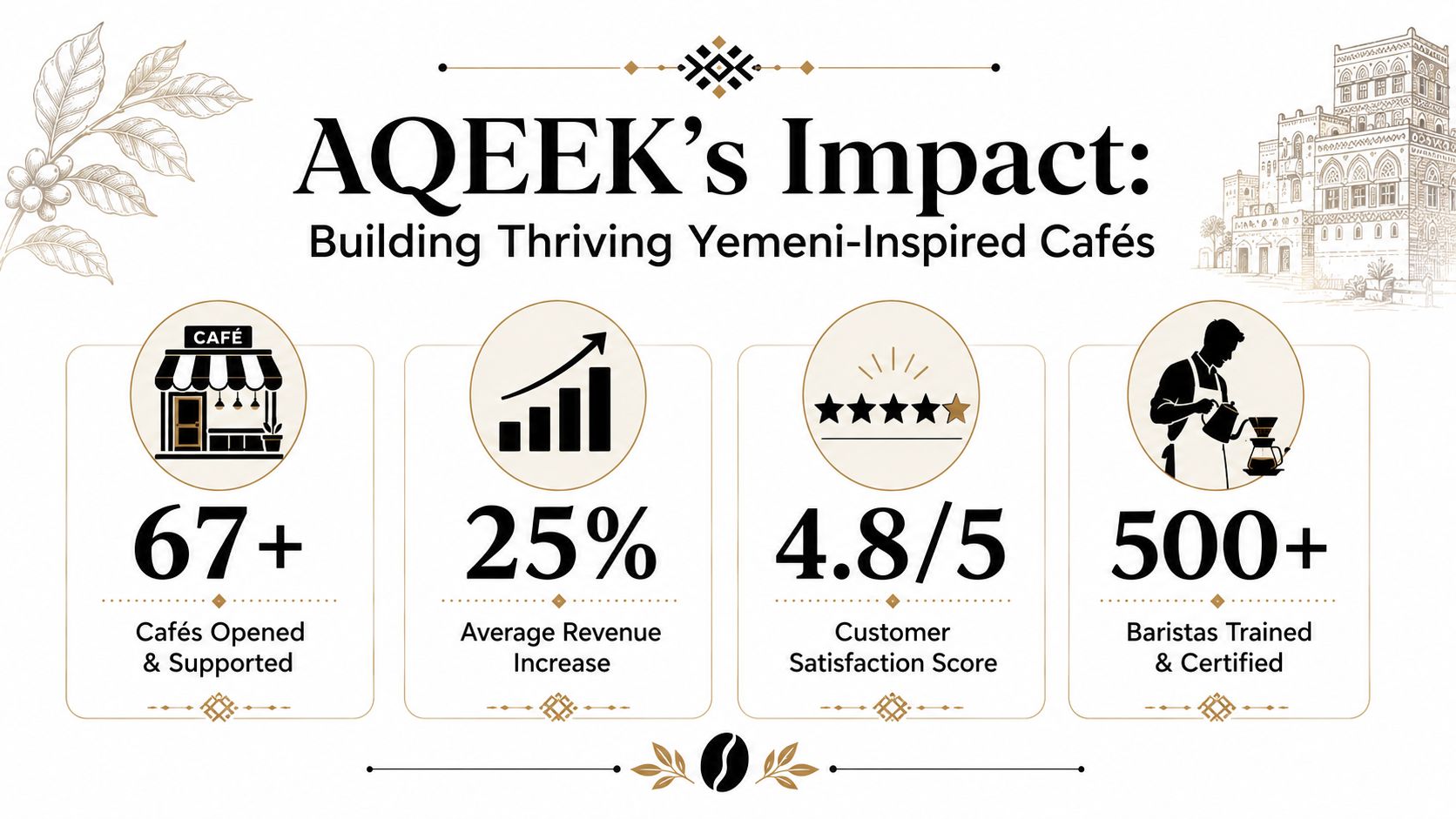
A founder's real challenge isn't just training people
The founder usually starts with taste. They know the profile they want. They know the feeling they want the café to carry. But once the shop opens, the practical questions pile up quickly.
Can the bar produce a traditional espresso menu and a Yemeni-inspired signature menu without bottlenecks? Can a new hire learn the drinks without diluting them? Can customers understand the menu fast enough to order confidently?
Those aren't abstract branding problems. They're operating problems.
For founders exploring that path, AQEEK has written about how it supports Yemeni coffee shop launches, including menu, setup, and operational support.
What thriving cafés usually get right
The strongest shops tend to do a few things well at the same time:
They simplify complexity behind the scenes. Recipes are standardized before launch, not improvised during service.
They sequence drinks intelligently. Staff know which beverage components can be prepped, which must be finished à la minute, and how to batch thought without batching quality.
They train the spoken experience. A guest asking “What makes this Yemeni?” gets an answer that is short, clear, and confident.
Consider a common example. A founder wants a house signature inspired by Yemeni flavor memory. The weak version is a drink with too many moving parts and no bar logic. The strong version uses a standardized build, a defined cup sequence, and a concise service script. The drink still feels distinctive, but it no longer slows the whole line.
Why this matters for brand durability
A café can survive mediocre décor. It usually can't survive operational confusion dressed up as authenticity.
When training includes menu engineering, the team learns how to protect identity under pressure. The bar doesn't become less cultural. It becomes more legible. The drinks carry story without collapsing into inconsistency.
That's the key lesson for Yemeni coffee shops. Heritage creates the opportunity. Systems let the opportunity scale.
A Founder's Guide to Barista Training ROI
Most owners don't need more inspiration. They need a sharper filter.
A lot of barista training content still avoids the question founders care about. What does this training change in the business? Public course descriptions often list espresso, milk texturing, sanitation, and customer service, but they rarely explain how training reduces drink errors, supports staffing, improves consistency, or speeds service. Operator-oriented training is more useful when it is treated as a process-improvement tool rather than a beginner badge, as outlined in this owner-focused view of barista training ROI.
That idea matters even more in a Yemeni café, where the concept often carries a premium storytelling burden. If training doesn't strengthen both execution and identity, the return stays fuzzy.
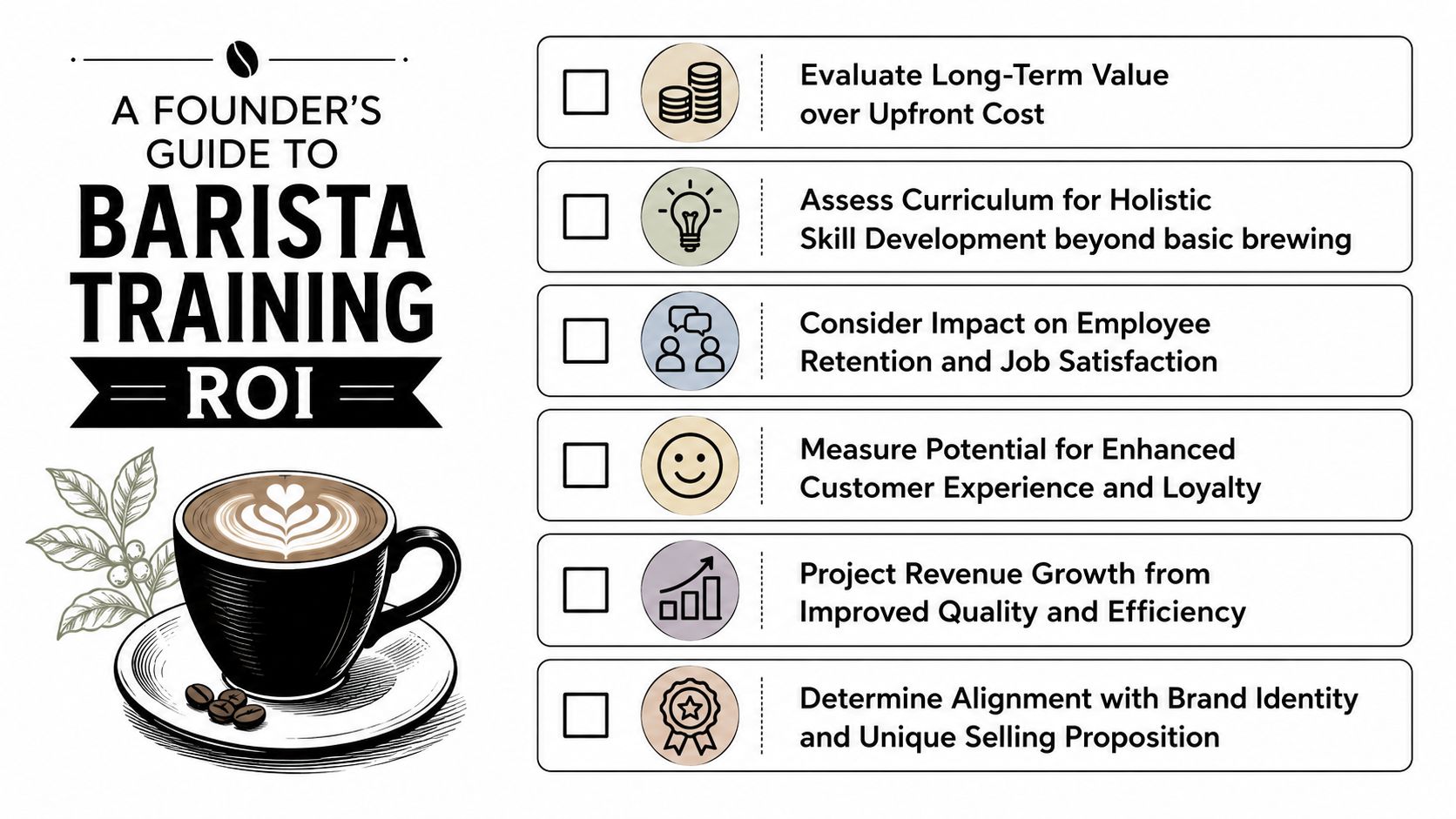
Questions worth asking before you buy any class
Use these as founder-level screening questions:
What business problem is this training solving? If the answer is only “learn coffee basics,” keep pressing.
Does it teach workflow, not just recipes? Your bar needs movement standards, reset habits, and service logic.
Will it help build a distinct menu? A Yemeni café needs signature drinks that are teachable and repeatable.
How does it handle retraining? Staff turnover is real. Training must be transferable.
Does it support guest communication? Teams should be able to explain heritage without sounding scripted.
Is there any operational benchmark at all? Even if the class stays qualitative, the provider should talk in terms of consistency, throughput, and error reduction.
Cost matters, but cost alone is the wrong lens
A course fee is visible. Poor training costs are hidden. They show up in remakes, slow service, confused hires, uneven drinks, and a brand story no one can tell cleanly.
Here's a simple comparison:
Question | Low-ROI training | High-ROI training |
|---|---|---|
Main outcome | Certificate or exposure | Repeatable operational habits |
Menu relevance | Generic drinks | Brand-aligned beverage system |
Team transferability | Trainer-dependent | SOP-friendly and scalable |
Founder value | Short-term confidence | Long-term process control |
Owner test: If you can't explain how a class will change your bar next month, you probably can't justify it this week.
For Yemeni coffee founders, ROI also includes something less discussed but very real. Training should protect authenticity from drift. Every new employee can either deepen the concept or blur it. Good training reduces that blur.
Join the Mokha Renaissance
The old question was, “Where can I take barista training classes?” The better question is, “What kind of café am I training people to build?”
Yemen gives that question weight. Coffee didn't arrive in modern café culture as a blank product. It came through places, rituals, trade routes, and memories that still shape how people experience the cup. When a training program takes Yemeni heritage seriously, baristas don't just gain technical skill. They gain a framework for serving coffee with clarity and meaning.
Professional training also has economic value. One industry training listing says that completing a certified barista course can be associated with an average salary increase of around 20 to 25 percent for skilled workers, which signals real demand for proven competence in the labor market, according to this barista course listing.
That's one reason this moment feels larger than a trend. Founders want systems. Teams want confidence. Guests want a coffee experience that feels distinct and believable. Yemeni coffee can answer that demand, but only when the people behind the bar are trained to carry both story and standards.
The Mokha renaissance isn't only about reviving an origin. It's about restoring a way of thinking. Coffee can be cultural memory, disciplined craft, and a durable business at the same time.
If you're building a café, refining a Yemeni-inspired concept, or training a team to serve coffee with both precision and heritage, connect with AQEEK Coffee. Their work sits at the intersection of Yemeni coffee history, bar workflow, menu development, and real-world café operations.
