
A great coffee shop menu is so much more than a list of what you sell. It’s your shop’s story, your sales pitch, and your brand identity all rolled into one. Before you even think about what drinks to offer, you have to answer a fundamental question: who are we?
The answer to that question will guide every single decision, from whether you serve a classic flat white or a funky lavender-honey latte.
Your Menu Starts with a Clear Identity
Before a single bean is ground, you need to lay the groundwork. This isn't just about picking popular drinks; it's about building an experience that connects with a specific type of person.
Are you going to be a high-energy spot for professionals to grab a quick espresso on their way to work? Or are you creating a quiet, cozy retreat where students can camp out for hours with a book and a bottomless cup of drip coffee?
Nailing down this concept is the most important thing you'll do. It keeps your menu focused and strategic, not just a random collection of stuff you think might sell.
This process really boils down to three key stages.
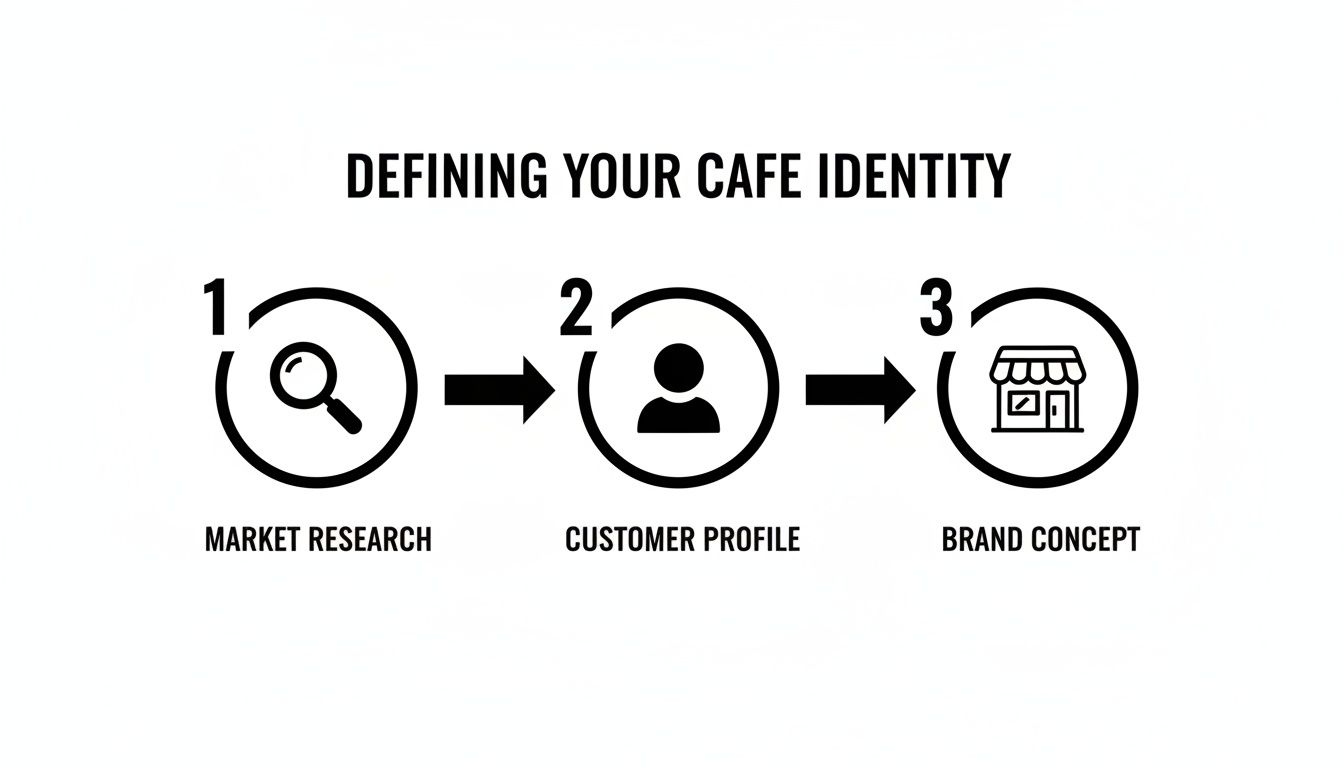
As you can see, it all flows together. Understanding the local scene and your target customer is what allows you to build a brand, and that brand is what dictates what goes on the menu.
Research Your Local Market
First things first: get out and walk the neighborhood. Do this at different times of the day. Is it a quiet residential area full of families, a bustling business district, or a funky arts neighborhood? Each environment has its own unique rhythm and needs.
Then, start doing some friendly competitor analysis. Visit the other coffee shops nearby. Don't just grab a menu—sit down, watch, and listen. Pay attention to their customers, their busiest times, and the general vibe.
What are they nailing? Take note of their best-selling items and how they price them.
Where are the gaps? Maybe nobody is offering a really good, fast batch brew for the morning commuters. Or perhaps there's a serious lack of comfy seating for people who want to linger in the afternoon.
What makes them unique? Is it their meticulously sourced single-origin espresso, their incredible in-house pastries, or their ridiculously fast service?
Finding these gaps is your opportunity to shine. For instance, Juniper Coffee & Eatery in Farmington, New Mexico, really connected with their community by weaving in local culture. They offer things like a blue corn bowl and a SPAM breakfast burrito—items that resonate deeply with the people who live there.
Define Your Ideal Customer
Once you have a feel for the market, it's time to get crystal clear on who you're trying to attract. I always recommend creating a customer persona—a detailed profile of your perfect guest. Give them a name, a job, and a daily routine.
My best advice: Treat this customer persona as your north star. Every time you think about adding a new item, ask yourself, "Would 'Sarah the freelance designer' actually order this?" If the answer is a hard no, it probably doesn't belong on your menu.
This keeps you from falling into the trap of trying to be everything to everyone, which is a fast track to a confusing and unprofitable menu.
The coffee market is huge, but that also means the competition is fierce. The industry has hit a global revenue of $473.10 billion, and coffee shops are responsible for nearly 80% of that. Those numbers show just how critical it is to have a sharp, well-defined identity to grab your piece of the pie.
Building Your Core Menu with Signature Items
Alright, you've nailed down your concept. Now for the fun part: building the menu. This is where your café's personality really comes to life, translating that big idea into delicious, tangible things people will love. The goal here isn’t to offer every drink under the sun; it's to curate a smart, intentional selection that works.
Think of your menu in two parts: the core essentials and the show-stopping signature items. Your essentials are the workhorses—the lattes, cappuccinos, and drip coffees that customers know and expect. These have to be flawless. Every single time.
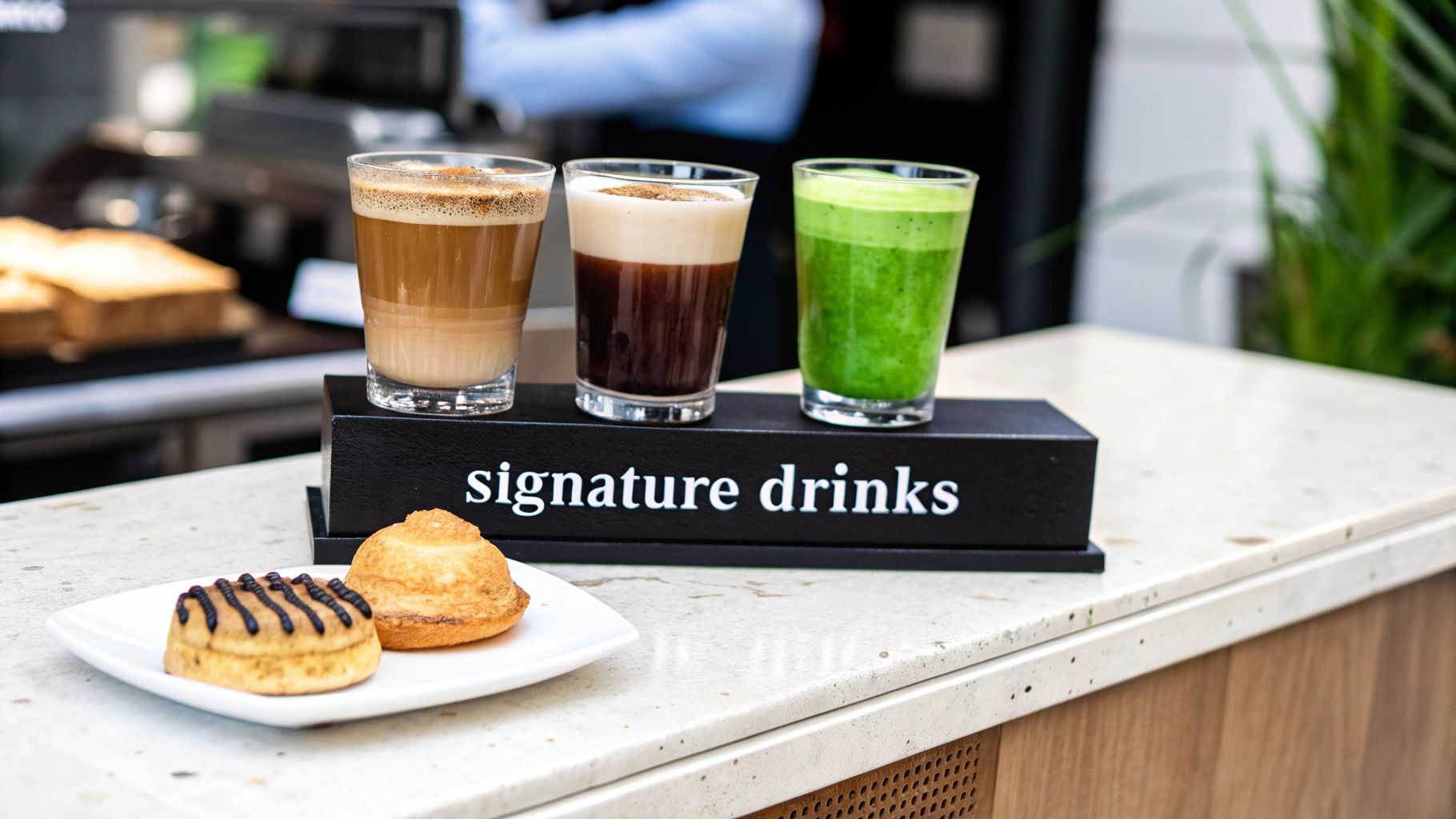
But it’s your signature items that will get people talking. These are the unique creations that set you apart, fill up Instagram feeds, and become the reason someone chooses your shop over the one down the street.
Balancing Classics with Unique Creations
A great menu strikes that perfect balance between comfort and curiosity. Your customers need to be able to find their daily go-to, but they also get excited about trying something new. If you only offer the basics, you're forgettable. If you only have wild, experimental drinks, you might alienate the folks who just want a really good cup of coffee.
Start by anchoring your menu with high-quality versions of the standards:
Espresso Drinks: This is your bread and butter—lattes, cappuccinos, flat whites, Americanos. Focus on impeccable technique and fantastic beans.
Brewed Coffee: Have a solid batch brew ready for the morning rush and maybe a manual option like a pour-over for the coffee aficionado with a few extra minutes.
Non-Coffee Options: Don't forget a well-curated selection of teas (black, green, herbal) and a rich, decadent hot chocolate. These are non-negotiable.
With that foundation in place, you can start getting creative. The demand for specialty coffee is huge—it now captures 25% of the U.S. market and has a global value of $45 billion. This isn't just a niche anymore. In fact, 45% of American adults enjoyed a specialty coffee just yesterday. Your signature items are your direct line into that market.
To help you map out the essentials, this table breaks down the core coffee categories. It's a great starting point for seeing where your profit comes from and who you're serving with each item.
Core Coffee Menu Item Analysis
Menu Category | Example Items | Target Audience | Typical Profit Margin |
|---|---|---|---|
Espresso-Based | Latte, Cappuccino, Americano, Flat White | Daily commuters, remote workers, social meetups | 65%-80% |
Brewed Coffee | Drip Coffee, Pour-Over, French Press | Morning rush crowd, coffee purists, budget-conscious | 80%-90% |
Cold Coffee | Cold Brew, Iced Latte, Iced Americano | Younger demographics, afternoon visitors, warm climates | 70%-85% |
Blended/Frappes | Caramel Frappe, Mocha Cookie Crumble | Students, treat-seekers, dessert lovers | 60%-75% |
As you can see, the simpler the drink, often the higher the margin. But a balanced menu needs a mix of these to appeal to everyone walking through your door.
Developing Your Signature Items
This is your chance to really shine. Your signature items should feel like your shop and be tough for competitors to copy. We're not just talking about adding another syrup to the rack; this is about thoughtful, intentional creation.
Imagine a rustic, cozy café offering a "Toasted Maple Pecan Cold Brew." Or a bright, modern shop with a "Sparkling Rosemary Lemonade." The key is making it feel authentic to your brand. I once consulted for a shop in New Mexico, and they put a blue corn waffle on their menu. It was a smash hit because it connected directly to the local culture and gave people an experience they couldn't get anywhere else.
Your signature drink should be more than just a menu item; it should be a story. It’s the drink people specifically travel to your shop for and the one they tell their friends about. Make it memorable, delicious, and Instagram-worthy.
These unique items are also often your highest-margin offerings. While a standard latte has a great margin, a signature drink featuring a unique, house-made syrup can easily command a higher price with only a small increase in cost. If you’re hunting for inspiration, browsing different recipes can be a great way to get the creative juices flowing.
Sourcing and Supplier Relationships
The quality of your menu comes down to the quality of your ingredients. Simple as that. In this business, consistency is king, and it all starts with your suppliers. Don't just chase the lowest price—find partners who are as obsessed with quality as you are.
Coffee Roaster: This is your most important relationship, bar none. Find a roaster whose flavor profiles align with your vision. Work with them to dial in a house espresso blend and find some exciting single-origin beans to feature.
Dairy and Alternatives: You need high-quality milk that steams like a dream. Also, offer a tight selection of the most popular non-dairy milks, like oat and almond.
Pastries and Food: This is a big decision. Will you bake everything in-house or partner with a great local bakery? A partnership can be a huge win, giving you incredible, fresh products without the massive overhead of running a full kitchen. Plus, it’s a great cross-promotional opportunity.
Building solid relationships with these suppliers is the operational backbone of your café. It means you get consistent products, fair pricing, and—crucially—a heads-up when supply chain issues are on the horizon. That stability allows you to focus on the creative side of running a killer coffee shop.
Pricing Your Menu for Maximum Profitability
A gorgeous menu is one thing, but if the numbers don't add up, even the busiest café will find itself in trouble. This is where a smart, deliberate pricing strategy comes into play. It’s what turns every latte and croissant you sell into a building block for a healthy, sustainable business.
Let’s be clear: pricing isn’t about pulling a number out of thin air or just peeking at what the shop down the street is doing. It's a calculated process that balances what an item costs you to make, what your customers believe it’s worth, and your own profitability goals. The first step, and honestly the most important, is figuring out exactly what each item on your menu costs you.
Nailing Down Your True Cost of Goods Sold
To price anything accurately, you have to know its Cost of Goods Sold (COGS). This goes way beyond just the obvious ingredients. You need to account for every single tiny component that goes into putting that final product in a customer's hand.
Think about a standard 12oz latte. Your cost breakdown needs to include:
The precise weight of the espresso beans you used.
The exact volume of milk, plus a little extra to account for steaming waste.
The cost of the cup, the lid, and the sleeve.
Even the sugar packets or stir sticks the customer might grab.
Getting this granular isn't optional—it's essential for accurate pricing. A good starting point is with your suppliers. If you're looking to get a better handle on ingredient costs, exploring something like a wholesale program for your coffee beans can lock in better pricing and give you more stability.
Once you’ve calculated the total cost for each item, you’re ready to actually set a price.
Choosing Your Menu Pricing Strategy
There are a few solid ways to approach pricing, and frankly, the best strategy is usually a mix of different methods. You have to look at your internal costs just as much as you look at what's happening outside your four walls.
Cost-Plus Pricing This is the most direct method and your foundational starting point. You figure out your COGS for an item, then add a markup to hit your target selling price. In most coffee shops, a good target food cost percentage to aim for is 20-30%.
Let's say a caramel latte costs you $1.10 to make (beans, milk, syrup, paper goods, the whole shebang). If you want to hit a 25% food cost, your math looks like this:
$1.10 (Your COGS) / 0.25 (Target Cost %) = $4.40 (Menu Price)
You’d probably round that up to $4.50 to keep the menu looking clean. This approach ensures you're covering all your direct costs and hitting your profit margin on every single sale.
Competitor-Based Pricing This is all about market research. See what other local cafés are charging for their lattes and croissants. This is critical for making sure you're in the right ballpark and meeting customer expectations. You simply can't price your latte at $7.00 if everyone else on your block is at $5.00.
But a word of caution: never use this method in isolation. Your competitor might have a sweetheart deal on rent, a different labor model, or cheaper suppliers. Use their prices as a reality check, not a rulebook.
Pro Tip: The magic is in blending these two methods. Start with cost-plus pricing to find your non-negotiable, profitable price point. Then, look at your competitors and adjust as needed to position your brand. Do you want to be the premium option or the everyday value spot?
The Psychology Behind Menu Pricing
The way you display your prices can subtly nudge customers toward certain choices and shape how they perceive value. These little psychological tweaks can make a surprisingly big difference to your daily sales.
Charm Pricing: This is the age-old trick of ending prices in .99 or .95. To the human brain, a drink priced at $4.95 feels significantly cheaper than one at $5.00, even though it's just a nickel.
Minimize Price Cues: Try removing the dollar signs ($) from your menu. Studies have shown that the currency symbol itself makes people more conscious of spending. Listing a price simply as "5" instead of "$5.00" softens the focus on cost and makes the decision feel less transactional.
Strategic Grouping: Offer bundles, like a coffee and pastry special. This does two things: it gives the customer a sense of getting a good deal, and it helps you increase the average ticket size. You're gently guiding them toward a slightly higher spend than they might have planned.
When you combine a rock-solid understanding of your costs with smart market positioning and a dash of psychology, your menu stops being just a list of items. It becomes your most powerful tool for driving profit.
Designing a Menu That Guides Customer Choices
Your menu is so much more than a simple list of what you sell. Think of it as your most effective salesperson—one that works around the clock to guide customer choices, highlight your most profitable items, and tell your brand’s story without saying a word.
A thoughtfully designed menu makes it easy for people to find exactly what they want and maybe even tempts them to try something new. But a cluttered, confusing menu does the opposite. It slows down the line, frustrates customers, and often leads them to just order the most familiar thing they see, which might not be your best or most profitable item. The goal is to create something that’s both beautiful and incredibly functional.
Harnessing the Golden Triangle
Menu engineers have known for decades that people don't read menus like a book. Our eyes follow a surprisingly predictable path, often called the "golden triangle." Most people look first to the middle of the menu, then scan up to the top right corner, and finally sweep over to the top left.
This is a golden opportunity. You need to put your highest-margin signature drinks and special combo deals right in these prime spots. That unique "Toasted Maple Pecan Cold Brew" we came up with? It absolutely belongs in one of these hotspots, not buried halfway down a long list of cold drinks.
A well-designed menu isn’t about tricking anyone. It's about making their decision-making process smoother. By putting your best items where their eyes naturally fall, you’re helping them discover what makes your café special.
Typography and Readability
The fonts you choose say a lot about your brand's personality. A cozy, rustic café might use a warm serif font, while a sleek, modern spot could go for something clean and minimalist. Whatever style you land on, readability is non-negotiable.
Your font has to be large enough for someone to read from a few feet away, which is especially critical for large menu boards behind the counter. Steer clear of overly decorative or script fonts that are tough to decipher at a glance. You can create a clear visual guide by using different font sizes and weights:
Section Headers: Use a bold, larger font for things like "Espresso Drinks" or "Pastries."
Item Names: Keep these clear and slightly smaller than the headers.
Descriptions: Use your smallest, simplest font for short, appealing descriptions.
This simple hierarchy helps customers scan the menu quickly and find what they’re looking for, even during a busy morning rush.
The Power of Descriptions and White Space
Never underestimate what a few carefully chosen words can do. Instead of just listing "Vanilla Latte," try something a little more evocative, like, "Our classic espresso with perfectly steamed milk and a hint of sweet Madagascar vanilla." That small tweak turns a simple commodity into a genuine experience. Just keep descriptions short, enticing, and focused on flavor.
Just as important is what you leave out. White space—the empty area around your text—is your best friend. It prevents the menu from looking cluttered and overwhelming. A menu packed from edge to edge with text is stressful to look at and hard to read. Giving your items room to breathe creates a sense of calm and sophistication, making everything feel more approachable.
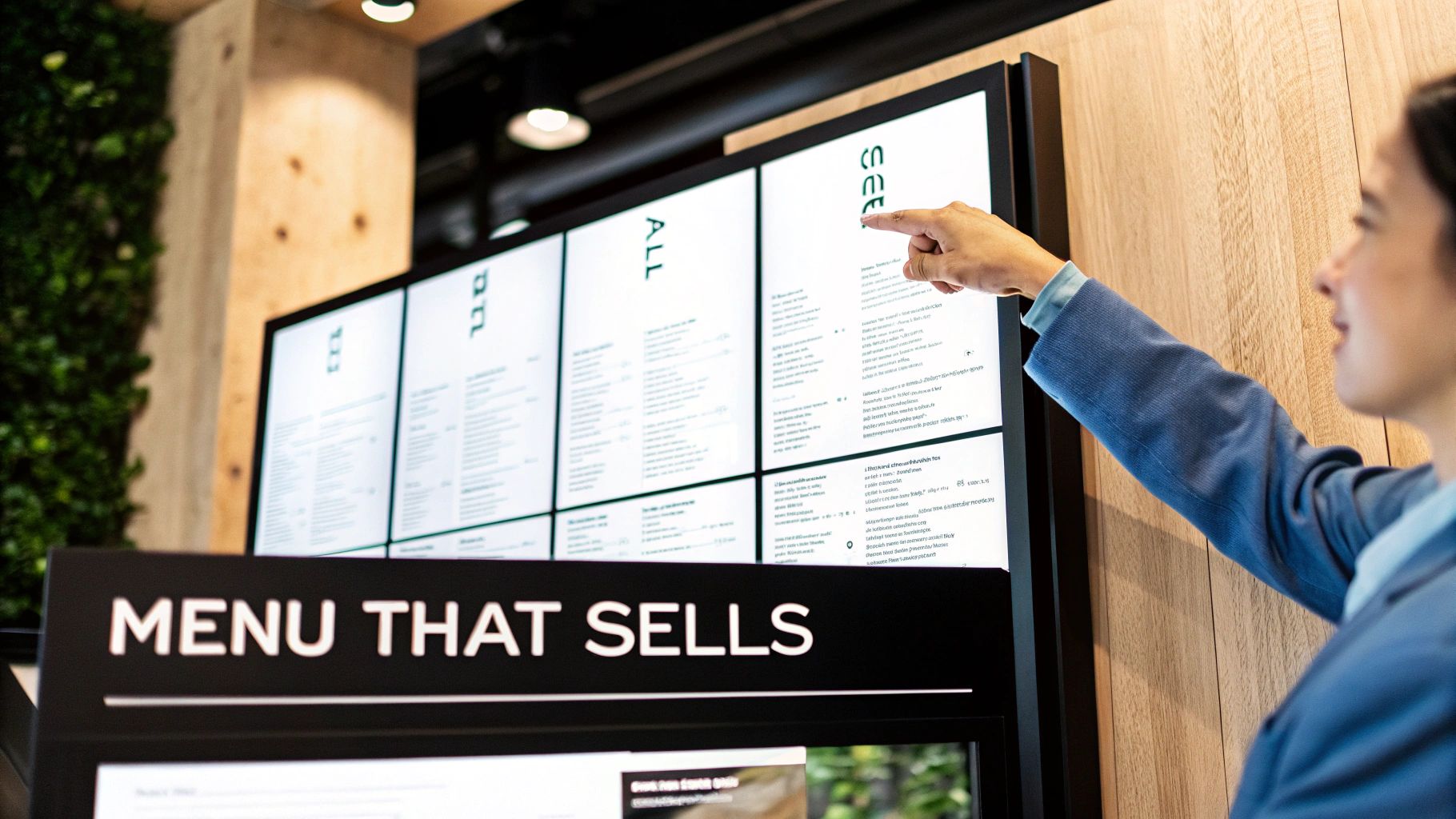
Finally, think about the format. A classic printed menu can feel personal and traditional, perfect for a café where people sit and stay a while. Digital menu boards, on the other hand, offer incredible flexibility. You can update prices in seconds, feature a daily special, or even use subtle animation to draw attention to high-profit items, making them an incredibly powerful tool for any modern café.
Expanding Your Menu Beyond Coffee
A perfectly pulled espresso is the heart of any great coffee shop, no doubt about it. But relying only on coffee is like running a restaurant that only serves appetizers. If you want to build a truly resilient and profitable business, you have to give people a reason to visit all day, not just during the morning caffeine rush.
The secret? Strategically expanding into non-coffee drinks and food. This is how you turn a dead afternoon into a serious revenue stream.
This isn’t just about tacking on more options for the sake of it. It’s a calculated move to capture a wider audience and, crucially, increase how much each person spends. The modern coffee consumer expects variety, and the numbers don't lie.
The market has completely shifted. Cold beverages now bring in a massive $18 billion in the U.S. and account for a staggering 75% of Starbucks' drink sales. And it's not just coffee; the tea market is a $66 billion industry growing at 6.6% every year. You can dive deeper into these trends and get the full picture in this comprehensive coffee statistics report.
Capitalizing on the Cold Beverage Boom
Let's be clear: the demand for cold drinks isn't just a summer fling anymore. It's a year-round powerhouse, especially with younger customers. The best part? These drinks often have fantastic profit margins and are quick to make, so they won't wreck your workflow.
Here are a few high-impact options to consider:
Nitro and Standard Cold Brew: This is non-negotiable for any serious café. Cold brew is smoother, less acidic, and packs a punch, appealing to coffee purists and newbies alike. Adding a nitro tap gives you that creamy, Guinness-like texture that commands a premium price for minimal extra effort.
Specialty Iced Teas and Lemonades: Think way beyond basic black iced tea. House-made infusions like a hibiscus-mint green tea or a sparkling rosemary lemonade are refreshing, cheap to produce, and offer huge margins. They're a perfect draw for the non-coffee crowd.
Shaken Espressos: The big chains made these famous for a reason—they're simple but feel sophisticated. A double shot, a little sweetener, and milk (or a dairy alternative) all shaken with ice creates a beautiful, layered drink that’s practically made for Instagram.
Introducing Functional and Wellness Drinks
Another category exploding in popularity is "functional" beverages—drinks that offer some kind of perceived health benefit. This is your chance to tap into the wellness-conscious market, a group that’s almost always willing to pay more for high-quality, health-focused ingredients.
Get creative and make it fit your brand. A health-forward café could offer a golden milk latte with turmeric and ginger. If you're near a gym, maybe a protein-boosted cold brew smoothie is the ticket.
Don't overlook the power of a great matcha or chai latte. When you source high-quality ingredients and prepare them with the same care you give your espresso, these drinks can become signature items. They build an intensely loyal following among customers looking for a comforting, caffeinated alternative.
The Financial Upside of a Smart Food Program
Food is the final piece of the puzzle. It’s what transforms your shop from a quick pit stop into a place where people settle in. A well-curated food menu can instantly increase your average ticket, turning a $5 latte sale into a $12 breakfast combo.
The key is to pick items that complement your coffee, don't require a full-blown kitchen, and won't slow down your baristas.
Start simple with these high-margin, low-hassle ideas:
Local Pastries: Partnering with a respected local bakery is a brilliant move. You get incredible croissants, scones, and muffins without the massive overhead of an in-house baker. Plus, you get to support another local business, which customers love.
Grab-and-Go Options: Think overnight oats, yogurt parfaits, and pre-made sandwiches. These are perfect for the commuter crowd. You can prep them in batches during slow periods, so they're ready for a lightning-fast sale during the morning chaos.
High-Margin Snacks: These are your impulse buys right at the register. Think premium chocolate bars, gourmet cookies, or small bags of house-made granola. They're an easy and profitable add-on to almost any order.
By thoughtfully building out your menu, you give customers more reasons to visit and more ways to spend. That’s how you build a more profitable and dynamic coffee shop that thrives all day long.
Common Questions About Coffee Shop Menus
Putting together the perfect coffee shop menu always seems to stir up more questions than answers. It's never really "done"—it's a living document that has to evolve with the seasons, your customers' tastes, and your own business goals. Nailing it is a mix of art, science, and a whole lot of listening.
Let's walk through some of the most common questions that pop up when developing a menu. I'll give you some practical advice to help you get it right.
How Often Should I Update My Coffee Shop Menu?
This is a balancing act. You need to keep things fresh and tap into seasonal excitement, but you don't want to confuse your regulars or burn out your baristas with constant changes. A great rhythm to follow is a major menu review once or twice a year.
This doesn't mean you're tearing everything down and starting from scratch. Think of it more like a strategic tune-up. It’s your chance to dive into the sales data, see what’s not selling, and make room for potential new stars.
Beyond that big review, seasonal updates are your best friend for creating buzz.
Quarterly Specials: Every three months, roll out a small, curated list of 2-3 seasonal drinks. This is your pumpkin spice in the fall, peppermint mochas in the winter, and maybe a lavender-honey latte when spring hits. It's predictable in the best way.
Limited-Time Offers (LTOs): Use LTOs to piggyback on holidays or local events. A "Valentine's Day Mocha for Two" or a "Summer Fest Cold Brew" creates a little FOMO (fear of missing out) and can become a fun, short-term draw.
This strategy keeps your core menu stable and dependable for the daily crowd while giving everyone else a reason to keep coming back to see what's new.
What Are the Most Profitable Items on a Coffee Menu?
While every sale helps, some menu items are absolute profitability powerhouses. Knowing which products have the best margins means you can feature them more prominently and train your team to recommend them.
As a general rule, the simpler the drink, the better the margin. Your biggest costs are coffee, water, and milk, and these are all relatively inexpensive.
Here are the usual suspects when it comes to high-margin heroes:
Drip Coffee & Cold Brew: These are your financial workhorses. The ingredient cost is rock-bottom, which means you're often looking at profit margins of 80-90%.
Espresso & Americanos: Just coffee and water. It doesn't get much more profitable than that.
Specialty Lattes: You're adding syrups and maybe pricier alternative milks, but you can also charge a serious premium for these. That keeps your margins in a very healthy 65-75% range.
Iced Teas & Lemonades: If you brew these in-house, the cost is pennies per glass. You can price them similarly to coffee and watch the profits roll in, especially during warmer months.
The real game-changer for profitability isn't just selling one high-margin item. It's about raising the average check size. A drip coffee is great, but a drip coffee and a high-margin scone? That’s where the magic happens. Smart pairing suggestions and upselling are key.
How Can I Test New Menu Items Before Launching?
Just throwing a new drink on the menu without testing it is a huge risk. What if it’s a dud with customers? Worse, what if it brings your entire workflow to a screeching halt during the morning rush? A soft launch is absolutely essential for gathering feedback before you commit.
Start by introducing the new item as a "Weekend Special" or a limited-time feature. This takes the pressure off. You can see how it sells without having to print new menus or fully train everyone. Keep a close eye on the sales numbers during this trial run.
Next, go straight to the source for feedback. Get your baristas to ask customers what they think of the new drink. "Hey, you're one of our regulars—we're trying out a new brown sugar latte. Would you be willing to give it a taste and tell me what you think?" This kind of direct feedback is gold.
At the same time, watch what’s happening behind the counter.
Clock it: How long does it actually take to make the drink when it's quiet versus when there's a line out the door?
Watch the flow: Does making the drink require a barista to run all over the place or create a bottleneck at the espresso machine?
Check the setup: Are the new ingredients a pain to store or grab quickly?
If the new item sells well, customers are raving about it, and it doesn't mess up your operational rhythm, you’ve got yourself a winner. It's officially ready for a permanent spot on the menu.
