
Before you can even think about pouring a beautiful rosetta, you have to know what's happening inside that steaming pitcher. Let's break down the science of microfoam—it’s less about magic and more about how two key players, protein and fat, work together to create that silky, paintable texture.
Why Milk Chemistry Is Key to Perfect Latte Art
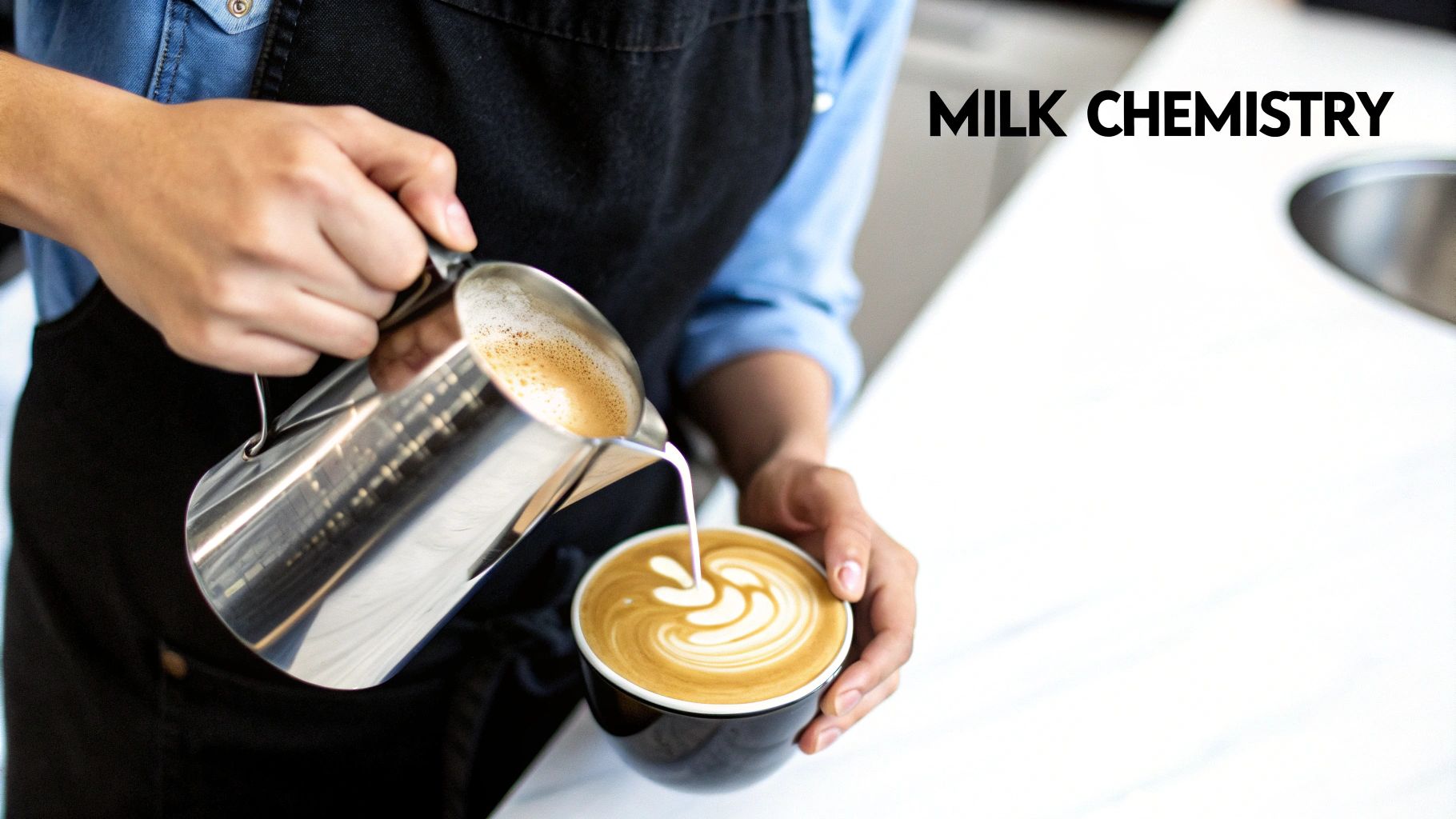
Getting a handle on the science of milk steaming is the secret weapon that separates the pros from the amateurs. It’s not just about getting the milk hot. You’re fundamentally changing its chemical makeup to create a velvety microfoam that pours like wet paint. Once you understand this, you can troubleshoot on the fly and pull consistently great shots, no matter what kind of milk you're using.
At its heart, milk is just an emulsion of water, proteins, fats, and sugars. For our purposes—making killer latte art—we really only care about two of those: protein and fat. They have a love-hate relationship, and getting them to cooperate is the whole game.
The Role of Protein in Foam Stability
Think of proteins as the scaffolding for your foam. When you hit the milk with steam, the heat and air cause the proteins (mostly casein and whey) to denature, which is a fancy way of saying they unwind from their tightly coiled shapes.
Once unfolded, these proteins have two distinct ends. One end hates water (hydrophobic) and immediately grabs onto the air bubbles you're creating. The other end loves water (hydrophilic) and stays anchored in the liquid. This creates a strong, elastic film around every tiny air bubble, keeping them from popping or merging into bigger, useless bubbles.
Key Takeaway: In general, more protein means a more stable, dense foam. This is exactly why you see "barista blend" plant milks fortified with things like pea protein—they're trying to mimic the structural power of dairy.
Milk with a solid protein content, like the 3.2–3.4% found in most whole milk, builds a durable network of uniform bubbles. That's what gives you the glossy, wet-paint shine and the stability you need to pour intricate art. Nailing this is a huge focus in professional training, something we dive deep into in our barista academy courses.
How Fat Influences Texture and Flavor
If protein builds the house, fat furnishes it. Fat is all about that creamy, luxurious mouthfeel that makes a latte so comforting. The tiny fat globules distribute themselves throughout the foam, smoothing everything out and making the texture more fluid and less rigid.
But here’s the catch: fat can also be a foam-killer. Especially at the beginning of the steaming process, fat molecules get in the way, competing with the proteins for a spot on the air bubbles. This can make it harder to build foam in the first place. It’s why skim milk froths up into a stiff, airy meringue—with almost no fat to weigh it down, the foam gets big and bubbly but lacks that silky texture.
The sweet spot for latte art is a milk with enough fat for that rich flavor but not so much that it destabilizes the whole structure. It’s a delicate balance, and it’s the reason whole milk remains the undisputed king in most cafés.
Comparing Dairy Milks for Superior Foam Quality
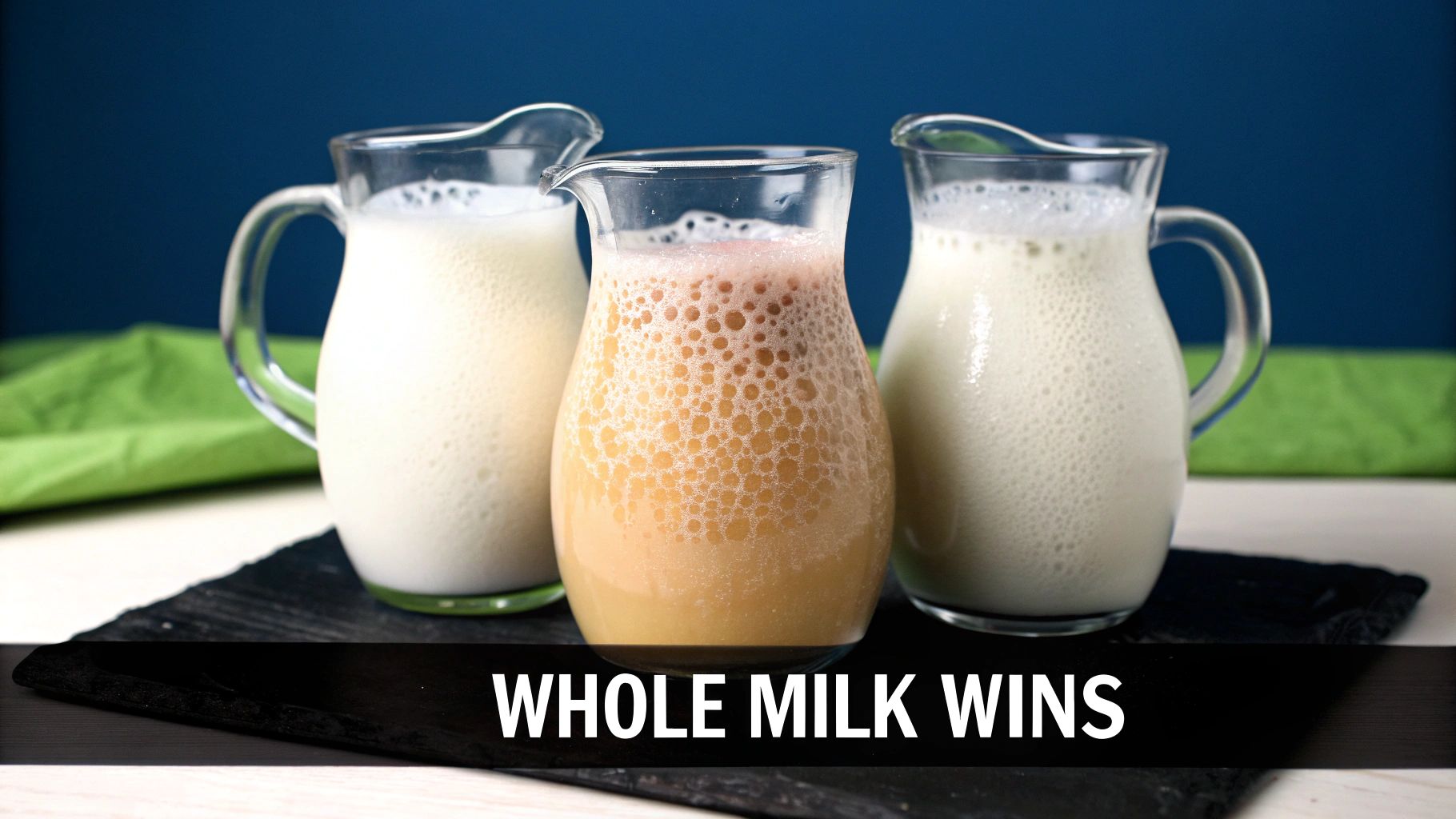
When it comes to pouring beautiful latte art, not all dairy milks are created equal. The subtle shifts in fat and protein content have a massive impact on foam texture, stability, and control. Understanding why one milk works better than another is the first step toward pulling off consistently great pours.
For good reason, whole milk is the undisputed champion in the café world. Its composition creates the perfect canvas for detailed designs, offering a forgiving and versatile medium for baristas of all skill levels.
Whole Milk: The Barista Gold Standard
For decades, whole cow's milk has been the go-to choice for specialty coffee shops. It’s all about the balance. With a composition of around 3.2–3.5% fat and 3.2–3.4% protein, it hits the sweet spot for creating dense, glossy microfoam with tiny, uniform bubbles.
This structure is exactly what you need for pouring complex patterns like rosettas and tulips because it holds its shape far longer than lower-fat options. In practical terms, this gives a barista a wider window to pour and a velvety texture that flows predictably out of the pitcher. It's why you'll see competition baristas and training programs universally recommend starting with whole milk to nail down your technique. You can find more insights on milk performance from Perfect Daily Grind to see how the pros approach it.
The fat brings that rich, creamy mouthfeel and gives the foam its fluid, paint-like consistency. At the same time, the high protein content builds a stable, elastic foam that can hold intricate shapes without breaking down.
Why It Works: Whole milk's magic lies in its chemistry. The fat delivers a silky, luxurious texture, while the protein provides the structural backbone needed for high-contrast, detailed art.
This combination creates a microfoam that folds perfectly into the espresso, resulting in a single, unified drink with a glossy surface ready for art. It's forgiving enough for a beginner but performs at the high level demanded by professionals.
Reduced-Fat Milks: 2 Percent and 1 Percent
When you start to move down the fat ladder to 2% (reduced-fat) and 1% (low-fat) milks, things change. You can still get foam, but the texture and behavior are noticeably different. Without as much fat to enrich the foam, the final microfoam is often lighter and far less creamy.
The protein is still there, so these milks can create a stable foam. But the lower fat content makes that foam structure a bit more rigid and less fluid. This can cause a few common headaches for latte artists:
Faster Separation: The foam and liquid tend to separate much more quickly in the pitcher, forcing you to pour immediately.
Less Pouring Control: The texture just doesn't flow as smoothly, making it much harder to execute those delicate, fine lines.
Stiffer Foam: The foam can get stiff almost instantly, feeling more like a traditional cappuccino topping than a silky latte.
For baristas, this all adds up to a much shorter window for pouring art. You need to have flawless technique to avoid a bubbly, dry-looking surface. Sure, you can probably pour a heart or a simple tulip, but those complex, multi-layered designs become a serious challenge.
Skim Milk: The Zero-Fat Challenge
Skim milk (or nonfat milk) is the final boss of difficult milks for latte art. With virtually no fat (typically less than 0.5%), the foam it produces is in a different league entirely—and not in a good way. The high concentration of protein relative to fat allows it to whip up a huge volume of foam that is incredibly stiff and dry.
Think of it less like latte foam and more like a meringue. It's packed with air and holds its shape, but it completely lacks the silky, integrated texture needed for pouring anything detailed. Instead of flowing like wet paint, skim milk foam tends to just flop onto the espresso in dollops.
This makes it nearly impossible to create defined patterns. The foam has very large bubbles, sits on top of the coffee instead of mixing with it, and offers almost no fluidity for pouring. While it froths up easily, it doesn't create the microfoam that is the very foundation of quality latte art. For this reason, most baristas focused on visual artistry avoid it entirely.
Finding the Best Plant-Based Milk for Latte Art
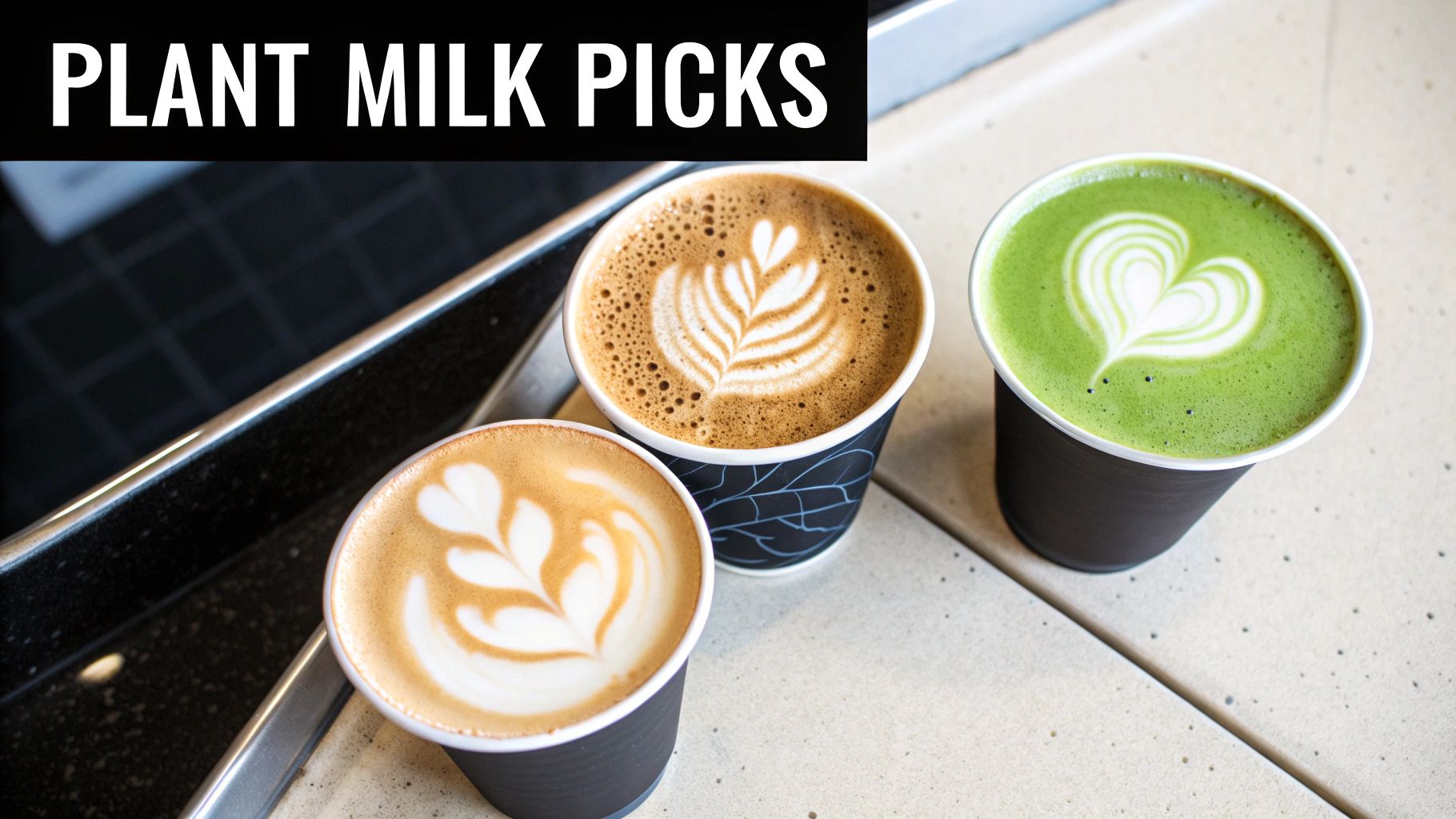
As more customers move away from dairy, plant-based milks have become an essential part of any modern café. But if you’ve ever tried steaming standard almond or soy milk from the grocery store, you know the struggle—they just don't have the right stuff for stable, pourable microfoam.
That’s where barista blends come in. These formulas are specifically engineered with added fats, proteins, and emulsifiers to act more like whole dairy milk under the steam wand. This innovation is what makes consistently beautiful plant-based latte art a reality.
Oat Milk: The Creamy Contender
Oat milk has absolutely taken over the specialty coffee world, and for good reason. Barista-grade oat milk delivers a creamy, full-bodied texture that’s shockingly close to whole milk.
Its flavor profile is another big win. With a neutral, faintly sweet taste, it lets the espresso's unique notes shine instead of overpowering them. When you steam it, oat milk creates a glossy, silky microfoam that's a dream to pour, making it a fantastic choice for baristas at any skill level. Its secret? A higher soluble fiber and fat content that creates an incredibly stable and cohesive foam structure.
Soy Milk: The Original Powerhouse
Before oat milk became a global phenomenon, soy was the undisputed king of dairy alternatives. It’s still a powerhouse, known for producing a thick, protein-rich foam that holds its shape beautifully—sometimes even longer than dairy.
The one catch is its distinct flavor. Soy's nutty, beany character can be a perfect match for some espresso blends but can clash with others. It's a more subjective pairing that requires some thought.
Pro Tip: Keep a close eye on your thermometer with soy. If you push it past 140°F (60°C), the proteins can curdle, leaving you with a grainy, separated texture that ruins the foam.
Soy is a reliable workhorse, but it demands a bit more finesse to get the texture and flavor balance just right.
Almond and Coconut Milk: The Textural Challenges
While people love drinking them, almond and coconut milks are notoriously difficult for latte art. Their lower protein and fat content creates a thin, delicate foam that collapses in a heartbeat.
Almond Milk: Standard almond milk tends to produce a bubbly, airy foam that just doesn't have the density for pouring art. Barista blends help, but the foam is still fragile and demands a fast, confident pour.
Coconut Milk: The rich, tropical flavor is great for specialty drinks, but its high-fat, low-protein makeup causes it to separate easily. The foam is often oily and lacks the structure for anything more complex than a basic heart.
These milks are usually better suited for specific menu items where flavor is the priority, not intricate art.
The rise of brands like Oatly since the 2010s shows just how much the market has shifted. They re-engineered plant milks by boosting protein, adding stabilizers like sunflower lecithin, and dialing in the fat content. This approach has been so effective that tasting panels often rank these blends as having the best mouthfeel and most stable pour.
When Starbucks went global with oat milk in 2021, it cemented its place in the mainstream. This demand allows manufacturers to price these specialized cartons at a premium—often 10–40% higher than standard versions—a cost reflecting both the complex formulation and customers' willingness to pay for a better latte. For more expert opinions, you can read about the best milks for lattes on Food Republic.
To help you choose, here's a side-by-side look at how the most popular barista blends perform.
Plant-Based Milk Performance for Latte Art
This table breaks down how the top plant-based milks stack up when it comes to creating high-quality latte art.
Milk Type | Foam Stability | Texture & Creaminess | Flavor Profile with Espresso | Best For |
|---|---|---|---|---|
Oat Milk | Excellent | Rich, velvety, and most similar to whole milk. | Neutral and slightly sweet; complements most espresso. | All-around performance, beginner-friendly, and intricate art. |
Soy Milk | Very Good | Thick and dense, but can curdle if overheated. | Distinct nutty/beany flavor that can be polarizing. | Simple, bold designs where foam longevity is key. |
Almond Milk | Fair | Thinner and less creamy; foam can be fragile. | Pleasant nutty flavor that pairs well with medium roasts. | Quick pours and flavor-focused drinks. |
Coconut Milk | Poor to Fair | Can be oily and prone to separation. | Strong tropical flavor that can overpower espresso. | Specialty drinks where the coconut flavor is the star. |
Ultimately, choosing the best plant-based milk comes down to investing in a barista blend. They provide the scientific foundation—the right balance of fats, proteins, and stabilizers—that gives your skill behind the machine a chance to truly shine.
Mastering Your Steam Wand: A Guide to Different Milks
Let's be honest: achieving that glossy, pourable microfoam for latte art is less about the type of milk and more about how you handle it. You can have the best milk in the world, but if your steaming technique is off, you’ll never get the results you want. The real secret is learning to adapt your approach to each milk’s unique personality.
Think of whole milk as your training ground. Its perfect balance of fat and protein makes it incredibly forgiving, so it’s the ideal starting point for mastering the fundamentals. Once you nail the technique with whole milk, you can apply those principles—with a few key tweaks—to just about anything else.
The Whole Milk Benchmark: Your Foundation
Steaming whole milk is a dance in two parts: stretching and texturing. First, you introduce air to build foam. Then, you spin that foam into the milk until it’s a single, silky liquid.
Prep is Key: Always start with cold milk in a cold pitcher. This simple step buys you more time to work your magic before the milk gets too hot.
Stretching (The "Hiss"): Dip the steam wand tip just below the surface. You're listening for a gentle, steady hiss—like the sound of tearing paper. That's the sound of air being pulled in to create your foam.
Texturing (The "Whirlpool"): Once the pitcher feels lukewarm to the touch (around 100°F or 38°C), sink the wand a bit deeper. The hissing should stop, and you'll see a powerful vortex form. This whirlpool is crucial for breaking down big bubbles and folding the foam seamlessly into the milk.
Know When to Stop: Keep the vortex going until the pitcher is hot but not painful to hold, usually between 140-155°F (60-68°C). Go any hotter, and you'll scald the milk, killing its sweetness and wrecking the foam's structure.
This classic method produces that velvety, paint-like texture that makes whole milk so reliable for latte art. Of course, having the right espresso equipment gives you the precision needed to nail this every single time.
How to Adjust Your Technique for Plant-Based Milks
This is where the real skill comes in. Plant-based milks have entirely different protein and fat structures, which means the standard dairy technique will often leave you with a bubbly, separated mess. They need a much gentler touch.
The number one mistake baristas make is over-aerating. Plant-based proteins are more delicate and can't hold as much air as dairy proteins. Introduce too much air, and you'll get a stiff, dry foam that’s impossible to pour.
With oat milk, the game is all about a short stretch and a long, rolling texturing phase. Its unique fats and soluble fibers need that extra time in the whirlpool to emulsify properly and create that signature glossy sheen.
Here’s how to adapt for the most common alternatives:
Oat Milk: Aerate for just a few seconds—long enough to hear that first hiss—then immediately plunge the wand deeper to start the vortex. Spend most of your time texturing to build that beautiful, silky body.
Soy Milk: Temperature is your biggest enemy here. Keep it cool, aiming for a final temp around 140°F (60°C) to avoid curdling. Just like with oat, a very short stretch followed by a long texturing phase is your best bet.
Almond Milk: This one is notoriously thin and fragile. You need to be quick and confident. Use an even shorter aeration time than for oat milk, then focus on creating a fast, stable whirlpool to build what little foam you can before it breaks down.
Troubleshooting Common Steaming Nightmares
Even seasoned pros run into issues. Knowing how to diagnose and fix them on the fly is what separates a good barista from a great one.
Problem 1: The Foam is Bubbly and Gross
If your foam looks like dish soap, you were too aggressive with your aeration. This usually happens when the steam wand is too high, creating a loud, roaring sound instead of a soft hiss.
The Fix: Next time, submerge the tip just a little deeper during the stretching phase for a gentler introduction of air.
Problem 2: The Milk is Hot but Thin as Water
No foam at all? You under-aerated. The steam wand was likely buried too deep from the start, so it just heated the milk without adding any air.
The Fix: Keep the steam wand tip closer to the surface for a bit longer to get that hiss going before you start texturing.
Problem 3: The Pitcher is a Separated Mess
This is a classic plant-milk problem, but it can also happen with overheated dairy. You end up with a thick cap of foam sitting on top of watery liquid. This means you either went too hot or failed to create a strong enough vortex.
The Fix: Watch your temperature carefully and focus on creating a powerful, sustained whirlpool to fully integrate the foam and liquid. Don't be afraid to give the pitcher a good swirl on the counter right after steaming to keep it mixed.
Choosing the Right Milk for Your Specific Goal
There's no single "best" milk for latte art. The right choice really comes down to what you're trying to achieve. Are you a pro aiming for competition-level perfection? A café owner trying to please everyone? Or maybe you're just at home, working on your craft. Your goal dictates your milk.
This simple decision tree can get you started, breaking down the initial choice between the creamy foam of whole milk and the versatility of plant-based options.
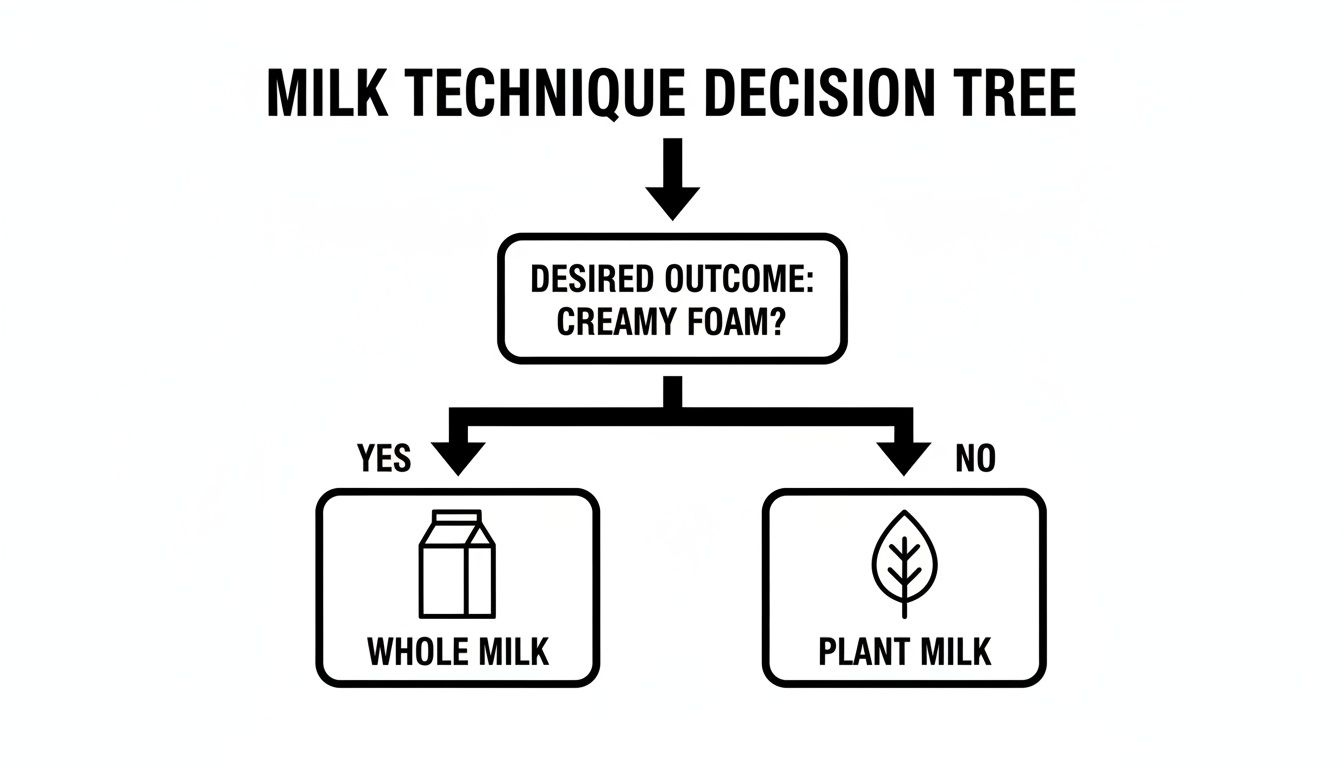
As you can see, whole milk is the tried-and-true path for classic latte art. But when you venture into the world of plant-based milks, you have to be a bit more thoughtful about the texture and flavor you're after.
For the Professional Barista Chasing Perfection
When your goal is flawless, high-contrast latte art—the kind that wins competitions—there’s really no substitute for whole dairy milk. The magic is in its composition: a near-perfect ratio of roughly 3.5% fat and 3.4% protein. This balance creates a microfoam with an elasticity, gloss, and stability that other milks just can't replicate.
You get a velvety, paint-like texture that flows predictably, giving you the control you need for intricate designs like stacked tulips, graceful swans, and detailed rosettas. The foam integrates seamlessly with the espresso, creating a pristine canvas that holds its definition long after you’ve finished pouring. For a pro, whole milk isn't just an ingredient; it's a critical tool for performance.
Situational Recommendation: If you’re a competitive barista or a professional focused on producing the most visually stunning latte art possible, make whole milk your non-negotiable standard. Its consistency and superior foaming properties are the bedrock of advanced techniques.
Mastering this standard is a huge part of high-level training. For baristas looking to build that rock-solid foundation, our basic barista training package offers the hands-on instruction needed to perfect these skills.
For the Café Owner Balancing Quality and Demand
As a café owner, you’re playing a different game. You have to deliver exceptional quality while also catering to the ever-growing demand for dairy-free options. The mission is to find an alternative that performs reliably, keeps customers happy, and doesn't give your baristas a headache.
In this context, a barista-grade oat milk is the clear winner. Brands like Oatly Barista Edition or Califia Farms Barista Blend are specifically formulated with added oils and stabilizers to mimic the behavior of whole milk. They steam beautifully, creating a creamy, durable microfoam that’s forgiving to pour and almost never curdles.
Performance: It steams consistently every time, creating a silky texture that works for most common latte art designs.
Flavor: The taste is neutral and slightly sweet, complementing espresso instead of overpowering it. It’s a real crowd-pleaser.
Workflow: Its reliability makes training new staff easier and helps your team maintain speed and consistency during a chaotic rush.
While you might not get the same razor-sharp definition as with whole milk, its performance is more than enough for the daily grind of a busy café. It’s a far cry from the struggles you’d face with standard almond or coconut milk.
For the Home Barista Seeking Reliability and Value
When you're practicing at home, your priorities shift again. You need a milk that’s easy to find, affordable, and consistent enough for daily practice sessions. And while barista oat milk is fantastic, that premium price tag can add up quickly.
This is where barista-grade soy milk really shines. It's been a café staple for years for a good reason: its high protein content creates an exceptionally thick and stable foam. While its distinct flavor isn't for everyone, it provides a surprisingly robust canvas for nailing fundamental shapes like hearts and simple tulips.
Cost-Effectiveness: It's generally a lot easier on the wallet than premium oat milk brands.
Foam Stability: The foam it produces is dense and holds its shape well, giving you a little extra time to focus on your pour.
Availability: You can find a barista-specific formula in almost any major grocery store.
The one thing to watch with soy is its sensitivity to heat. You have to be careful to steam it to around 140°F (60°C) to keep it from curdling. But for a home barista focused on honing their skills without breaking the bank, soy milk is an excellent, accessible choice. By understanding your specific goal, you can pick the right milk and set yourself up for a great pour, every single time.
Common Questions About Milk for Latte Art
Even after you've got a handle on the science and steaming techniques, real-world questions always pop up. Every barista, from a fresh trainee to a seasoned pro, runs into weird situations that can totally throw off a pour. Here, we'll dive into some of the most common issues and give you straight, practical answers to help you troubleshoot on the fly.
Think of this as your field guide for those "what the heck just happened?" moments. Nailing these little details is often the last piece of the puzzle for pouring consistently beautiful latte art.
Why Is My Almond Milk Curdling in the Espresso?
Ah, the dreaded curdled almond milk. It's one of the most common and frustrating things that can happen when working with dairy alternatives. When you see that grainy, separated texture, it’s a chemical reaction happening in real-time. The acidity of the espresso and the sudden heat shock are causing the milk's proteins to clump together and separate from the liquid.
The first line of defense is always using a "barista blend" almond milk. These are made for this exact purpose, formulated with stabilizers and emulsifiers that help the proteins hold up against the heat and acid. But even with the right product, your technique is just as important.
To minimize the risk of curdling:
Let the Espresso Breathe: Give the shot about 30 to 60 seconds to cool down in the cup. This small temperature drop makes a huge difference in reducing the initial shock.
Don't Overheat the Milk: Aim for a slightly lower final temperature, around 140°F (60°C). Pushing almond milk too hot makes its proteins much more fragile and prone to breaking.
Pour Gently: A slow, steady hand helps the milk and espresso combine smoothly, preventing that abrupt, curdling reaction.
Can I Use Organic or Grass-Fed Milk?
Absolutely. In fact, many baristas swear by them. Organic and grass-fed milks are fantastic for latte art, as their protein and fat content is usually right where you want it to be, similar to conventional whole milk. They often produce an incredibly rich, creamy microfoam that pours like a dream.
There's just one small thing to keep in mind. Since the diet of grass-fed cows can vary with the seasons, you might notice slight, natural shifts in the milk's fat and protein composition. This just means you might need to make tiny tweaks to your steaming routine from one delivery to the next to keep things consistent.
Key Insight: When using specialty milks, your best friend is consistency. Find an organic or grass-fed brand that you love and stick with it. The more you work with it, the more you'll learn its specific quirks and master how it behaves under the steam wand.
What's the Best Temperature for Steaming Milk?
The sweet spot for most milks is somewhere between 140°F and 155°F (60°C to 68°C). This is the magic window where you create stable, silky microfoam and bring out the milk’s natural sweetness. If you push it any hotter, you'll scald the milk, which not only gives it a burnt, flat taste but also breaks down the very proteins you need for good foam.
But this range isn't a hard-and-fast rule for everything. More delicate plant-based milks, especially certain oat and almond blends, do much better on the cooler end of that spectrum. For these, I'd suggest aiming for 140°F (60°C). A lower temperature helps keep the foam from separating and preserves its structure, giving you a much better canvas for your art.
Is UHT Milk Any Good for Latte Art?
You can use UHT (Ultra-High Temperature) milk for latte art, but it's rarely a professional's first choice. The intense heating process used to make it shelf-stable fundamentally changes the milk's protein structure, and that directly affects how it steams.
While you'll definitely get foam from UHT milk, it tends to be stiff and bubbly rather than silky and integrated. The texture is often described as "dry" or "airy," with larger bubbles that are tough to pour with any detail. This makes creating high-contrast, intricate art incredibly difficult. It might work as a backup if you're in a pinch, but if you're chasing that glossy, velvety microfoam that defines great latte art, fresh milk is always the way to go.
