
At its heart, specialty coffee is the best of the best—the top 5% of all coffee grown in the world. It’s not the stuff you find in a generic can at the grocery store. This is coffee grown in very specific, ideal climates, resulting in nearly perfect beans that produce the most incredible flavors and aromas you can imagine. And this isn't just marketing fluff; it's a verifiable standard.
Unpacking the Meaning of Specialty Coffee
So what really makes a coffee "specialty"? It's less of a product and more of a philosophy. Think of it as a quality-obsessed journey from the moment a seed is planted to the final sip in your cup. This stands in stark contrast to commodity coffee, which is all about mass production. Commodity coffee is produced for volume and consistency, often mixing beans from all over the place without a second thought. Specialty coffee, on the other hand, is all about celebrating the unique character and excellence of a specific coffee at every single step.
The journey starts with the farmer. These aren't just farmers; they're artisans who cultivate particular coffee varietals in unique microclimates. They pay meticulous attention to things like soil health, altitude, and rainfall—what the industry calls terroir—because they know these elements are what shape the final flavor of the bean.
From Meticulous Farming to Precise Standards
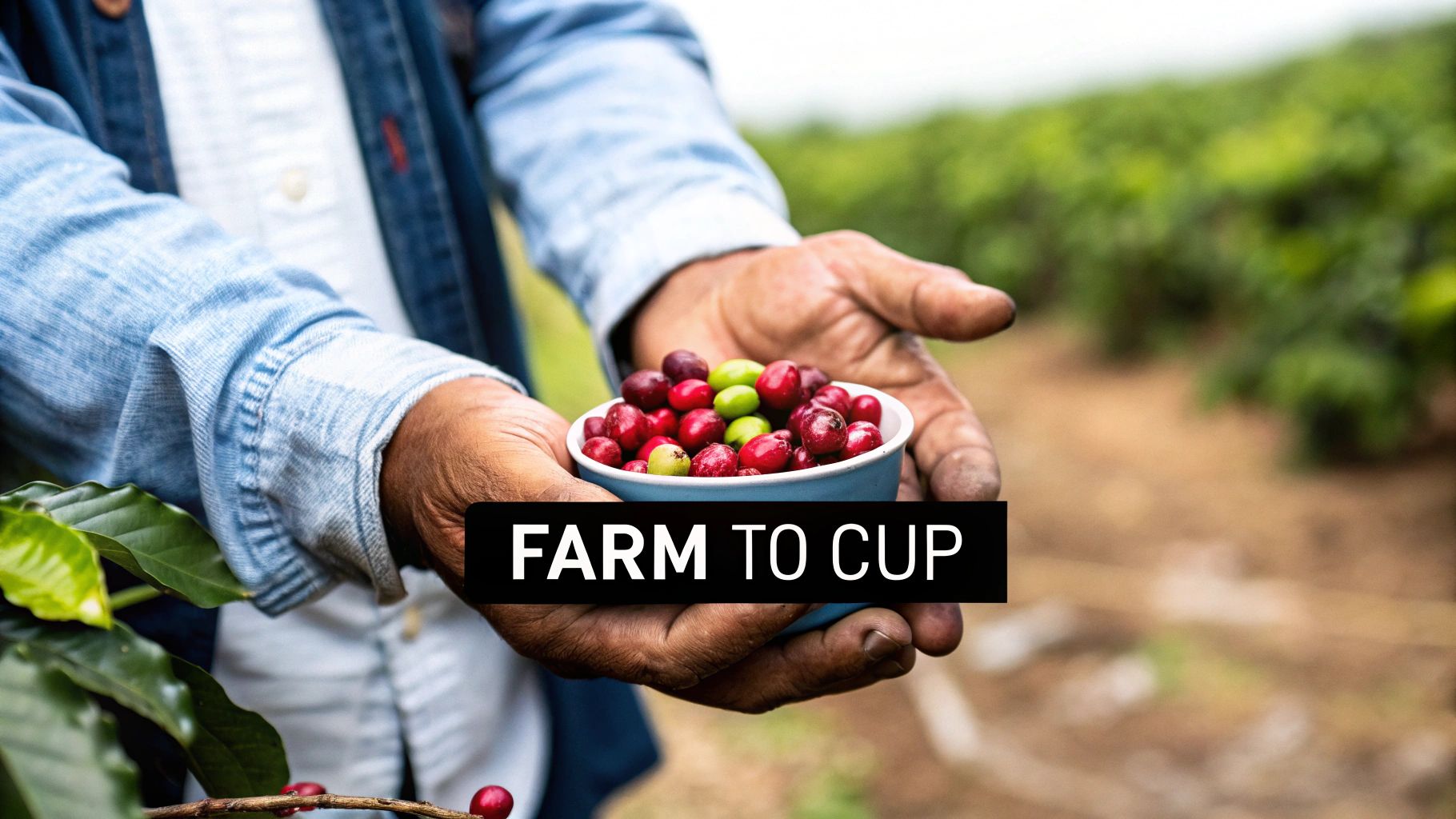
The work is far from over once the coffee is grown. To even be considered "specialty," the coffee cherries have to be picked at their absolute peak of ripeness. This is often done by hand, a painstaking process to ensure only the best fruit makes the cut. From there, the beans are processed using specific methods—like washed, natural, or honey—each carefully chosen to bring out certain desirable flavors in the final cup.
The entire process is held to an incredibly high standard, largely defined by the Specialty Coffee Association (SCA), the guiding authority in the coffee world. They've established the benchmarks for what truly qualifies as top-tier coffee.
The core idea behind specialty coffee is a commitment to a defect-free product with a distinct and memorable character. Every single bean reflects its origin, the farmer’s dedication, and the roaster's artistry.
This journey, from the farm to the final grading, has several critical stages where quality can be either protected or lost.
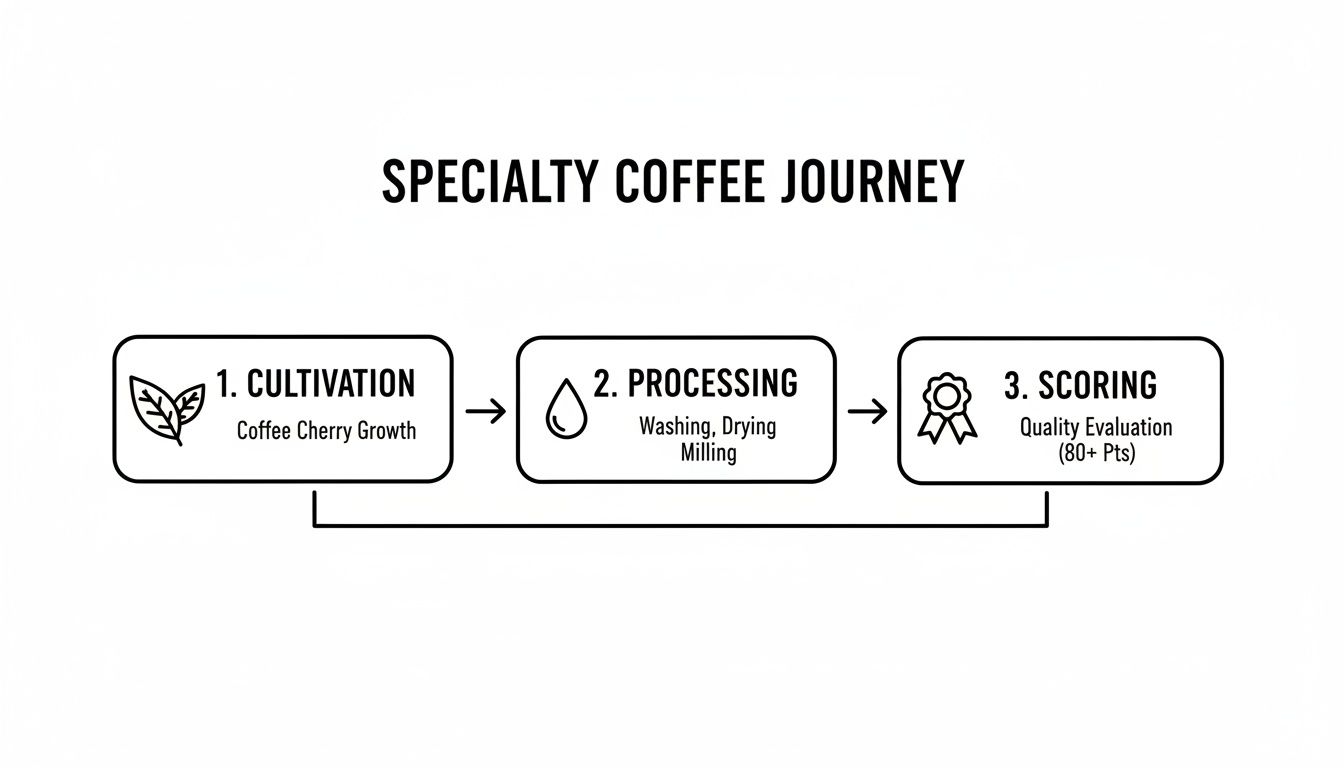
As you can see, cultivation, processing, and scoring are all make-or-break moments for a coffee's potential.
The Official Score: A Mark of Excellence
The final exam for any coffee hoping to earn the specialty title is a formal tasting, or "cupping." In this process, certified sensory experts called Q Graders evaluate the coffee on a 100-point scale. They score attributes like aroma, acidity, body, and the balance of flavors.
A coffee must score 80 points or higher to officially be called specialty. This number isn't arbitrary; it's a globally recognized seal of quality that honors the immense effort invested along the entire supply chain.
This scoring system creates a clear hierarchy in the coffee world:
80-84.99 points: Very Good. This is the entry-level for specialty coffee.
85-89.99 points: Excellent. These coffees often showcase complex and exciting flavor profiles.
90-100 points: Outstanding. This is the absolute peak, representing the rarest and most exceptional coffees available.
Specialty Coffee vs Commodity Coffee Key Differences
To put it all in perspective, here's a quick comparison of the key differences between specialty and commodity coffee.
Attribute | Specialty Coffee | Commodity Coffee |
|---|---|---|
SCA Score | 80 points or higher | Below 80 points |
Beans | Single origin, specific varietal | Blends from various unknown sources |
Harvesting | Hand-picked at peak ripeness | Often mechanically harvested |
Flavor Profile | Complex, distinct, and unique | Generic, often bitter or bland |
Traceability | Fully traceable to a specific farm or region | Little to no traceability |
Focus | Quality and unique character | Quantity and price |
This table highlights just how different the two worlds are. One is about craft and origin, the other about mass-market efficiency.
Two final concepts are absolutely fundamental to specialty coffee: traceability and transparency. Unlike the anonymous blends of commodity coffee, every single bag of specialty coffee can be traced back to a specific farm, producer, or cooperative. This direct connection creates accountability and gives you, the drinker, the story behind your cup—where it came from, who grew it, and how it was processed. It's what turns a simple beverage into a meaningful agricultural product.
How a Coffee Gets Its Flavor: Origin and Processing
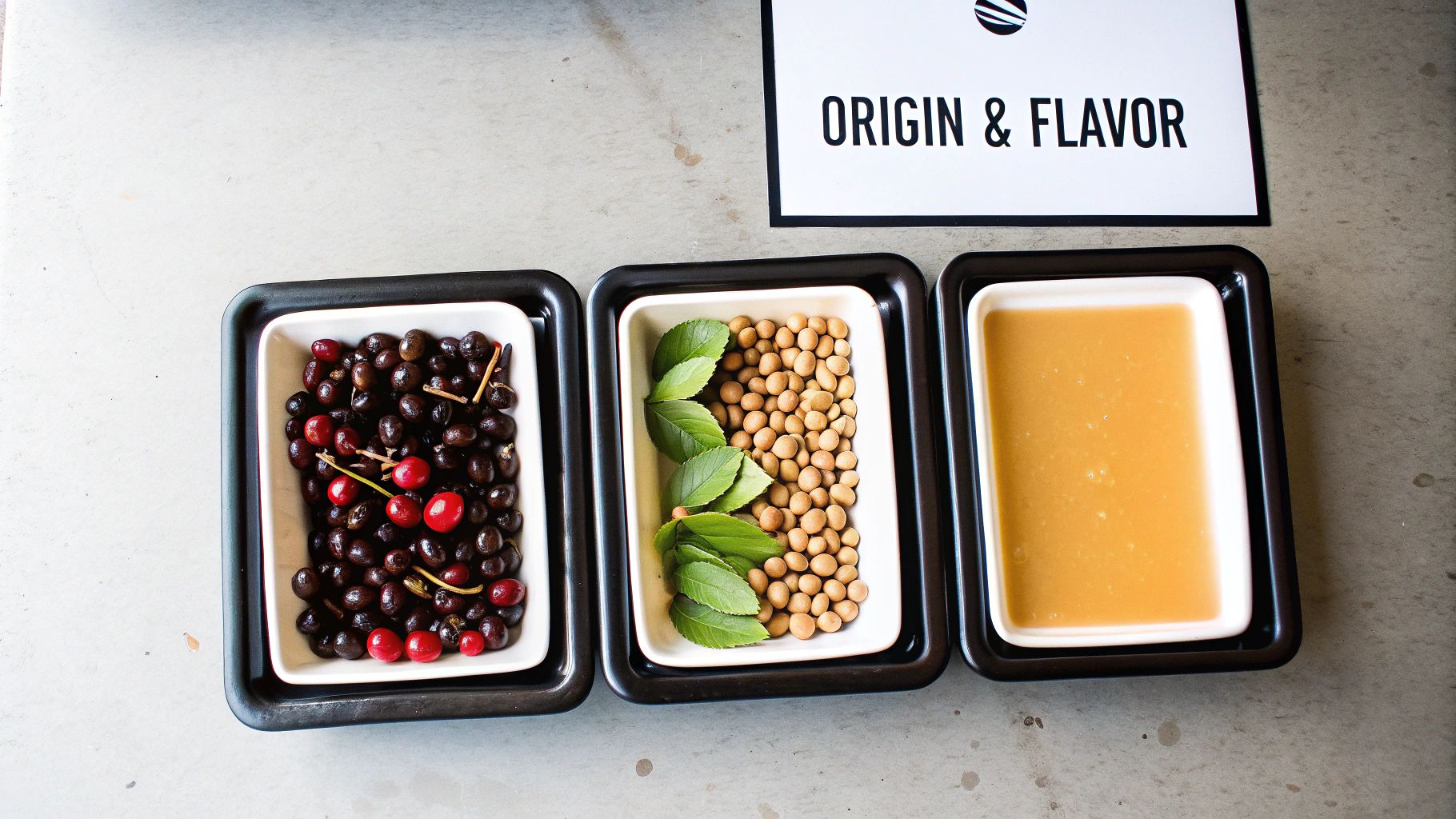
Ever wonder why one coffee tastes like blueberries and another like bright lemon zest? It’s not magic, and it’s not added flavouring. That incredible diversity comes down to two key factors: where the coffee was grown (origin) and how it was handled after being picked (processing).
Think of it like wine. A Pinot Noir grape grown in Burgundy, France, tastes entirely different from one grown in Oregon. The same principle applies to coffee. The bean is a storyteller, and its first chapter is always about its home.
We call this environmental fingerprint terroir—a French term that covers everything from soil and altitude to rainfall and sunshine. A coffee grown in the high-altitude volcanic soil of Colombia will have a completely different character than one from the warm, humid lowlands of Brazil. This is what we mean by origin, and it’s the foundation of flavor.
The Power of Place: Terroir and Unique Origins
Terroir sets the stage for a coffee's potential. For instance, coffee grown at higher elevations tends to mature more slowly. This slower process creates denser beans packed with complex sugars and acids, which translates directly to brighter, more dynamic flavors in your cup.
Some origins have such a distinctive terroir that they've become legendary. Take Yemen, for example—the historic birthplace of coffee cultivation.
The ancient, terraced farms and arid climate of Yemen create a one-of-a-kind growing environment. The coffee plants are stressed in just the right way, forcing them to concentrate their flavors. This produces the complex, winey, and spicy notes that made historic Mokha coffee famous centuries ago.
This is why traceability is a cornerstone of specialty coffee. Knowing a coffee is from a specific region, like Haraz in Yemen or Yirgacheffe in Ethiopia, gives you a roadmap of what to expect. You can dive deeper into how these ancient traditions shape modern flavor by exploring the rich history of Yemeni coffee.
Unlocking Flavor: The Art of Coffee Processing
If terroir provides the raw ingredients, then processing is the chef’s technique that brings those flavors to the forefront. Processing is simply the method used to get the bean out of the fruit it grows in, called the coffee cherry. How this is done has a massive impact on the final taste.
Let's look at the three main methods.
1. Washed (or Wet) Processing
Think of wanting the pure, crisp flavor of an apple. You’d wash it and peel away the skin to get right to the fruit's clean essence. That's the goal of washed processing.
The Process: The cherry’s skin and fruity pulp are completely washed off with water before the bean is dried.
The Result: This method strips away outside influences, highlighting the intrinsic qualities of the bean itself—its acidity, clarity, and complexity.
Flavor Profile: Clean, bright, and vibrant. You'll often find floral or citrus notes and a crisp acidity, common in top-tier Colombian or Kenyan coffees.
2. Natural (or Dry) Processing
Now, imagine you want the deep, jammy sweetness of a raisin. You’d dry the whole grape, skin and all, letting the sugars concentrate. This is the soul of natural processing.
The Process: The entire coffee cherry is laid out to dry in the sun with the bean still inside. The bean ferments within the fruit, absorbing all those rich, sugary flavors.
The Result: This ancient method creates a coffee with a heavier body, more muted acidity, and a wild, intense sweetness.
Flavor Profile: Fruity, sweet, and often described as jammy or wine-like. It’s where those distinct notes of blueberry, strawberry, and tropical fruit come from, especially famous in coffees from Ethiopia.
3. Honey (or Pulped Natural) Processing
The honey process is a beautiful middle ground, borrowing from both washed and natural techniques. The name has nothing to do with bees; it comes from the sticky, honey-like layer of fruit mucilage left on the bean as it dries.
The Process: The cherry's skin is removed, but some (or all) of that sugary mucilage is left clinging to the bean during the drying phase.
The Result: You get a beautifully balanced cup. It has the rounded sweetness and body of a natural but with more of the clarity you'd find in a washed coffee.
Flavor Profile: Sweet and syrupy. Look for notes of stone fruit, brown sugar, or even actual honey. This method is popular in places like Costa Rica and Brazil.
By understanding both a coffee's origin and its processing method, you can start to predict its flavor before you even grind the beans. It turns a simple daily ritual into a fascinating sensory journey.
The Science of Scoring: How Experts Grade Coffee
So, what really separates a good coffee from a truly exceptional one? While your personal preference is what matters most in your cup, the specialty coffee industry has a remarkably objective way to measure quality. This process is called cupping, and it's what ensures "specialty" is a genuine benchmark, not just marketing fluff.
This isn't a casual taste test. It's a formal evaluation carried out by certified sensory professionals known as Q Graders. Think of them as the master sommeliers of the coffee world. They use a detailed protocol and a 100-point scale developed by the Specialty Coffee Association (SCA) to analyze every nuance of a coffee. This systematic approach creates a universal language for quality that's understood from a farm in Ethiopia to a café in New York.
To even be considered specialty, a coffee has to hit a score of at least 80 out of 100 points—a high bar that reflects incredible dedication at every step of the journey.
Breaking Down the Cupping Score Sheet
That final score isn't pulled out of thin air. It’s the sum of several distinct attributes, each graded on a scale of 6 to 10. Q Graders meticulously evaluate ten key metrics to build a complete sensory profile. Understanding these components is like learning to read the story the coffee is telling you.
Here are some of the most important categories they look at:
Fragrance/Aroma: This is the coffee's first impression. Fragrance is the smell of the dry grounds right after grinding, while Aroma is the scent that blooms when hot water hits the coffee. Graders are sniffing for appealing notes—is it floral, fruity, nutty, or something else?
Flavor: This is the heart of the experience, capturing the coffee's main character once you taste it. It’s where those specific notes we love to talk about—like milk chocolate, fresh blueberry, or zesty lime—come to life on the palate.
Aftertaste: A great coffee doesn't just disappear. The aftertaste evaluates the flavor that lingers after you swallow. Is it pleasant, clean, and memorable, or does it leave a bitter or dry sensation?
Acidity: In the specialty world, acidity is a very good thing! We're not talking about sourness, but rather the bright, sparkling quality that makes a coffee feel vibrant and alive. Think of the pleasant tartness of a Granny Smith apple or the crisp finish of white wine.
From Individual Metrics to a Final Score
Beyond those core components, graders also assess how the coffee feels in your mouth. Body describes the weight and texture on your tongue. Is it light and delicate like a tea, or is it rich, creamy, and syrupy? Then there’s Balance, which looks at how well all the elements—flavor, acidity, aftertaste, and body—come together in a harmonious way.
Finally, graders check for consistency and purity. A coffee gets a high score for Uniformity if every single cup in the tasting session is identical. Clean Cup is a crucial one; it means the coffee is completely free from any "off" flavors or distracting taints that might point to a defect in processing.
Specialty coffee scoring is fundamentally a process of subtraction. Every coffee starts with a perfect score of 100. Points are then deducted for any flaw, however small. The final number reflects its purity and perfection.
A Simplified Cupping Session
Picture a Q Grader at the cupping table. They start by leaning over the dry grounds, taking deep inhales to assess the fragrance. Then, they pour hot water over them and "break the crust" with a spoon, releasing an intense wave of aroma.
After a few minutes, the tasting begins. You'll see them slurp the coffee loudly from a spoon—a technique that sprays the liquid across their entire palate to engage all their taste buds.
They'll score each of the ten attributes. Maybe a coffee gets an 8.5 for its bright, citrusy acidity but a 7.5 for its lighter body. After tallying all the scores and subtracting points for any defects, they arrive at a final number—say, 86.5. That single number instantly tells a roaster or café owner anywhere in the world everything they need to know about that coffee's quality, proving that specialty coffee is an art built on a foundation of measurable science.
The Crucial Roles of Roasting and Brewing
A high-scoring green coffee bean is pure potential. It holds the entire story of its origin—the soil, the altitude, the farmer's care—but that story is locked away inside a dense little seed. The roaster and the brewer are the storytellers, the artists who finally unlock this potential and bring it to life in your cup.
Think of a roaster like a world-class chef and the green bean as a prime cut of steak. You wouldn't cook a delicate filet mignon the same way you’d handle a hearty ribeye, right? In the same way, a roaster develops a unique roast profile for each coffee, meticulously controlling time and temperature to highlight its very best qualities. The goal is to coax out the bean’s inherent sweetness, acidity, and complexity without burning away what makes it special.
This is a delicate dance between art and science. One of the most important chemical transformations happening inside the drum is the Maillard reaction—it’s the very same process that gives a loaf of bread its golden-brown crust and incredible aroma. This reaction creates hundreds of new aromatic compounds, developing those signature nutty, toasty, and chocolatey notes we all love.
The Art and Science of the Roast
As the beans tumble and heat, pressure builds inside until they audibly pop. This is the "first crack," and it’s a pivotal moment in the roast, marking the transition into a "light roast." From here, the roaster is making split-second decisions based on sight, sound, and smell.
Ending the roast just after the first crack will preserve the bright, floral, and acidic notes that speak directly of the coffee's origin. Pushing the roast a little longer starts to deepen the flavors, bringing out more caramelized sugar and rich chocolate notes while softening the acidity. But go too far, and you risk erasing the bean's unique character entirely, replacing it with a generic, smoky "roast" flavor. This is why specialty roasting is such a craft; it's about honoring the bean, not overpowering it.
Roasting isn't about creating flavor from scratch. It's about developing the incredible flavors that are already there, hidden inside the green coffee bean. The perfect roast makes the coffee taste most like itself.
The Final Step: Brewing Perfection
Once the roaster has worked their magic, the baton is passed to the brewer. This could be a professional barista in a bustling café or you in your own kitchen on a quiet morning. This final stage is just as critical. Even the most exquisitely roasted specialty coffee can be ruined by a poor brew.
Simple variables like grind size, water temperature, and brew time are the final gatekeepers of flavor. Get them wrong, and all the hard work that came before is lost.
Grind Size: Too coarse? You’ll get a weak, watery, under-extracted coffee. Too fine? You’re looking at a bitter, harsh, over-extracted cup.
Water Temperature: Water that’s boiling hot can scald the grounds, creating instant bitterness. But water that’s too cool will fail to pull out the full spectrum of amazing flavors.
Brewing Method: The device itself shapes the final result. A French press will give you a rich, full-bodied brew, while a pour-over is designed to highlight clarity and delicate, nuanced notes.
Achieving a great brew comes down to precision and using the right tools for the job. From a quality grinder to a temperature-controlled kettle, having the proper setup makes all the difference. You can explore a range of high-quality coffee brewing equipment to make sure you’re giving those special beans the treatment they truly deserve. Ultimately, great brewing honors the entire journey—from the farm to the roaster—letting the coffee’s true character shine through in every single sip.
Building a Winning Specialty Coffee Program
For any café owner, really digging into what makes specialty coffee special is more than just an interest—it's a massive strategic advantage. When you move beyond thinking of coffee as a simple commodity, you start a journey. A well-crafted specialty program can transform your shop from just another place to grab a cup into a genuine destination. It’s an investment, sure, but it’s an investment in quality, in storytelling, and in a customer experience that builds the kind of loyalty that defines your brand.
But let's be realistic. Building this kind of program is about more than just buying great beans. It demands a smart business strategy, especially with how unpredictable the economy is right now.
Navigating the Economics of Quality
Deciding to invest in premium beans comes with some real-world financial hurdles. Things like price volatility, rising supply costs, and supply chain shocks have really shaken up the economics of specialty coffee lately. Green bean prices have been climbing due to production disruptions, a challenge that both roasters and cafés have to figure out how to handle.
To put it in perspective, Arabica futures soared to a historic high of around USD 4.41 per pound in early 2025. This was largely driven by severe droughts in major growing regions like Brazil, where exports dropped by about 21% in the first half of the year alone. It’s a trend that highlights a much bigger market reality, with forecasts pointing toward a global coffee supply deficit for the 2025/26 crop year. You can get a deeper dive into these market dynamics at intelligence.coffee.
Even with these costs, the investment in specialty coffee almost always pays off. It gives you the justification for premium pricing, attracts customers who truly care about quality, and creates a powerful marketing story that commodity coffee just can’t touch.
Choosing Your Sourcing Model
Once you've committed to quality, the next big question is: where do you get your beans? There are two main paths you can take, and each has its own set of pros and cons.
Working with Importers/Roasters: This is the most common and straightforward route, especially when you're starting out. Your partners handle the incredibly complex logistics of sourcing, quality control, and shipping. They offer a curated menu of coffees, often provide top-notch training, and ensure your supply is consistent. The trade-off is a slightly longer supply chain, but the reliability and expertise they bring to the table are invaluable.
Direct Trade: This approach is all about building a personal relationship directly with coffee producers at their farms. It gives you incredible transparency and allows you to share a powerful, authentic story with every customer who walks through your door. While it's incredibly rewarding, going direct requires significant resources, a deep understanding of logistics, and the capital to purchase coffee in large volumes.
A winning specialty program is built on a foundation of smart partnerships. Whether with a trusted roaster or a specific farm, the right relationship ensures both quality in the cup and a compelling story for your customers.
Curating a Menu That Tells a Story
Your menu is your single most important communication tool. Instead of overwhelming customers with a long, confusing list of options, curate a focused selection that shines a spotlight on the unique stories behind each coffee.
Think about organizing your offerings to guide your customers on a journey:
Feature a Single Origin: Put one exceptional coffee in the spotlight. Give customers the tasting notes and share details about its origin, the farm it came from, and how it was processed. This isn't just selling coffee; it's creating an educational experience that gives people a reason to come back.
Offer a Consistent Blend: Your house blend is your workhorse. Develop a signature blend for your espresso drinks that delivers a reliable, delicious flavor profile your customers can count on, day in and day out.
Rotate Limited Offerings: Keep things fresh and exciting by bringing in rare or micro-lot coffees from time to time. This generates buzz and is a fantastic way to showcase the incredible diversity the world of specialty coffee has to offer.
Empowering Your Team to Share the Value
At the end of the day, your baristas are your brand ambassadors. You can have the best beans in the world, but they won't mean a thing if your team can’t explain what makes them so special.
Invest in training that goes way beyond just pulling a perfect shot. Your team should be able to confidently explain the difference between a washed and a natural process coffee, describe the flavor profile of your single-origin feature, and share the story of the farmers who grew the beans. This simple shift turns a routine transaction into a memorable interaction, educating your customers and building a true community around a shared love for exceptional coffee.
Ready to Bring Specialty Coffee to Your Café?
Knowing what specialty coffee is—the history, the scoring, the incredible care that goes into it—is one thing. But actually bringing that quality and those compelling stories to your customers? That's the real challenge. It’s a journey from concept to execution, and it requires a partner who lives and breathes every single step, from the farm to the final pour.
That’s where we come in. At AQEEK Coffee, we help you translate the complex, beautiful world of specialty coffee into a real, tangible advantage for your business.
We don't just sell beans; we build partnerships. Our work is grounded in sourcing genuinely exceptional coffees, including those with deep roots in historic origins like Yemeni Mokha. This brings a level of authenticity to your menu that you just can't find anywhere else. We’ll help you build a coffee program that does more than just sell drinks—it creates a community around a shared appreciation for true quality.
How We Partner With You
We’ve found that a truly great coffee program rests on three core pillars. This is what we deliver to every single one of our partners:
Exceptional Sourcing: We give you access to unique, high-scoring coffees that come with a memorable story your customers will love.
Expert Training: We empower your team with certified training, giving them the skills to masterfully brew each coffee and talk about its value with confidence.
Strategic Support: Think of us as part of your team, providing guidance on everything from menu creation and workflow efficiency to building a brand that truly stands out.
Choosing a specialty coffee partner isn't just about the coffee. It's about finding a team that's as invested in your success as you are—one that helps you create an experience that keeps customers coming back.
Ready to turn your vision into a reality? We invite you to see the AQEEK difference for yourself.
Take a look at our wholesale coffee program to see how we can help you build an unforgettable coffee experience. Let's schedule a chat, send you some samples, and start brewing something special together.
Your Specialty Coffee Questions, Answered
Let's tackle some of the most common questions that pop up when people first dive into the world of specialty coffee. Think of this as a quick-start guide to clear up any confusion, whether you're a curious coffee drinker or a café owner looking to level up.
Is Specialty Coffee Stronger Than Regular Coffee?
This is a great question, and the answer depends on what you mean by "strong."
If you’re talking about caffeine, not necessarily. Caffeine content is mostly about the bean type (Robusta has more than Arabica) and how you brew it. A specialty coffee isn't inherently more caffeinated.
But if "strong" means a powerful, memorable flavor? Absolutely. Specialty coffee is all about intense, complex, and clean flavors. You're tasting the origin, not just a generic "coffee" taste or the burnt notes of an over-roasted bean. The goal is balance and clarity, not a bitter jolt.
Why Does Specialty Coffee Cost More?
The price tag on a bag of specialty coffee isn't arbitrary; it reflects the incredible amount of care and expertise poured into it from farm to cup. You're paying for a completely different process.
Here’s a breakdown of what that higher cost covers:
Meticulous Farming: Farmers are often paid a significant premium to hand-pick only the ripest coffee cherries, which is far more labor-intensive.
Rigorous Sorting: Every batch is meticulously sorted to remove any defective beans. This quality control step is crucial for flavor but naturally reduces the final amount of coffee sold.
Artisanal Roasting: Skilled roasters don't just "cook" the beans. They spend countless hours developing unique roast profiles for each small batch to bring out its best characteristics.
Ethical Sourcing & Sustainability: That price often includes fair wages and premiums paid directly to farmers and their communities, ensuring the entire supply chain is sustainable.
You are paying for a chain of quality—from the farmer’s expertise to the roaster's craft. This ensures that everyone involved is fairly compensated for producing an exceptional product.
Is Specialty Coffee Better For Your Health?
In many ways, yes. Since specialty coffee is graded to be free of major defects like mold, fungus, or insect damage, you're starting with a much purer, cleaner raw ingredient.
The beans are also typically roasted much fresher, which helps preserve their natural antioxidants. Plus, the lighter roast styles common in the specialty world have been shown to retain higher levels of beneficial compounds like chlorogenic acid compared to the dark, often burnt commodity coffees.
How Do I Start Buying Specialty Coffee?
Getting started is the fun part! The best first step is to walk into a local specialty coffee shop and just be curious.
Talk to the baristas—they live and breathe this stuff and are usually thrilled to share their knowledge. Ask them what single-origin pour-over they're excited about, or simply tell them what flavors you typically enjoy (fruity, chocolatey, nutty) and ask for a recommendation. There's no better way to understand what is specialty coffee than to taste it and talk about it with an expert.
Another fantastic route is exploring online roasters. Look for those who provide tons of detail—the farm, the processing method, the altitude, and specific tasting notes. This information empowers you to make a choice you’ll love.
