

When most people hear the word Yemeni, their minds often jump to headlines of conflict and hardship. But behind the news, there's a story of an enduring people and a cultural identity woven into one of the world's most beloved rituals: coffee. We're going to step past that common narrative to explore the true heart of what it means to be Yemeni, all through the lens of its legendary coffee.
The Enduring Soul of Yemeni Coffee Culture
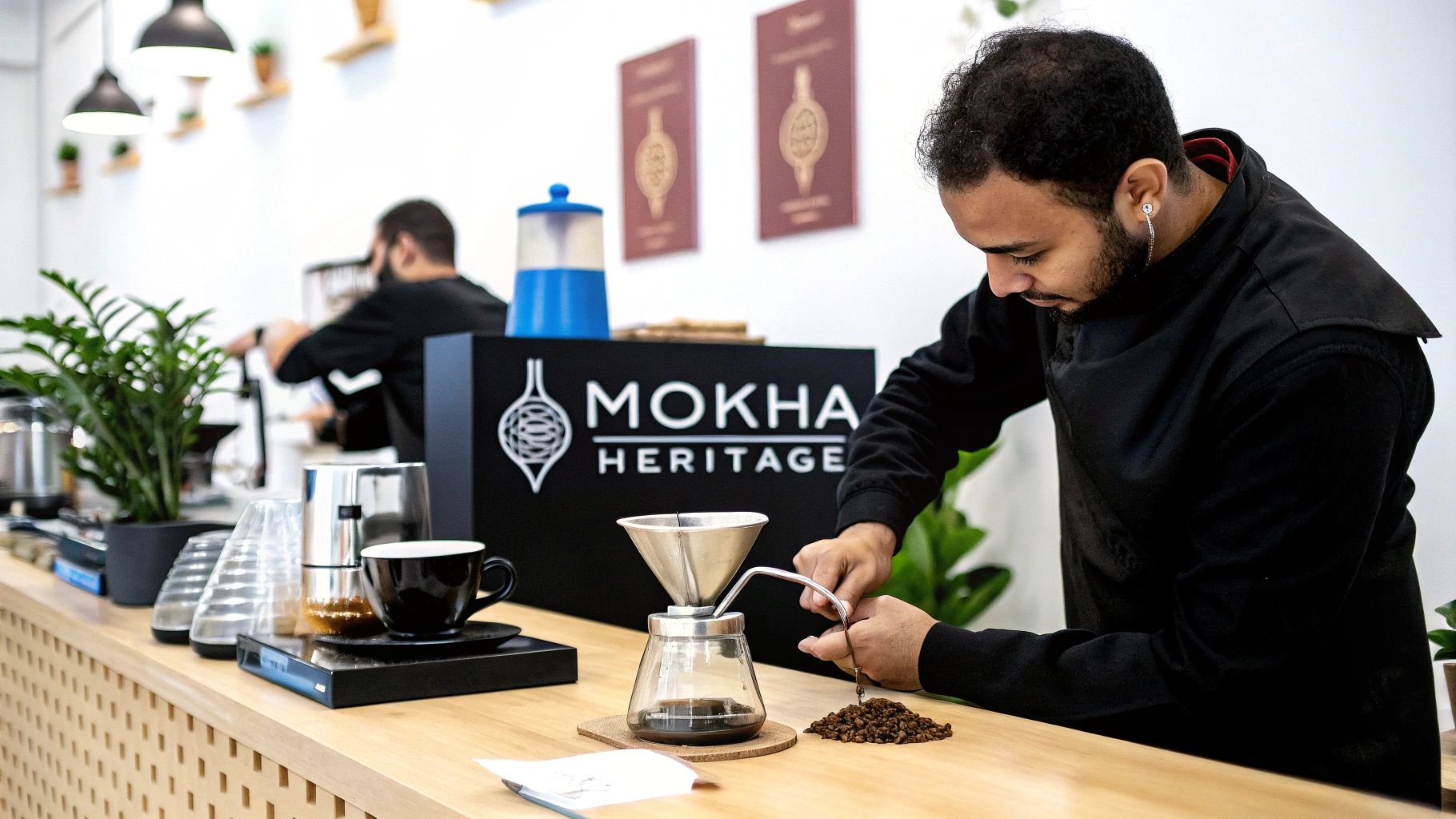
To really get Yemeni coffee, you have to go back in time to the ancient Port of Mokha. For centuries, this was the place—the one and only gateway for coffee to reach the rest of the world. It’s how "Mokha" became a name synonymous with coffee itself.
Fast forward to today, and we're seeing a "Mokha Renaissance" in full swing. A new generation of roasters, entrepreneurs, and cafe owners are breathing new life into this ancient legacy, connecting it with a modern audience that craves authenticity.
This guide is for anyone who wants to do just that: bring genuine Yemeni coffee into their business. It doesn’t matter if you're dreaming of opening a café, you're a veteran barista, or you run a specialty retail shop. The goal here is to give you real, practical insights.
A Bridge from Heritage to Modern Cafés
Connecting with Yemeni coffee is about so much more than a unique flavor profile. It's about grabbing hold of a story of resilience, tradition, and quality that is second to none. When you truly understand where these beans come from, you can build a brand story that clicks with customers who are looking for something real.
We'll walk through everything you need to know to honor this heritage the right way:
Master the Storytelling: Get to know the history of the Mokha monopoly and the deep cultural meaning poured into every cup.
Understand the Terroir: We’ll explore the distinct high-altitude terraced farms and the traditional, chemical-free ways the coffee is processed.
Develop Your Palate: Learn to pick out the complex flavor notes—from winey acidity to rich, dark chocolate—that make these beans so special.
Implement with Excellence: Get your hands on practical strategies for sourcing, brewing, building a menu, and training your team.
By focusing on authenticity and quality, a café can transform a simple cup of coffee into a cultural experience, offering customers a direct connection to the Yemeni people and their profound history.
This is more than just adding another origin to your menu. It's a chance to be part of reviving a coffee culture that literally shaped the world. You can dive deeper into the rich history and unique flavors of Yemeni coffee in our detailed article. Doing so gives you more than a premium product; it gives you a powerful story that will make your business stand out.
The Mokha Monopoly and Its Global Legacy
To really get to the heart of Yemeni coffee, we need to step back in time. This isn't just a story about a drink; it's a tale of innovation, tightly held control, and a legacy that literally shaped global trade. It all began centuries ago on the terraced mountainsides of Yemen, where the world's first cultivated coffee plants took root.
The earliest accounts we have are from the 12th century, where Sufi monks used coffee to stay awake through long nights of prayer and devotion. As you can imagine, a discovery that powerful didn't stay a secret for long. Its popularity exploded, and Yemen quickly became the exclusive source for this new global commodity, holding a complete monopoly on its cultivation for nearly two hundred years.
The Port of Mokha: The World's Only Gateway to Coffee
For a long time, if you wanted coffee, there was only one place to get it. Every single bean destined for the outside world had to pass through the legendary Port of Mokha on the Red Sea. This wasn't just a shipping hub; it was a fortress of control.
The Ottoman Empire, which ruled Yemen at the time, guarded this treasure fiercely. They went to great lengths to protect their monopoly, making it illegal to export fertile beans or live plants. They wanted to ensure no one else could grow what they had. The port was a whirlwind of activity, with ships from every corner of the known world arriving for their precious cargo. The name "Mokha" became so synonymous with the coffee passing through its gates that it became the coffee's name.
The global coffee trade as we know it was born in Yemen. The Port of Mokha wasn't just a shipping point; it was the sole gatekeeper of coffee culture, branding the name "Mokha" into the world's vocabulary and cementing Yemen's place in history.
This is a story no other origin can tell. For almost 200 years, Yemen had an undisputed global monopoly. Every bean left through one port, which is why "Mokha" is a word every coffee lover knows. You can find more fascinating details about Yemen's historical coffee monopoly and its economic impact in this historical overview.
The End of an Era and a Lasting Legacy
Of course, no monopoly lasts forever. The inevitable finally happened in the late 17th century when the Dutch managed to smuggle a live coffee plant out of Yemen. They took it to their colonies in Java, and from there, coffee cultivation spread across the globe. Just like that, the monopoly was broken.
But the legacy of Mokha is far from over. Those original Yemeni heirloom varieties are the ancestors of many of the world's most famous coffees, like Typica and Bourbon. It's an authentic, powerful history that can't be replicated.
For any café today, this story is pure gold. It gives you so much to work with:
Educate Customers: You can share the incredible history of how coffee began and explain that "Mokha" is so much more than a chocolate latte.
Create a Premium Experience: When you serve Yemeni coffee, you're not just serving a drink; you're offering a taste of history. That experience justifies its unique profile and premium price point.
Build a Strong Brand Identity: Connecting your café to this story of heritage and resilience sets you apart. It's a genuine narrative that truly resonates with people who care about where their coffee comes from.
Growing Coffee on the Terraced Mountains of Yemen
You can't talk about Yemeni coffee without talking about the land itself—a rugged, high-altitude terrain where growing anything, let alone world-class coffee, seems next to impossible. But it’s here, in iconic regions like Haraz and Bani Mattar, that some of the most extraordinary coffees are born. The secret isn’t modern tech; it’s ancient wisdom perfectly suited to a demanding environment.
These aren't the sprawling, manicured plantations you might picture elsewhere. Instead, coffee plants cling to ancient, hand-carved agricultural terraces that scale the steep mountainsides like giant staircases. These structures, some centuries old, are marvels of engineering built to capture precious rainwater and stop soil from eroding in the semi-arid climate.
This timeline shows how Mokha's legacy began in Yemen and spread to influence the entire world.
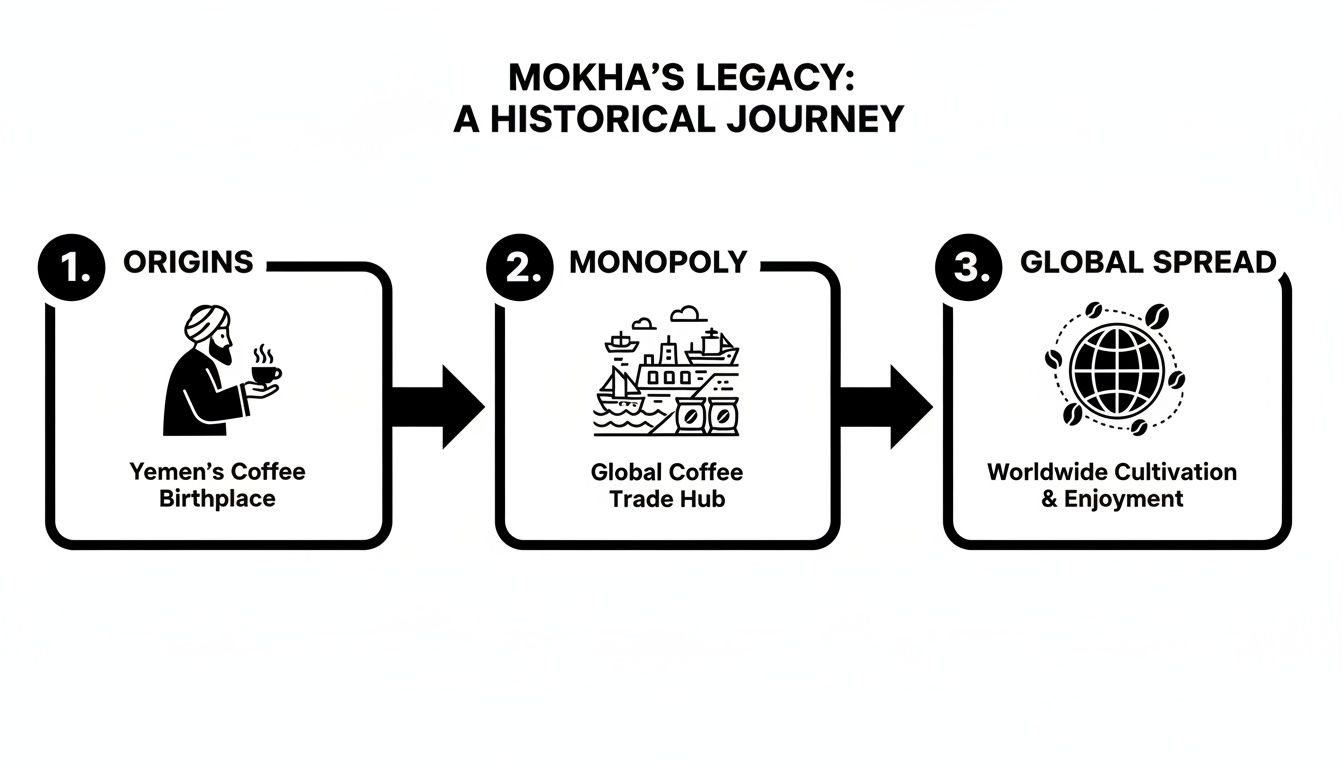
You can see a clear story unfold, from the coffee’s discovery by Sufi monks to its global trade managed through the Port of Mokha, and finally, its journey out into the rest of the world.
Organic by Default: An Ancient Tradition
What makes this whole process so special is its purity. Yemeni coffee is, for all intents and purposes, organic by default. This isn't a modern trend; it's a practice that predates certification programs by hundreds of years. Farmers have passed down their methods through generations, creating a system that works in perfect harmony with the local ecosystem.
This deeply rooted tradition means no synthetic fertilizers, pesticides, or herbicides touch the plants. Frankly, the challenging terrain and tiny farm sizes make those inputs impractical anyway. Instead, farmers rely on natural, time-tested techniques to keep the soil fertile and pests at bay, preserving the coffee's authentic quality.
This commitment to tradition is a powerful story for any café. It connects your customers to a chemical-free, environmentally conscious way of farming that has been perfected for over 500 years.
The Art of the Natural Process
Harvesting and processing are just as meticulous and steeped in tradition. Farmers hand-pick only the ripest, reddest coffee cherries. It's incredibly labor-intensive work, but this selective picking is the first and most critical step in developing the coffee's signature sweetness and complexity.
After the harvest, the cherries are laid out for a natural sun-drying process. This is one of the oldest methods in the world. Whole cherries are spread out on rooftops or even in special ventilated caverns, where they're turned by hand constantly to ensure they dry evenly.
This slow, patient drying allows the sweet, fruity pulp of the cherry to infuse directly into the bean inside. The result? Those deep, winey, and complex fruit notes that make Yemeni coffee so legendary. It's a delicate art that simply can't be rushed. You can learn more about the unique cultivation and processing methods of Yemeni coffee beans in our deep-dive article.
The table below breaks down just how different this approach is compared to more common modern methods.
Traditional Yemeni vs Modern Coffee Processing
Attribute | Traditional Yemeni Method | Modern Washed/Honey Method |
|---|---|---|
Drying | Whole cherry, sun-dried on rooftops or raised beds | Pulp is removed (washed) or partially removed (honey) before drying |
Water Usage | Minimal, relies on arid climate | Water-intensive, especially for washed processing |
Flavor Profile | Deep, complex fruit; winey, bold, earthy | Clean, bright, acidic (washed); sweet, balanced (honey) |
Inputs | No synthetic fertilizers or pesticides | Often reliant on chemical inputs for larger-scale farms |
Infrastructure | Simple, traditional tools and family labor | Requires machinery like depulpers and fermentation tanks |
As you can see, the Yemeni way is a testament to working with nature, not against it, to produce something truly unique.
Despite its traditional roots, this industry is the lifeblood for huge communities. Coffee farming in Yemen currently covers an estimated 34,497 hectares and supports around one million people, from the farmers in the mountains to the exporters at the port. These smallholder farmers are the guardians of a legacy, continuing a chemical-free tradition that yields some of the best organic, premium naturals you'll ever taste.
Decoding the Unique Flavors of Yemeni Coffee
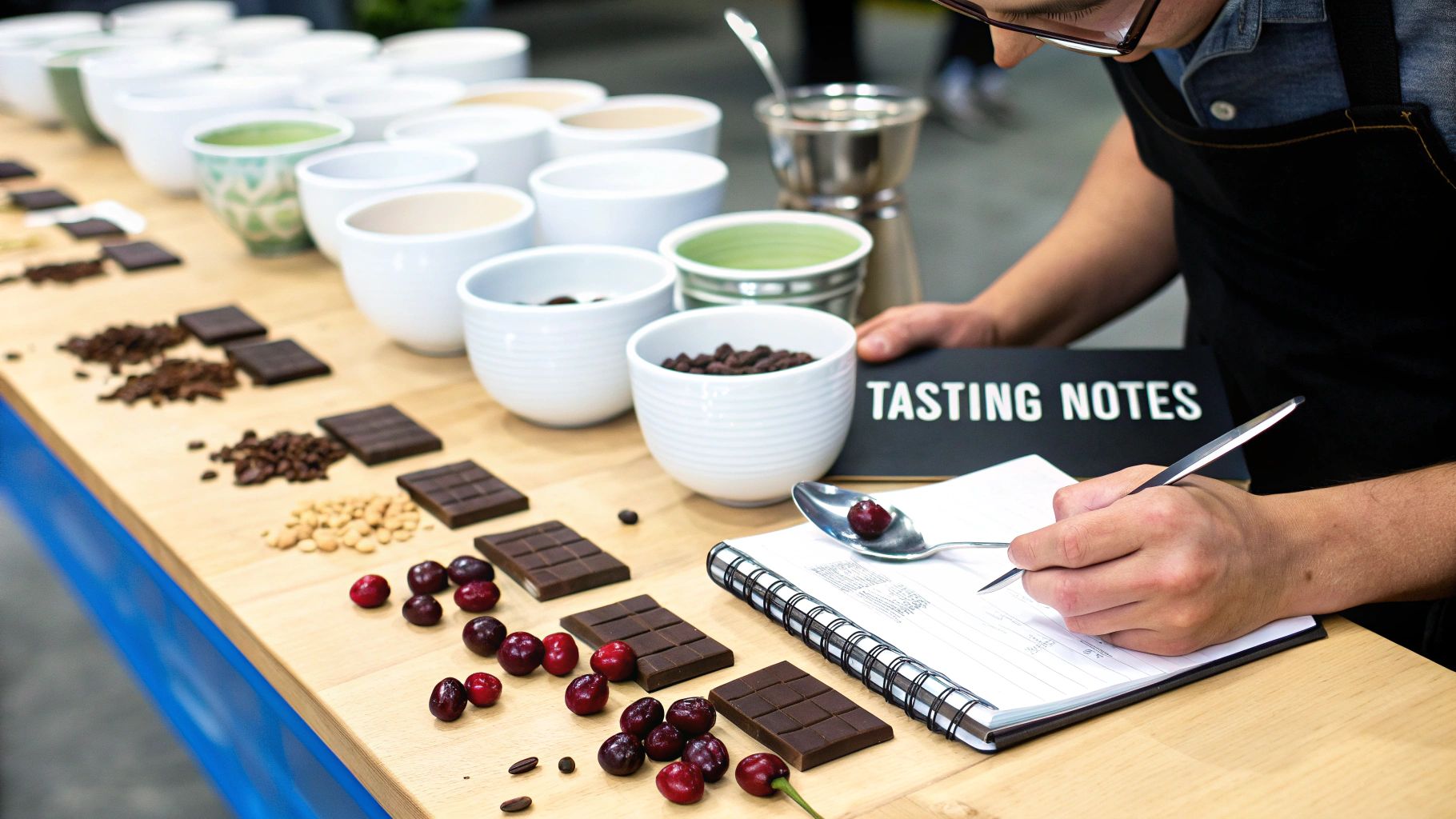
Tasting a true Yemeni coffee for the first time is something you don't forget. It’s a sensory experience that feels ancient, connecting you directly to the terraced mountainsides and traditional methods that have shaped it for centuries. Forget the clean, bright profiles you might be used to. Yemeni beans offer something wilder, more complex, and deeply layered. They demand your full attention.
The secret is really in the sun. The entire coffee cherry is dried whole, with the bean still inside. Over weeks, the sugars and fruit compounds slowly infuse into the bean’s core, creating an intensity you just don’t find elsewhere. Think of the difference between a fresh grape and a raisin—that drying process concentrates everything, transforming the flavor into something truly profound.
The Classic Yemeni Flavor Profile
When you're cupping a Yemeni coffee, you'll find a combination of notes that is immediately distinct. While every farm and every lot will have its own personality, a classic foundation ties them together. Learning to spot these characteristics is key for you and your team to really communicate what makes this coffee so special.
Here’s what you should be looking for on the cupping table:
Distinct Fruitiness: This is the soul of Yemeni coffee. It’s not about fresh, zesty citrus. Instead, you get these deep, dried fruit notes—think cherry, apricot, and prune. It’s a rich, almost jammy sweetness that stands completely on its own.
Winery Acidity: The acidity isn't sharp or aggressive. It's much more complex and rounded, often described as wine-like. It brings a pleasant tang that gives the cup structure and life, much like a good red wine.
Rich Chocolate and Spice: Hiding just underneath all that fruit is a base of dark chocolate, raw cocoa, and warm spices like cinnamon, cardamom, and even a hint of nutmeg. These notes give it a satisfying depth and a finish that seems to last forever.
It’s this dance between the bright, winey top notes and the rich, spicy foundation that makes the classic Yemeni profile so balanced and compelling.
Roasting to Preserve Delicate Aromatics
To do justice to these unique flavors, the roast is absolutely critical. A heavy, dark roast would simply steamroll the delicate fruit and spice, erasing the very thing that makes the coffee unique in the first place.
The goal of roasting Yemeni coffee isn't to add flavor, but to carefully unlock the complex tastes already sealed inside the bean by its unique terroir and processing. A light-to-medium roast is essential for this.
This lighter touch allows the coffee’s natural sweetness to shine and keeps all those intricate aromatics intact. It lets the coffee’s story—the sun, the soil, the altitude—come through clearly in every cup. Pushing the roast too far would be like overcooking a prime cut of steak; you just lose all the nuance.
Choosing the Best Brewing Methods
Once you’ve nailed the roast, your brew method is the final piece of the puzzle. You need something that offers clarity and control, allowing the subtle flavors to stand out without getting lost or muddled.
Pour-Over (V60, Kalita): This is your go-to. A pour-over gives you an incredibly clean cup that highlights the coffee's bright acidity and lets all those delicate fruit and floral notes sing.
Siphon: If you want to create a truly memorable experience for a customer, the siphon is fantastic. It’s a bit of theater, but it also produces a remarkably clean and aromatic cup. The full-immersion vacuum process extracts a huge spectrum of flavors with stunning clarity.
We generally suggest steering clear of methods like the French press. It can introduce too much sediment, which can easily obscure the delicate, nuanced notes that make Yemeni coffee such a treasure. By carefully choosing your roast and brew method, you can make sure every single cup is an exceptional experience that honors this coffee's incredible heritage.
Bringing Yemeni Coffee to Your Café Menu
Bringing authentic Yemeni coffee into your café is so much more than just adding another origin to your hopper. It’s a chance to build a unique, premium experience for your customers—one rooted in a powerful story of resilience and heritage unlike any other in the coffee world.
To do it right, you need a thoughtful approach. It’s about weaving that narrative through your menu, your team’s training, and every conversation you have with your customers. This isn't just about selling a great cup of coffee. It's about offering a connection to the culture that literally shaped the entire industry. When you treat it with the respect it deserves, you create something special that will attract discerning coffee lovers and build a loyal following.
Crafting a Compelling Menu
Your menu is the first place a customer will encounter your Yemeni coffee. It needs to be clear and enticing, sparking curiosity without being overwhelming. The goal is to signal that this isn't just another coffee—it's a curated experience.
Start by giving your Yemeni selection its own dedicated space. Don't just bury it in a long list of single origins. Let it breathe under a heading like "The Mokha Heritage Collection" or "Ancient Origins of Yemen." This simple move immediately sets it apart and helps justify its premium position.
From there, think about a few signature offerings that really let the coffee’s unique qualities shine.
The Classic Pour-Over: This is the purist’s choice. A simple V60 brew lets the coffee’s incredibly complex notes do all the talking. On the menu, describe what they can expect: "Notes of dried cherry, winey acidity, and warm spice."
The Siphon Experience: For a bit of theater, offer a siphon brew as a tableside experience for two. It’s a fantastic way for your baristas to share the story of Mokha while the coffee brews right in front of your guests.
Traditional Ibrik Preparation: To offer a truly authentic touch, you could serve coffee brewed in a traditional Ibrik (or cezve), served in small, demitasse-style cups. This method produces a rich, unfiltered brew that connects directly to Yemeni tradition.
Your menu should do more than list prices. It should be a storytelling tool, inviting customers on a journey to the terraced mountains of Yemen and the ancient Port of Mokha. Brief, evocative descriptions are your best friend.
Training Your Baristas to Be Storytellers
Your baristas are your most important ambassadors. A customer might hesitate to spend a little more on a coffee they've never tried, but a passionate and knowledgeable barista can easily bridge that gap. Their ability to share the story of Yemeni coffee is just as crucial as their skill in brewing it.
Your training needs to go beyond just brew recipes. You have to arm your team with the history and context they need to speak confidently and authentically about what makes this coffee so special.
Key Training Pillars:
The Origin Story: Make sure everyone understands the history of the Port of Mokha and Yemen's pivotal role as the birthplace of the global coffee trade.
Flavor Fluency: Hold regular cuppings so your team can personally identify and describe those classic Yemeni flavor notes—the winey acidity, the deep fruit, the unmistakable spice.
The Human Element: Teach them about the ancient, terraced farms, the painstaking hand-picking process, and the smallholder farmers who are the backbone of this tradition.
This knowledge turns a simple transaction into a memorable, educational interaction. When a customer asks, "What makes this so special?" your barista will have a compelling, genuine answer ready to go.
Marketing the Heritage Respectfully
Marketing your Yemeni coffee requires a delicate balance. You want to highlight its unique history and incredible quality without exploiting the country's current struggles. The focus should always be on celebrating the culture, the resilience of its people, and the beautiful product that comes from their dedication.
Use your social media, website, and in-store signs to tell this story. Share stunning images of the terraced landscapes and talk about the ancient, chemical-free farming methods that have been used for centuries. Explain the difference between "Mokha," the historic port, and "mocha," the chocolatey drink.
This kind of educational content builds value and positions your café as a trusted source for truly exceptional coffee. By investing in a high-quality product like the Hoopoe Single Yemeni Origin, you give your customers an authentic taste of this incredible legacy. Authenticity and excellence, built on a foundation of respectful storytelling, will set your business apart.
A Few Common Questions About Yemeni Coffee
Even when you appreciate the history and the incredible quality, some practical questions always pop up when you think about bringing Yemeni coffee into a café. It's totally normal. Whether you're a café owner deciding on your next single-origin or a customer just curious about what's in your cup, getting these questions answered is key.
Let's dive into some of the things people ask most often.
What Makes Yemeni Coffee So Expensive, and Is It Worth It?
The price tag on Yemeni coffee tells a story. It’s a direct reflection of its rarity, the back-breaking manual labor that goes into every bean, and the enormous logistical challenges of getting it out of the country. We’re not talking about big, mechanized farms here. This coffee grows on tiny, ancient terraces carved into steep mountainsides, where every single cherry has to be picked by hand.
After the harvest, the beans are meticulously sun-dried using traditional methods passed down through generations. Then you have to factor in the reality of navigating a country in conflict. All of this adds up. Honestly, every single bag that makes it to a roaster is a small miracle of resilience and dedication.
So, is it worth it for a specialty café? Absolutely, one hundred percent. The price is more than just a number; it's a value proposition.
Unforgettable Flavor: It delivers a taste experience that you just can't find anywhere else. Those deep, winey, dried-fruit notes create a cup that people remember and talk about.
A Story Worth Telling: The history of Mokha is one of the most powerful narratives in coffee. It's authentic, captivating, and gives customers a reason to connect with what they're drinking.
It Sets You Apart: Putting a true Yemeni coffee on your menu is a bold statement. It instantly distinguishes your café from the competition and signals a serious commitment to quality.
Don't think of it as an expense. It's an investment in authenticity, world-class quality, and an experience your customers will never forget.
How Is Mokha Different from the Mocha I Order?
This is probably one of the most important things to get straight, and it’s a fantastic teaching moment for your customers. The confusion makes sense, but they are two completely different things.
Mokha (sometimes spelled Mocha) is a legendary port city in Yemen. For hundreds of years, it was the world’s one and only gateway for coffee. All coffee exports went through this port. Because of that incredible legacy, authentic coffee from Yemen is often called Mokha coffee.
A mocha, on the other hand, is the chocolate-and-espresso drink you see on every café menu. The drink was actually named in honor of the original beans from Mokha, which were famous for having natural chocolatey notes in their flavor profile.
Mokha is a world-renowned coffee origin, treasured for its complex, fruity, and spicy character. A mocha is a café recipe made with espresso, steamed milk, and chocolate.
Making this distinction clear for your customers is a simple way to show your expertise and give them a much deeper appreciation for the coffee you're serving.
What's the Best Way to Brew Yemeni Coffee?
To really do justice to the delicate and wild flavors of Yemeni coffee, your brewing method is everything. The goal is to get a clean, clear cup that lets all those nuanced aromatics shine. For that, manual brewing is the way to go.
A pour-over, using something like a V60 or Kalita Wave, is a fantastic choice. These methods give you a super clean cup, allowing the bright, winey acidity and distinct fruit notes to take center stage. A Siphon brewer is another amazing option that not only produces a pristine cup but also adds a bit of beautiful tableside theater for your guests.
If you want to lean into tradition, brewing it in an Ibrik (or cezve) can be a really special offering. It's a completely different experience from a clean pour-over, but it connects the coffee directly to its cultural roots.
I’d generally steer clear of methods like a French press. The heavy sediment can easily muddy the very subtleties you’re trying to showcase. Precision is your friend here—use a medium-fine grind and keep your water temperature between 198-202°F (92-94°C) for the best extraction.
How Can I Be Sure the Yemeni Coffee I'm Buying Is Ethical?
This is non-negotiable, especially when you're sourcing from a region facing so many hardships. Looking out for the well-being of the farmers who pour their lives into this coffee has to be the top priority.
The best way to do this is to work with reputable importers or roasters who have built direct relationships on the ground in Yemen. Transparency is the number one sign of an ethical partner, so don’t be shy about asking the tough questions.
Key Questions to Ask Your Supplier:
Can you trace this coffee? They should be able to tell you the specific region, the cooperative, and maybe even the names of the farmers who grew it.
How do you ensure farmers are paid fairly? Ask about their pricing model. A good partner will be able to explain how they guarantee farmers are properly compensated for their incredibly difficult work.
Do you support the local community? Many of the best importers reinvest in the communities they work with, funding local projects and helping improve infrastructure.
True specialty coffee is a chain that starts with a seed and ends in a cup. That chain is only as strong as the people who grow it.
At AQEEK Coffee, we are dedicated to reviving Yemen’s legendary Mokha heritage by helping you build a modern, high-performing café. We provide end-to-end support, from certified barista training to signature menu development, ensuring your business is built on a foundation of authenticity and excellence. Discover how we can help you turn coffee into culture by visiting us at https://aqeek.com.
