

Steam lifted off the pot just as the room went quiet. The first sip was heavy, spiced, and unmistakably Yemeni, the kind of cup that doesn't just wake people up but tells them where coffee began.
The Drink That Awakened the World
If you want to understand how to make Yemeni coffee, start with the people who first brewed it with purpose. By the 15th century, approximately 1450 CE, Yemeni Sufi monks began cultivating coffee and drinking it to sustain their focus during long spiritual practices, marking the first documented use of coffee for mental sustenance. Those same monks were also the first to develop roasting techniques that brought out richer, more complex flavors, shaping the basic mechanics that still define coffee preparation today, as noted in this history of Yemen's role in coffee.
That matters in the cup. Yemeni coffee isn't built around speed, oversized milk drinks, or hiding the bean under syrup. It comes from a tradition where the brew had a job to do. It had to be fragrant, fortifying, and steady. That old purpose still gives the coffee its identity.
For cafés, that history isn't decoration. It's the core of the guest experience. When a barista can explain why the drink is brewed slowly, why spices belong in the pot instead of as an afterthought, and why the cup is small but intense, the coffee stops being a novelty and becomes a house specialty with meaning. That's the difference between selling a beverage and offering a ritual.
Yemeni coffee asks for patience. In return, it gives you character that faster methods often flatten.
The modern revival of this style only works when operators respect the old logic. You can't market heritage while serving a generic brew profile. You need the right bean, the right roast, the right grind, and the right service language. That's why the story in Coffee Was Born in Yemen. America Is Finally Tasting It Right resonates so strongly with serious café owners. It reminds people that Yemeni coffee isn't a trend to borrow from. It's a lineage to handle carefully.
What makes this different from ordinary spiced coffee
A lot of operators make one common mistake. They treat Yemeni coffee like regular coffee plus cardamom.
That doesn't work.
The spice should support the bean, not cover it. The roast should deepen the coffee's body, not burn it into bitterness. The brew should feel intentional from first aroma to final pour. When you get those decisions right, the cup tastes rooted, not improvised.
The Roots of Mokha Yemen's Coffee Heritage and Beans
The bean does most of the heavy lifting. If the bean is wrong, every brewing technique after that becomes damage control.
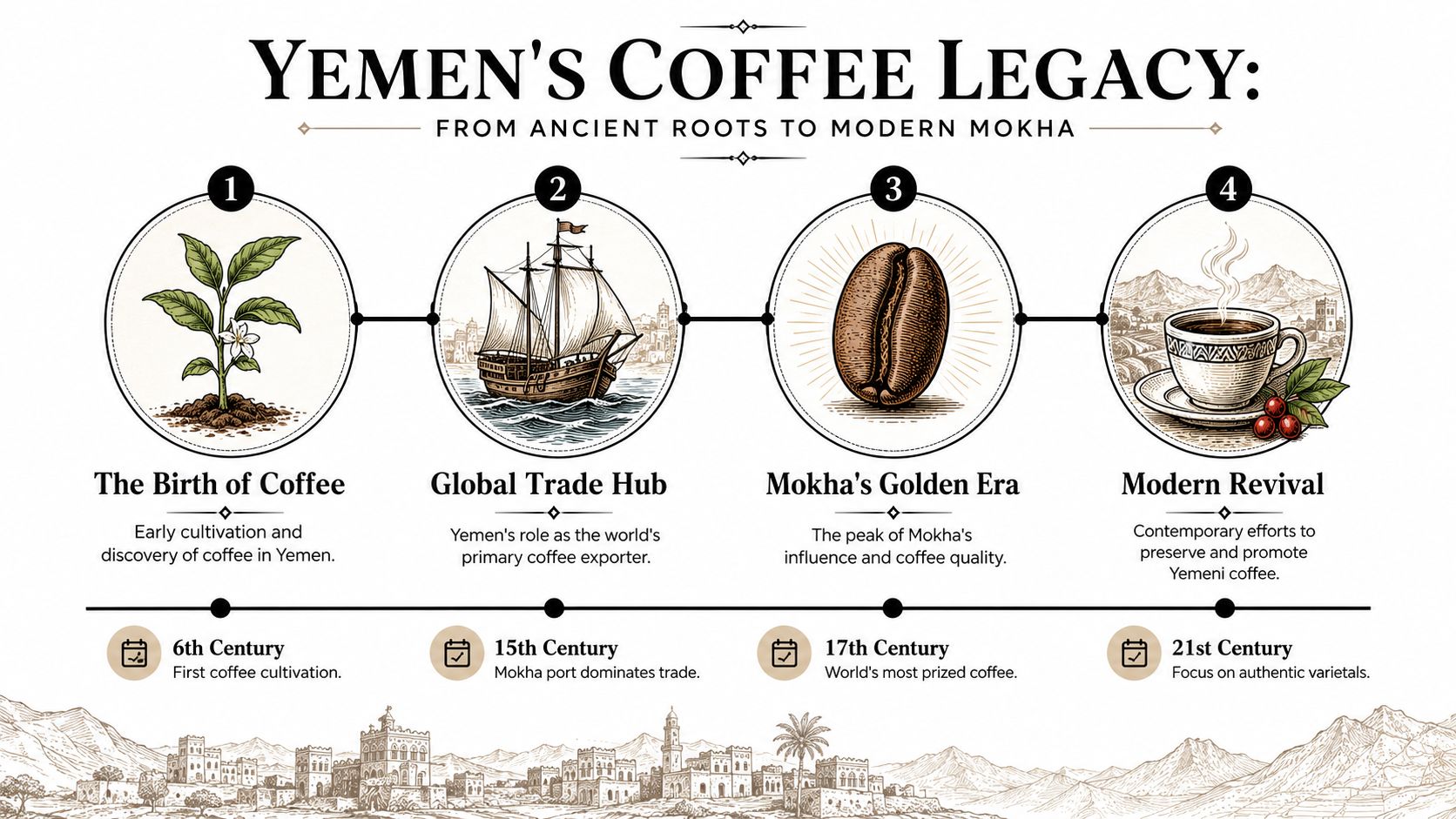
Yemen is historically recognized as one of the oldest known coffee-producing regions, with institutional coffee consumption dating back to the 15th century. That role made Yemen the primary gateway for coffee to reach the global market through the port city of Mokha, and the flavor profile associated with Yemeni coffee comes from ancient growing conditions and dry-processing methods preserved for over 500 years, according to this overview of Yemeni coffee heritage.
Why Mokha still matters
Mokha isn't just a romantic name on a bag. It represents the trade route that carried Yemeni coffee into the world and gave the region a permanent place in coffee history. When people talk about Mokha today, they often mean chocolate notes or a stylistic profile. In the original sense, they are talking about origin, movement, and legacy.
That legacy also shaped the bean itself. Yemeni coffees are often described as earthy, aromatic, and complex, with dried fruit tones and chocolate notes. Those aren't marketing adjectives pulled from nowhere. They come from the environment, the drying method, and the way coffee farming in Yemen stayed close to its old form while many other producing regions industrialized around consistency first.
What to look for in authentic Yemeni beans
When you're sourcing for home use or for a café program, don't chase generic labels. Look for signs that the coffee still reflects Yemeni handling and profile.
A practical buying checklist:
Origin clarity: The seller should clearly identify the coffee as Yemeni, not just "Arabica" or "Middle Eastern style."
Process character: Dry-processed coffees tend to carry the rustic fruit-and-cocoa character people expect from Yemeni lots.
Roast compatibility: The bean should be suitable for medium to dark roasting, because that profile supports the traditional brewing style better than a bright, tea-like approach.
Aroma before brew: Good Yemeni coffee should smell deep and alive even before water touches it. Flat aroma usually means age, poor storage, or a roast that missed the mark.
Buying rule: If the coffee tastes interchangeable with any standard specialty lot, it probably won't deliver a convincing Yemeni cup.
Why old farming methods still shape the cup
Traditional Yemeni coffee production has remained unchanged for over 500 years, with small family farms planting on terraced fields carved into the terrain. Another important historical claim is that Yemeni coffee is the ancestral wild coffee beverage from which 90 to 100% of all other coffees consumed today originate, as described in this history of Yemen coffee cultivation.
That kind of lineage should affect how you evaluate the cup. You're not looking for polished uniformity above all else. You're looking for structure, perfume, density, and a wild edge that hasn't been scrubbed out. In practical terms, that means some lots may present more rustic intensity than the average café buyer is used to. That's not a flaw. It's often the signature.
Bean choice for home brewers and café operators
Home brewers should choose beans that can tolerate a fine grind and direct-heat brewing without turning ashy. Café operators need to think one step further. The bean must hold up under repetition, staff variation, and service pressure.
Here's a simple comparison:
Use case | Best bean priority | What to avoid |
|---|---|---|
Home brewing | Aromatic lots with strong spice compatibility | Ultra-light roasts that brew thin |
Café service | Lots with body, clarity, and dependable roast behavior | Delicate coffees that collapse under batch inconsistency |
Signature menu use | Beans with dried fruit, cocoa, and earthy depth | Generic dark roasts sold as "Arabic coffee" |
If you're serious about learning how to make Yemeni coffee correctly, bean selection isn't one step among many. It's the foundation.
Preparing the Foundation Roasting and Grinding for Authenticity
Roasting decides whether Yemeni coffee tastes noble or muddy. Grinding decides whether it tastes complete or hollow. Most failures happen before the pot ever reaches the flame.
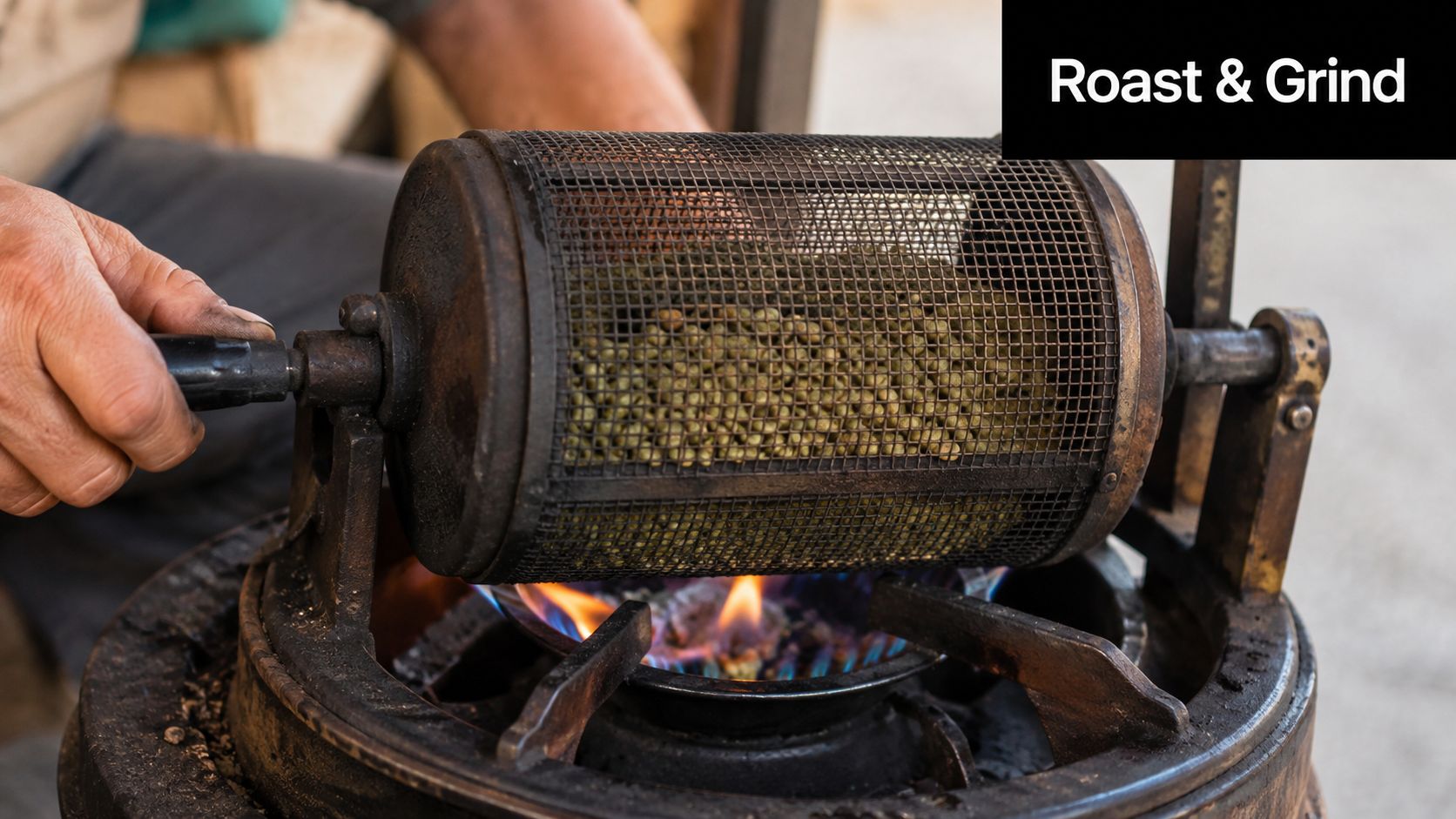
Yemeni coffee is often roasted medium or dark to maximize its full-bodied, rustic, and musky character, a style that sets it apart from Arabica coffees commonly processed and brewed differently, as described in this guide to Yemeni coffee flavor and roasting. That's the practical target. Not charcoal. Not Scandinavian light. You want enough development to deepen body and support spice, while keeping the bean's dried-fruit complexity intact.
Roast for body, not for fashion
A lot of modern roasters underdevelop Yemeni coffee because they're trying to preserve acidity at all costs. That approach usually strips the cup of its historic identity. The brew comes out sharp, papery, and thin.
A better target is a roast that does three things:
Builds solubility: The coffee needs to extract properly in a small pot over direct heat.
Protects sweetness: Good medium to dark development can keep the cup rich without making it taste scorched.
Supports spice integration: Cardamom, ginger, or cinnamon should settle into the coffee, not fight with green roast notes.
For café owners who want a deeper technical read on development and roast behavior, this AQEEK roasting guide for Yemeni espresso beans offers useful context.
Grind finer than you think
The grind for authentic Yemeni coffee should be very fine, closer to powder than to standard drip coffee. If your grinder produces coarse particles or wide particle spread, the cup won't have the weight and texture you're after.
What works best:
Flat burr commercial grinders: Strong choice for café service when you need repeatability.
High-quality home burr grinders: Fine if they can reach a Turkish-style range without overheating.
Hand grinders with precise adjustment: Good for small-batch ritual service, slower for volume.
What doesn't work well:
Blade grinders: They produce uneven particles. Some dust, some boulders. That inconsistency turns direct-heat brewing into guesswork.
Pre-ground coffee of uncertain age: It loses aromatic force fast and rarely lands at the right particle size.
Grind inconsistency doesn't show up as a small defect. It shows up as a flat nose, harsh finish, and weak body all at once.
A practical prep standard
Before you brew, set a prep standard and stick to it.
Roast to a point where the coffee smells dense and sweet, not grassy.
Rest the beans long enough to stabilize after roasting.
Grind immediately before brewing whenever possible.
If you're in a café, write down grinder settings and check them at the start of each shift.
Heritage and profit converge. A café can tell a beautiful story about Yemeni coffee, but if the roast is underdeveloped or the grind is sloppy, guests taste the mistake before they hear the story.
The Traditional Brewing Ritual Step by Step
The traditional brew is small in scale and unforgiving in feel. That is exactly why it works. It forces attention.

Use a small long-handled pot such as a rakwa or ibrik. Some households and cafés also use other traditional forms, but the principle stays the same. Fine coffee, water, low-to-moderate heat, close attention, and a careful pour.
Start with cold water and fine coffee
Begin with cold water in the pot. Add your finely ground Yemeni coffee directly to the water before heating. If you're using spices, add them now, not after brewing. Cardamom is the most common companion, while ginger and cinnamon can add warmth when used with restraint.
The common mistake is over-spicing. If the drink smells like a spice cabinet before it smells like coffee, you've already gone too far.
A balanced setup usually follows this pattern:
Coffee first: The coffee should remain the lead flavor.
Cardamom second: It lifts aroma and freshens the finish.
Ginger or cinnamon in support: Use one or both lightly, especially in café service where consistency matters.
Bring it up slowly
Set the pot over gentle heat and watch closely. You are not trying to hard-boil the coffee. You are trying to coax it upward.
As the liquid warms, the grounds begin to bloom and the foam starts to gather. Let it rise near the top, then pull the pot briefly off the heat before it spills. Return it to the flame and repeat. That rhythm builds texture and integrates the spice without roughening the cup.
Service cue: If the coffee races to a boil, the heat is too high. Slow brewing gives Yemeni coffee its composed, layered taste.
A rushed brew often tastes aggressive on the front and empty on the finish. A controlled brew lands deeper and cleaner.
This visual walk-through helps if you haven't seen the movement before:
Let the grounds settle before pouring
Once the coffee has risen a few times and the aroma is full, remove the pot from the heat and give it a short rest. This pause matters. It lets suspended particles settle enough to make the pour cleaner while keeping the brew thick and expressive.
Don't stir at the end. Stirring re-agitates the fines and muddies the cup.
Pour small and serve immediately
Pour into small handleless cups, often called finjan. Fill modestly. Yemeni coffee isn't meant to be swallowed in volume. It's meant to be revisited in short, aromatic sips.
A good service rhythm looks like this:
Warm the cups if possible.
Pour steadily, leaving the heaviest sediment behind in the pot.
Serve at once, while the top notes are still vivid.
Offer dates or a simple sweet if you want to soften the intensity.
What the finished cup should taste like
The best cups carry density without heaviness. You should get aroma first, then body, then spice, then a lingering earthy sweetness or cocoa-like depth depending on the bean.
If your cup tastes thin, check the grind.
If it tastes burnt, check the roast or heat level.
If it tastes muddy, check the settling and pour.
That is the center of how to make Yemeni coffee. Not memorizing a rigid recipe, but learning the rhythm well enough to repeat the result.
Serving Yemeni Coffee in a Modern Café
Most cafés fail with Yemeni coffee for operational reasons, not flavor reasons. They either romanticize it into something too slow to sell, or they industrialize it until the drink loses its soul.

A modern café can serve Yemeni coffee successfully, but only if the ritual is translated into repeatable standards. The guest should feel craft. The staff should feel control.
Build one station for one purpose
Don't bury this drink inside the espresso workflow. Give it a dedicated station with its own pot set, grinder setting reference, spice containers, cups, and service tray. If baristas have to borrow tools from three separate zones, tickets slow down and quality drifts.
A tight Yemeni coffee station usually includes:
Dedicated brew pots: Keep them separate from other stovetop or sand-heated applications.
A grinder dialed for this drink only: Resetting espresso grinders for a side ritual is a recipe for inconsistency.
Measured spice mise en place: Pre-portioned cardamom or ginger helps staff stay precise.
Finjan cups and servingware: Presentation is part of the product, not a garnish.
Write SOPs that protect the ritual
Your standard operating procedure should document more than ingredients. It should specify visual cues and movement.
Strong SOPs include:
SOP area | What to standardize |
|---|---|
Bean prep | Roast profile target, storage, rest period, grinder setting |
Brewing | Pot size, coffee dose, water level, spice addition point, heat level |
Visual cues | Foam rise, when to lift from heat, how long to rest before pouring |
Service | Cup type, pour volume, guest explanation, pairing suggestion |
Many owners provide inadequate training. They teach recipe memory but not sensory judgment. Yemeni coffee needs both.
A barista shouldn't just know the steps. They should know what the pot is supposed to look and smell like at each moment.
Keep authenticity without slowing the line
There are workable trade-offs.
For lower-volume service, brew each pot to order and let the barista narrate the ritual. That creates theater and earns the time. For higher-volume service, pre-portion coffee and spices, keep water measured, and train staff to run overlapping pots without rushing the rise. What doesn't work is holding finished Yemeni coffee for too long and pretending it still tastes alive. It won't.
Menu language matters too. Don't bury it under a vague label like "spiced house coffee." Call it Yemeni coffee. Briefly explain the profile. Tell guests whether it is served black, spiced, and in a small traditional cup.
For operators building a full menu concept around this category, this modern guide to ancient Yemeni coffee for cafés is a useful companion read.
Train the script, not just the drink
The person serving the cup should be able to say, in one short explanation, what makes it different. Not a lecture. Just enough to orient the guest.
A good staff script covers three things:
What it is: Traditional Yemeni coffee brewed in a small pot.
How it tastes: Full-bodied, earthy, aromatic, often with spice.
How to enjoy it: Sip slowly, often alongside dates or pastries.
That short script changes the sale. It reduces returns from guests who expected a standard drip coffee, and it raises the perceived value of the drink because the experience feels intentional.
Expanding the Experience Variations and Pairings
Once the base cup is strong, you can build an entire menu lane around it. At this stage, Yemeni coffee becomes more than a drink. It becomes a cultural anchor for the café.
Serve Qishr as a second signature
Qishr is one of the most important variations to know. It is a warm spiced drink made from coffee husks rather than the roasted bean itself. The result is lighter, fragrant, and especially effective as a companion offering for guests who want the aroma of the tradition without the weight of a full coffee brew.
A practical way to serve it:
Steep the husks gently: Don't treat them like dark coffee grounds.
Use ginger and cardamom carefully: Qishr should smell lifted and bright, not dense.
Offer it as a daytime or after-meal option: It broadens the menu without competing directly with the main Yemeni coffee service.
Build variations that still respect the origin
Not every guest wants the most intense traditional cup. That's fine. The answer isn't to dilute the identity. It's to create variations that still point back to the core.
Useful menu extensions include:
Honey coffee: A softer, sweeter expression for guests who find black coffee too severe.
Yemeni spiced latte: Best when milk supports the spice rather than burying it.
Cold brew adaptation: Works if the bean character stays recognizable and the drink isn't treated like a generic café cold brew.
Pair food that matches the cup's structure
Yemeni coffee likes food with restraint. The coffee already has depth. It doesn't need a dessert cart crashing into it.
Best pairings include:
Dates: Natural, simple, and culturally fitting.
Roasted nuts: Good with earthy and chocolate-toned coffees.
Baklava or other light sweets: Use sparingly so the syrup doesn't dominate.
Bint al-sahn: A strong café pairing when available, especially if you want the service to feel unmistakably Yemeni.
The best pairing doesn't overpower the coffee. It gives the next sip more shape.
For café owners, this pairing strategy also helps average ticket value in a way that feels natural. The guest isn't being upsold into random add-ons. They're being guided into a more complete experience.
If you're serious about learning how to make Yemeni coffee in a way that lasts, don't stop at the pot. Build the surrounding choices with the same care. That's where heritage becomes habit, and habit becomes a profitable house identity.
AQEEK Coffee helps cafés turn Yemeni coffee from a beautiful idea into a working operation. If you're building a menu, refining service standards, or designing a full café around Mokha heritage, AQEEK Coffee brings roasting insight, training discipline, and real-world café development experience to the process.
