

You've got a fresh bag on the counter, the grinder's ready, and the coffee already smells great. The problem is that aroma doesn't stay put for long if the beans sit in the wrong place, in the wrong container, or under the wrong light. In Yemeni coffee culture, that lesson goes back to Mokha, where traders had to protect coffee from heat, salt air, and long travel before anyone talked about “freshness” in modern terms.
Why Bean Storage Starts with Mokha
At 7 a.m., a barista in Sana'a might tip a newly roasted Yemeni lot into a clay vessel while a café owner in Brooklyn seals single-origin bags for the rush. Different cities, same pressure, because coffee starts changing the moment it's roasted and every storage choice either slows that change or speeds it up. Mokha sits behind that idea, not as a museum story, but as the original reminder that coffee is vulnerable the second it leaves the tree.
Yemen's port of Mokha was a major gateway for the global coffee trade, and one source says it helped maintain a monopoly on the world's coffee-bean supply for more than 100 years from the 16th to the 18th centuries (Mokha's coffee-trade history). The same port gave the word mocha its coffee meaning, and a Yemeni coffee-history source says that exported coffee made the name a synonym for coffee for about 250 years (how Mokha shaped the word mocha). That history matters because the original problem was always preservation, not branding.

Modern bean storage is just the refined version of that old shipping problem. What used to be wooden dhows and shaded lots is now airtight packaging, cool cabinets, and careful rotation. The promise here is simple, a practitioner-tested framework, grounded in Yemeni heritage, that keeps home and café beans inside a tight oxygen, temperature, humidity, and light window.
The Four Enemies Every Bean Faces
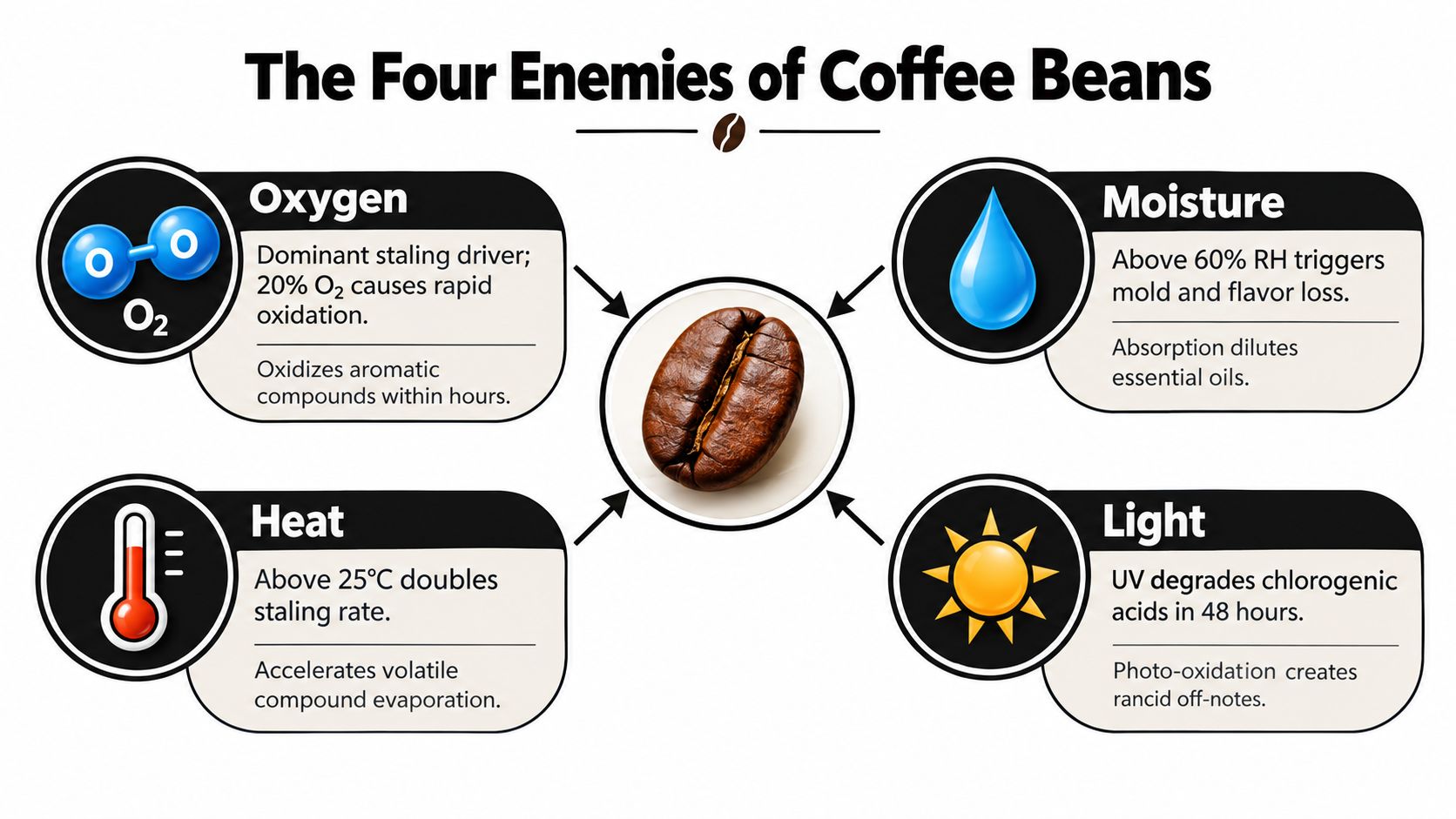
Coffee stales for four reasons, and the order matters. Oxygen is the dominant driver of staling in roasted beans, because it oxidizes the compounds that carry aroma and structure. Moisture, heat, and light all make that process worse, but oxygen gets first priority in any storage decision.
For roasted beans, keep the room cool, stable, and dry. A strong working band is about 15°C to 20°C with 50% to 60% relative humidity for preserved quality, and the broader practical range for daily storage sits close to 15°C to 22°C. For green coffee, the data points lower and tighter, with storage strongest around 15°C to 20°C and a moisture profile around 10% to 12.5% in the green state (green coffee storage guidance).
The same review also reports that coffee quality could be preserved for 6 months at 15°C when bean moisture stayed between 17% and 22% (green coffee preservation data). Another technical summary notes that storage at 15°C and about 65% relative humidity was adequate to prevent deterioration in bulk coffee, which is why a café storeroom should feel cool and stable, not merely “normal” (green coffee water-activity research summary).
Practical rule: If the storage spot feels warm, smells like food, or gets direct light, it's already too forgiving for coffee.
A fast audit takes less than a minute. Open the cabinet, feel for heat near the back wall, check whether the container blocks light, and confirm that the bag or bin seals tightly. For a deeper operational frame, the AQEEK guide on Yemeni coffee freshness and the AQEEK standard adds useful café context: the art of Yemeni coffee, freshness, and the AQEEK standard.
Choosing Containers That Actually Protect Flavor
The right container does three jobs at once, it slows oxygen exchange, blocks light, and limits moisture swings. The wrong one may look neat on a counter and still strip away aroma every time someone reaches in. In cafés, I judge containers by how often they're opened, because repeated access matters as much as the material itself.
What works and what doesn't
One-way valve bags are the cleanest answer for cafés moving bags quickly. They let CO2 escape after roast without pulling in fresh oxygen, which matters when product turns over fast and staff don't need to decant into extra vessels. For daily home use, ceramic canisters with gasket lids or opaque stainless containers usually make more sense because they block light and buffer small temperature swings.
Clear glass is the display option, not the freshness option. It looks appealing, but once sunlight hits the beans, the container becomes part of the problem. Vacuum bins help when you buy in bulk, but they're clumsy for frequent scooping because every pump cycle is another freshness tax.
Container | Oxygen Barrier | Light Blocking | Moisture Buffer | Best Use |
|---|---|---|---|---|
One-way valve bag | Strong | Strong if opaque | Moderate | Café turnover and quick-use home stock |
Ceramic canister with gasket lid | Strong | Strong | Good | Countertop daily use |
Amber glass jar | Moderate | Moderate | Low | Short-use storage away from light |
Clear glass jar | Weak | Weak | Low | Display only |
Vacuum-seal bin | Very strong when sealed | Depends on body | Good | Bulk weekly buys |
A useful commercial reference is the commercial kitchen container guide, especially if you're choosing food-safe bins for a back bar or prep area. The same logic shows up in AQEEK's storage-focused container option for organized café use, the OXO POP Container Big Square Short, 2.8 qt, which fits the broader rule that opaque, tight-sealing storage beats decorative storage every time.
Labelling, Rotation, and Smart Portioning
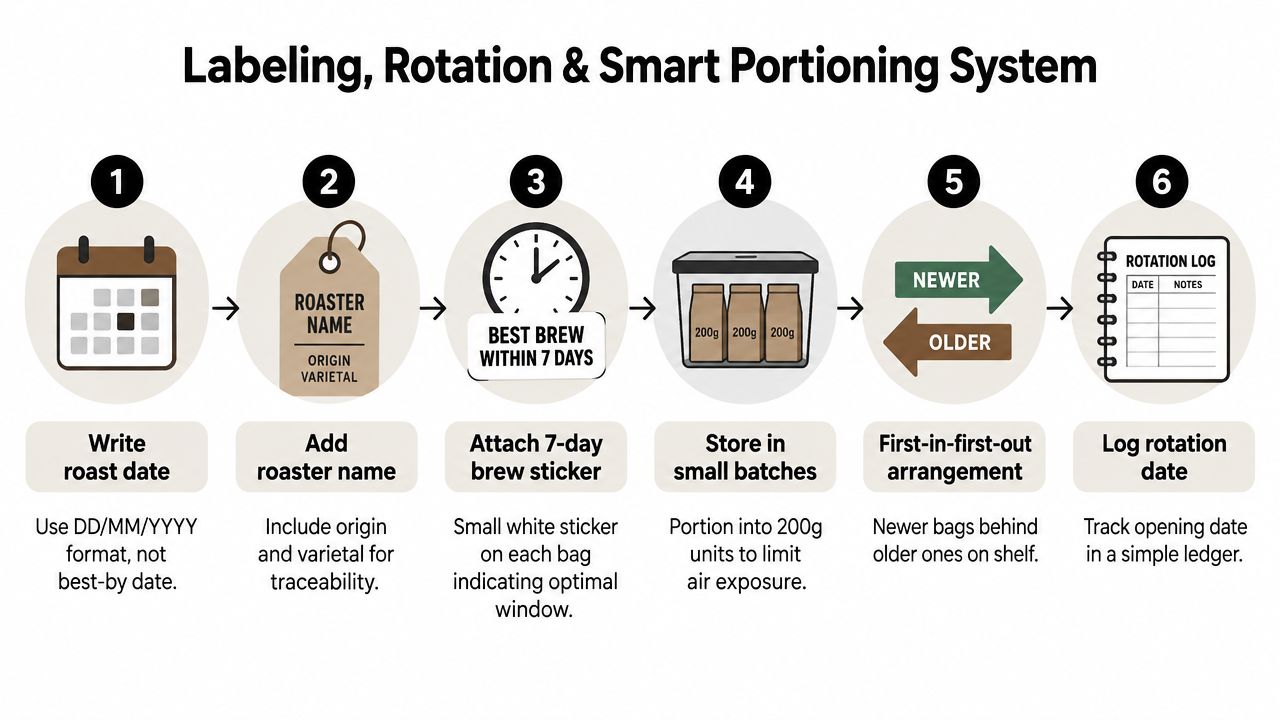
Good storage fails fast when staff can't tell what's older, what's open, and what needs to move next. The fix is a rotation system that feels boring in the best possible way. Every bag gets a roast date, every shelf has a direction, and every opening gets logged.
Build the habit into the bag
Write the roast date in DD/MM/YYYY format, add the roaster name, and put a small white sticker on the bag with a 7-day brew window. That keeps the decision visible at a glance, which matters when the morning rush starts. Use a FIFO bin, first in, first out, so older bags sit in front and newer deliveries go behind them.
Portioning should match use case, not habit. A 200 g daily-use tin works for a single household or small bar, a 1 kg valve bag suits a home grinder that stays busy through the week, and a 5 kg bulk purchase should be split into 250 g vacuum bricks at receiving so unopened coffee isn't exposed over and over. That's the same logic Mocha exporters used when they tied color-coded cord to parcels to track lots through the port.
Practical rule: Open less, seal more, and make the label do the memory work.
A receiving check only needs sixty seconds. Confirm the roast date, inspect the valve, weigh the bag, log the batch code, then file it behind older stock. That small ritual prevents the common café problem where the prettiest bag gets used first and the freshest beans age in the back.
Storage Mistakes That Quietly Kill Freshness
The most expensive storage mistakes are the ones that feel sensible. People refrigerate beans because they think cold equals fresh, or they keep them in a pretty jar because the counter looks better. Both habits damage the cup in ways that are easy to miss until the bag is already flat.
Refrigeration is a condensation trap. Cold beans pull moisture when they return to room air, and moisture migration accelerates staling instead of preventing it. Clear jars on a sunny counter fail for the opposite reason, because light breaks down oils and aroma compounds while the beans sit there looking untouched.
Opening the bag every morning to “let it breathe” also backfires. Each opening floods the headspace with oxygen, and repeated exposure speeds oxidation. Storing beans beside spices causes another problem, aroma transfer, because coffee absorbs nearby odors quickly.
Mistake | Why It Ruins Beans | Do This Instead |
|---|---|---|
Refrigerating roasted beans | Condensation adds moisture and speeds staling | Keep beans in a cool, dry cabinet |
Clear glass on a sunny counter | Light breaks down oils and flavor | Use opaque ceramic or stainless storage |
Opening the bag repeatedly | Each opening adds fresh oxygen | Portion into smaller sealed containers |
Storing near spices | Beans absorb off-odors | Keep coffee away from strong-smelling foods |
Buying pre-ground coffee | More surface area means faster aroma loss | Grind whole beans right before brewing |
Trusting “best by” over roast date | “Best by” can hide age | Buy by roast date and rotate by FIFO |
Mokha traders understood the same logic long before modern packaging. They protected lots with shade and breathable material because coffee didn't need theatrical handling, it needed protection from oxygen and light. That's still the rule, even if the container has changed.
When Freezing Beats the Countertop
Freezing isn't a moral choice, it's a timing choice. If you finish coffee fast, the counter is fine. If you buy larger bags or brew slowly, freezing protects flavor far better than letting beans age in an open kitchen.
A good decision framework starts with bag size and cadence. Under 250 g, most users can brew through the bag within about four weeks at room temperature. At 500 g and above, freezing on the day of roast becomes the safer move, especially for households that alternate between espresso and filter. If you drink under 200 g per week, room temperature works well. If you drink more than that, portion for the freezer in weekly units.
Roast style matters too. Dark roasts usually hold a bit longer at room temperature because their lower moisture and denser structure resist staling better than light Nordic roasts, which are more fragile and respond well to frozen brick storage. The point isn't to freeze everything. The point is to match the storage method to the pace of use.
The freezing protocol should be clean and one-directional. Portion beans into 150 to 200 g vacuum bricks, label them with the roast date, pre-chill the freezer to -18°C, and keep them in a dedicated aroma-safe drawer. When it's time to brew, thaw only what you need at room temperature inside the sealed bag for about 30 minutes, then open and grind.
The research behind freezing is consistent with that approach. One study in the brief reported that hermetic packaging at 10°C predicted 232 days of shelf life, while the same beans in non-hermetic packaging dropped to 45 days at that temperature. Another source found that reducing oxygen inside the container to 0.5% could extend shelf life by 20 times, which is why sealed, low-oxygen storage matters even when the beans are cold (packaging and oxygen control research).
A Café-Ready Storage SOP You Can Run Tomorrow
A good café SOP turns storage from a preference into a repeatable routine. That matters in Yemeni-inspired cafés and in any shop that cares about consistency, because the same bean can taste brilliant or dull depending on who handled it after receiving. AQEEK's SOP-building work is useful here, and their template for Yemeni cafés fits the same operational logic.
Green-bean room rules
Keep the green-bean room cool, dry, and off the floor. Pallets need spacing, and bags should stay sealed in GrainPro or Ecotact liners inside jute, with monthly moisture-meter audits so quality shifts get caught early. A target around 10°C to 15°C with 55% to 65% relative humidity is a practical working zone for inventory that needs to stay stable, not glamorous.
Roasted-bean station rules
Use opaque airtight containers, label each single-origin bin with roast date and roast-by day, and keep scoops gram-accurate. For filter, a 10-day roast-by target keeps the bar moving cleanly, while espresso can stretch to 21 days if the beans are stored well and the team respects the seal. No top-up policy, either, because topping off old beans with new ones buries age and ruins rotation.
Daily and weekly checks
At the bar, staff should inspect the degas valve at open, smell-test the grinder hopper, log hopper changeovers, and pull a vacuum at close. Once a week, run a random bean-weight check, inspect every container seal, sweep the shelves FIFO-style, and review freezer inventory so the frozen stock doesn't become forgotten stock. Keep one freshness log with origin, roast date, lot, restock, withdrawal, and a signed-off barista line, because written ownership is what keeps the system honest.
Zone | Daily Check | Weekly Check | Audit Frequency |
|---|---|---|---|
Green-bean room | Room feel, seal status, moisture note | Moisture-meter audit, pallet spacing | Monthly and weekly spot checks |
Roasted-bean station | Valve, aroma, label, hopper log | Container seal inspection, FIFO sweep | Daily and weekly |
Freezer inventory | Portion count, thaw log | Inventory review, label check | Weekly |
AQEEK Coffee brings this kind of storage discipline into café training, roasting, and workflow design. If you want your coffee program to feel more like a managed system and less like guesswork, visit AQEEK Coffee and compare their consulting, training, and café setup work against your current storage routine.
