

I walked into a café once after the morning rush and found the barista using three different notes for the same drink, none of them matching the manager's version. The coffee was strong, the intent was good, but the process was drifting. In a Yemeni café, that kind of drift doesn't just slow service, it chips away at a legacy that began in Mocha.
Preserving Mokha Heritage Through Modern Operations
Yemen's coffee story isn't a branding angle, it's the origin story of the modern coffeehouse. Mocha, or al-Makha, became Arabia's chief coffee-exporting center, and coffee shipped through that port gave the world the term “mocha” itself, with trade documented as the main export from the 15th century onward (Britannica on Mocha). Historical accounts also place Yemen at the center of coffee's early commercial spread, with one source describing a long period when Yemeni coffee supplied all coffee consumed globally, and another saying Yemen was the only source for almost 200 years (Yemen and Mocha coffee history). Coffee from Yemen's port of Al Mokha also fed the rise of coffee houses in Cairo, Istanbul, Amsterdam, and London (Al Mokha trade routes).
That history matters on a modern bar because heritage collapses fast when service gets chaotic. A guest who orders Yemeni coffee expects more than a drink, they're tasting a story of export, ritual, and place. If the recipe changes from shift to shift, the cup stops honoring the lineage it claims to represent.

RemoveUploadDownloadRegenerateAsk AI
Why heritage needs process
The most useful SOPs in a Yemeni café don't flatten culture into a checklist. They protect the repeatable parts so the team has room to deliver warmth, pace, and hospitality without improvising the basics every morning. That's the value of creating an SOP template for this kind of shop: it turns a high-meaning beverage into a high-consistency operation.
A solid template also gives you a way to teach the story without letting the story interrupt execution. A new hire can learn why Yemeni coffee matters, then follow the same opening, brewing, and closing standards every time. That's how authenticity survives rushes, staff turnover, and multiple service points.
For operators looking for a practical bridge between heritage and daily service, this modern guide to ancient Yemeni coffee for cafés is a useful companion piece. The big operational lesson is simple, history needs structure if you want it to survive the bar.
Architecting the Foundation of Your Café SOP
A café SOP template starts with document control, not recipes. A high-quality structure includes title, unique identifier, owner, effective date, version or approval status, purpose, scope, roles, prerequisites, procedure, acceptance criteria, related documents, and revision history (EPA guidance on SOP structure). Without those fields, the team never knows which version is current or who's responsible when a process starts slipping.
Build the template like a system, not a memo
Department-based organization works better than a single manual because it matches how cafés run. One recent template set organizes SOPs by kitchen, front of house, bar, and cleaning, with 16 procedures in one operating manual, while another offers 20 ready-to-use SOP templates across front-of-house, back-of-house, safety, and cash handling (restaurant SOP template library). That modular structure is precisely what a Yemeni café needs when opening, brewing, wiping, reconciling cash, and resetting the room all happen in parallel.
Practical rule: if a barista can't tell whether a document covers the bar, the register, or the dining room in the first few seconds, the template is too vague.
A master index solves the next problem, findability. It lets the team pull the approved procedure for a specific workflow instead of guessing which version lives in a shared drive. That matters most when you're scaling across shifts or locations, because a shop can't run on memory alone.
For owners who want to cut duplicate cleanup, repeated explanations, and version confusion, techniques to eliminate manual rework is a helpful reference point. The practical lesson is that document design should reduce repeat labor, not create another layer of admin.
AQEEK Coffee uses this approach as part of its consulting work, because a modern Yemeni café needs the same discipline whether the task is preparing qishr, stocking the bar, or closing the espresso machine. The template is the backbone, the workflow is the muscle.
The fields that keep the document audit-ready
Use fields that answer the questions staff ask during real service. Who owns this? What area does it apply to? Which version is approved? What equipment is required? What does success look like when the step is done correctly?
A useful café SOP usually reads cleanly when every page includes:
Owner and approver so responsibility is unambiguous.
Scope so staff know where the procedure starts and stops.
Prerequisites so the team doesn't skip setup.
Acceptance criteria so quality isn't left to opinion.
Related documents so training and reference materials stay connected.
That level of control keeps the document ready for training, review, and inspection. It also prevents the common failure where a nice-looking template exists, but nobody can tell whether it's the current process or just an old printout.
Designing Core Modules for Yemeni Coffee Workflows
A Yemeni café shouldn't build SOPs around generic restaurant categories alone. The menu and the workflow have to match the beverage identity, especially when the shop serves traditional drinks alongside espresso. A well-built template separates signature recipes, brewing methods, equipment care, quality checks, and safety so each workflow has its own operating logic.
Recipes need sensory standards, not just measurements
A recipe SOP for Yemeni coffee should state ingredients and order of operations, but it also needs sensory acceptance criteria. The barista should know what the cup should smell like, what the body should look like, and what the finish should feel like before the drink leaves the bar. That's especially important for drinks tied to heritage, because a technically correct recipe can still miss the character guests expect.
A modular menu system helps. Traditional drinks like qishr need their own workflow, while modern espresso-based drinks need their own shot, milk, and service standards. The methods differ, but both need clear grind, water, timing, and serving expectations so the cup doesn't drift from one shift to the next.
For equipment-dependent stations, AQEEK's approach to menu and layout planning works well because the SOP can match the actual placement of grinder, brewer, scale, and rinse zone. A drink procedure that ignores the station layout usually gets ignored by the team.
The internal reference that pairs well with this module is the ultimate coffee shop equipment list for new owners. It's useful because the equipment list and the SOP should be written together, not separately, or else the document ends up describing tools the team doesn't have.
The strongest recipe SOPs don't just say how to make the drink. They define what good looks like after the cup is finished.
Maintenance and safety belong in the same operating rhythm
Yemeni coffee workflows get slower when equipment drifts. If the grinder is inconsistent or the steaming wand isn't cleaned correctly, the barista starts compensating at the counter, and that's where quality slips. Maintenance procedures should live right beside opening, closing, and sanitation workflows so the team treats them as part of service, not optional extras.
For safety, keep the language direct and local to the station. If a task involves hot water, sharp tools, wet floors, or cross-contact risk, the SOP should name the hazard in plain language and show the correct response. The point isn't to create a legal document, it's to prevent avoidable mistakes on a busy bar.
This is also where AQEEK's station optimization mindset fits. A strong SOP doesn't just explain the drink, it supports the path the barista walks, the reach to each tool, and the order in which work happens. That's how a Yemeni café protects speed without sacrificing accuracy.
Writing for the Barista in the Middle of a Rush
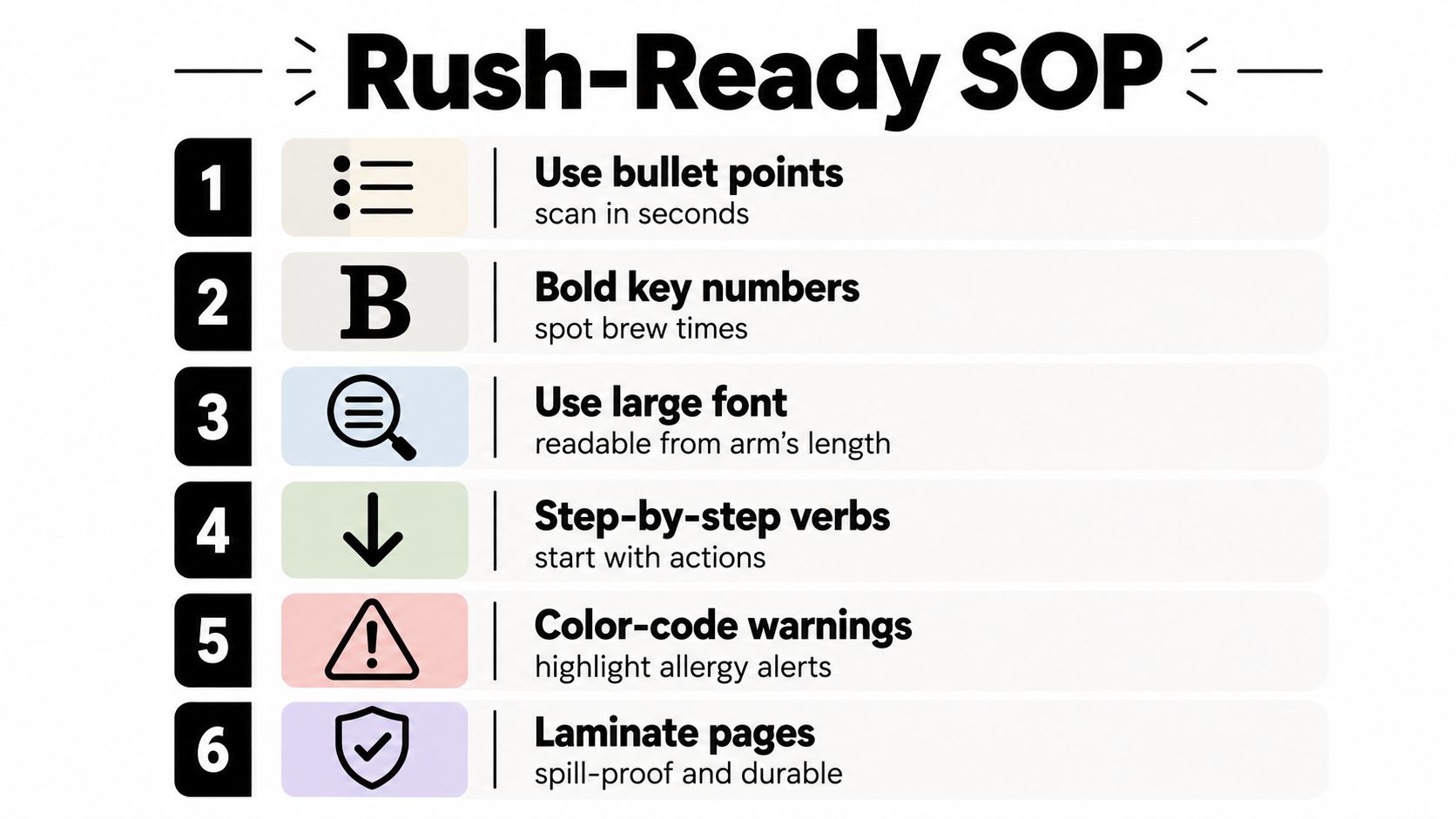
A barista in the middle of a rush does not need a document that reads like a policy binder. They need a procedure they can scan, trust, and finish without asking three people for clarification. For a café that is trying to protect Yemeni Mokha heritage on a crowded bar, that means the SOP has to carry the work, not add to it.
Keep the steps short and the exceptions separate
Simple tasks work best as short step-by-step instructions. Branching tasks need a hierarchical structure. Frequent yes-or-no decisions are easier to follow as a flowchart than as dense paragraphs, which matches the broader SOP guidance on choosing format by complexity (UNC SOP guidance).
Visual cues matter even more in cafés because attention is already split between drinks, guests, and sound. A photo of the correct crema color, the right pitcher fill level, or the proper tamp position can do more than a dense paragraph. Neutral guidance increasingly recommends hybrid SOPs, a numbered step list plus screenshots or photos, plus a short verification checklist, because that makes procedures easier to follow in the field (visual SOP guidance).
Write for the person who's never touched the machine before, not for the person who drafted the template.
That test catches the instructions that only make sense on paper. Hand the draft to someone unfamiliar with the task and watch where they hesitate, improvise, or ask for context you forgot to include. Those gaps show up fast when the line is out the door.
Make the page usable under pressure
Tooling for technical documentation helps teams think about readability, structure, and consistency before the writing gets too long. In a café, the same principle applies. The document has to work like a tool, not a report (tooling for technical documentation).
RemoveUploadDownloadRegenerateAsk AI
The front-line SOP should protect the reader from overload. Put the core action where the eye lands first, then keep unusual cases in a separate exceptions block. That is cleaner than burying edge cases inside the main recipe, and it keeps the standard path fast for the people who have to use it.
AQEEK Coffee's barista training classes pair naturally with this style of document because the training and the SOP can reinforce the same workflow language. If the class teaches one sequence and the SOP records another, the team gets confused. If both match, the barista moves faster with less correction.
Implementing Version Control and Review Cadences
A café SOP template without ownership becomes stale fast. Equipment changes, suppliers shift, and drink specs evolve, so the document has to be treated as a living file with a clear owner, a last-updated date, a change log, and a next review date. That's the only way to keep the latest approved process from getting buried under older drafts.
Governance is what keeps the template alive
Recent guidance consistently recommends version numbers, review dates, and a master index so teams can find the current SOP quickly (living SOP guidance). The same guidance also points to review discipline, testing by non-experts, and ongoing updates as processes change. In practice, that means someone has to own the document, someone has to approve changes, and someone has to make sure training reflects the revised version.
A simple rhythm works better than an elaborate one. Review the SOP on a fixed cadence, and review it again whenever a core workflow changes. That lines up with neutral guidance recommending periodic review rather than one-time documentation, because the failure isn't bad formatting, it's drift.
A template isn't finished when it looks polished. It's finished when the team can keep it current.
Training records matter here too. If a new version goes live, the owner should know who has seen it, who still needs refreshers, and where exceptions have been raised. That turns the SOP from an archive into an operational system.
What to protect from drift
The fastest way to lose consistency is to let informal fixes become permanent without updating the document. A grinder setting changes, a closing step gets skipped, or a new drink gets added, and suddenly the written process no longer matches the bar. That gap is where errors multiply.
Strong governance also keeps the shop honest about ownership. Shared ownership sounds collaborative, but it usually means nobody updates the file. One named owner, one current version, and one review date create accountability that a café can sustain.
Launching Your Mokha Renaissance with Confidence
A Yemeni café doesn't need generic paperwork, it needs a working system that protects the cup and the culture behind it. Creating an SOP template is how you make that happen, because it turns heritage into repeatable service instead of leaving quality to memory. Start with document control, build modular workflows, write for the person on the bar, then lock in version ownership so the system stays current.

RemoveUploadDownloadRegenerateAsk AI
The shops that do this well aren't the ones with the prettiest binders. They're the ones where a new hire can learn the standard, a shift lead can enforce it, and a guest can taste the same intention in every cup. That's the difference between a café that serves Yemeni coffee and a café that preserves its legacy.
AQEEK Coffee builds consulting, training, and SOP support around that exact operational standard. If you're shaping a Yemeni café or tightening an existing one, visit AQEEK Coffee and see how their consulting approach can help turn your workflow into a real Mokha renaissance.
AQEEK Coffee helps cafés turn Yemeni coffee heritage into daily execution through SOPs, training, menu design, and workflow planning. If you're ready to build a café that serves with consistency and cultural care, visit AQEEK Coffee and start shaping the operation behind the cup.
