

Discover 4th wave coffee: Science, Transparency, and Sustainability
If you think of coffee's history as a series of waves, the fourth wave is the one that brings everything into sharp, scientific focus. It takes the craft and passion of the third wave and elevates it with the precision of a science lab and the deep storytelling of a documentary film. We're moving beyond just appreciating good coffee to demanding radical transparency, scientific consistency, and a genuine, provable connection to the people who grow it.
What's Driving the 4th Wave Philosophy?
Think about how our relationship with food has changed. It’s no longer enough for something to taste good; we want to know where it came from, how it was made, and who benefited from its production. That's the same shift happening in coffee. The fourth wave isn't just an evolution; it's a response to the need for more substance behind the story.
It builds on the third wave’s foundation of quality but adds a demanding layer of science, data, and ethics. The people leading this charge aren't just baristas—they're part-scientist, part-storyteller, and part-advocate. They use technology to analyze and perfect every variable, from water chemistry to grind size, while demanding a level of transparency that follows a single coffee bean from a specific plot of land right into your cup.
A True Partnership with the Producer
At its heart, the fourth wave is about shrinking the world. It’s about closing the gap between you, the person drinking the coffee, and the farmer who nurtured the plant. This goes far beyond vague marketing phrases like "ethically sourced" and into the realm of hard facts and shared success.
Radical Transparency: It's common to see packaging that lists not just the country but the farmer's name, the specific altitude of the farm, the processing method used, and even the price paid at the farm gate.
The Producer as an Artisan: The farmer is finally celebrated as a skilled partner whose expertise in cultivation and processing is just as critical as the roaster's or barista's. They are no longer an invisible part of the supply chain.
A Scientific Approach: Roasters and cafés are now using tools like refractometers (to measure extraction) and water activity meters to ensure every single cup meets an exact, repeatable standard of excellence.
This movement has been supercharged by a massive cultural shift toward brewing at home. The fourth wave is defined by a measurable move from out-of-home, commodity-style drinking toward specialty, sustainable, and at-home premium coffee. This trend really took off when home brewing surged, with roughly 70% of coffee consumers reporting they were brewing at home more often by 2025. Still, café culture remains dominant, with out-of-home coffee accounting for about 78% of the industry's total revenue. This shows how the demand for transparency and quality is bridging the gap between professional cafés and the dedicated home enthusiast.
The fourth wave isn't just about what's in your cup. It's about understanding the entire ecosystem behind it—the science, the economics, and the human stories that make truly exceptional coffee possible.
Comparing 3rd Wave and 4th Wave Coffee
To really see the difference, it helps to put these two movements side-by-side. The third wave taught us to see coffee as an artisanal product, full of unique flavors and potential. The fourth wave is taking that appreciation and professionalizing it with scientific discipline and a much stronger ethical backbone.
Our guide on what is specialty coffee explores these quality standards in more detail, but the table below offers a quick comparison.
Comparing 3rd Wave and 4th Wave Coffee
Characteristic | Third Wave Focus | Fourth Wave Focus |
|---|---|---|
Core Philosophy | Coffee as a craft and an art form. | Coffee as a science and an ethical partnership. |
Transparency | Highlighting the country or region of origin. | Full traceability down to the specific farm or lot. |
Sourcing | Emphasis on "Direct Trade" relationships. | Documented, equitable pricing and true producer partnerships. |
Technology | Manual brewing methods (pour-over, AeroPress). | Data-driven tools (refractometers, advanced grinders). |
Consumer Goal | Appreciating unique flavor notes and terroir. | Understanding the entire value chain and its human impact. |
In short, the third wave opened the door to appreciating coffee's nuances. The fourth wave is walking through that door and turning on all the lights, revealing every single detail of the journey with clarity and purpose.
The Four Waves of Coffee Evolution
To really get what makes 4th wave coffee so special, it helps to understand how we got here. Coffee’s place in our culture wasn’t an overnight shift; it happened in a series of "waves," with each one completely changing our relationship with the drink. It’s a story that tracks coffee’s journey from a basic household good to a deeply scientific and ethical passion.
This visual timeline gives you a great snapshot of that evolution, from a simple home brew to a full-blown scientific discipline.
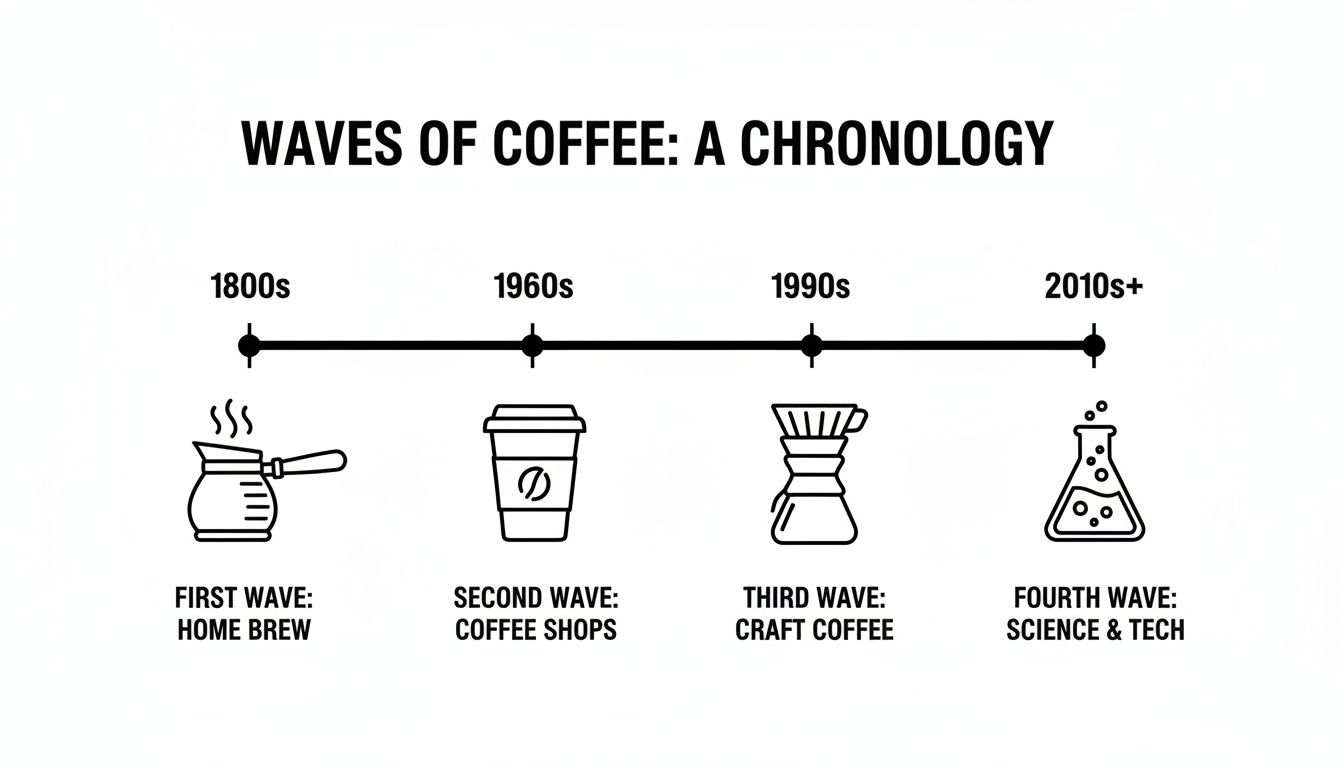
As you can see, the path is clear: it starts with mass-market coffee (First Wave), moves into the café experience (Second Wave), dives deep into craft (Third Wave), and finally lands on the scientific precision and ethical core of the Fourth Wave.
The First Wave: Coffee as a Household Stapole
The first wave was simple: get coffee into every home. Think of those iconic tin cans of Folgers or Maxwell House that sat on nearly every American kitchen counter from the early 1900s through the 1980s. The goal was mass production and affordability, not flavor or origin.
Coffee was just a commodity back then. It was a caffeine delivery system, a warm, reliable part of the morning ritual. This wave definitely succeeded in making coffee a daily habit for millions, but it also created a huge disconnect between the person drinking it and where it actually came from.
The Second Wave: Coffee as a Social Experience
Starting in the late 1980s and really taking off in the 1990s, the second wave turned coffee from a mundane drink into a social event. This was the era of Starbucks and Peet’s Coffee, which introduced the world to café culture as we know it. All of a sudden, we were learning a new vocabulary—lattes, cappuccinos, and espressos.
The focus shifted from the kitchen to the comfy coffee shop. It was all about the atmosphere, the brand, and the idea of a “third place” to hang out that wasn't home or work. While this wave made coffee a lifestyle choice, the beans themselves were still a bit of a mystery. The experience was the product, not necessarily the coffee.
The Third Wave: Coffee as a Craft
The third wave, which bubbled up in the early 2000s, was a direct response to the standardized, mass-market feel of the second wave. It treated coffee like an artisanal product, putting it on the same level as fine wine or craft beer. This is when terms like single-origin beans, terroir, and specific processing methods started to pop up in coffee conversations.
This movement was all about a deeper appreciation for the coffee itself. Baristas became skilled artisans, and manual brewing tools like the pour-over and AeroPress became popular because they gave us more control to highlight the unique flavors of beans from different parts of the world.
The third wave taught us to ask, "Where is my coffee from?" It was a crucial step that laid the groundwork for an even deeper line of questioning about quality, ethics, and the people behind the beans.
Key characteristics of the third wave included:
Focus on Origin: Highlighting the country and sometimes the specific farm where the coffee was grown.
Manual Brewing: Championing methods that gave the brewer precise control over the final cup.
Lighter Roasts: Shifting away from the dark, often burnt roasts of the second wave to let the bean's natural, delicate flavors shine.
The Fourth Wave: The Culmination of Science and Soul
And that brings us to the fourth wave. This isn't just the next step; it’s the culmination of everything that came before it. It takes the third wave's obsession with craft and supercharges it with scientific precision, radical transparency, and a genuine human connection back to the producer.
The fourth wave asks much tougher questions. It’s no longer just, "Where is my coffee from?" Now, it's, "Who grew my coffee, how were they paid for their work, and what scientific methods were used to unlock its absolute best flavor?" This is where technology, ethics, and incredible quality finally come together to create a complete and conscious coffee experience.
The Core Pillars of the 4th Wave Movement
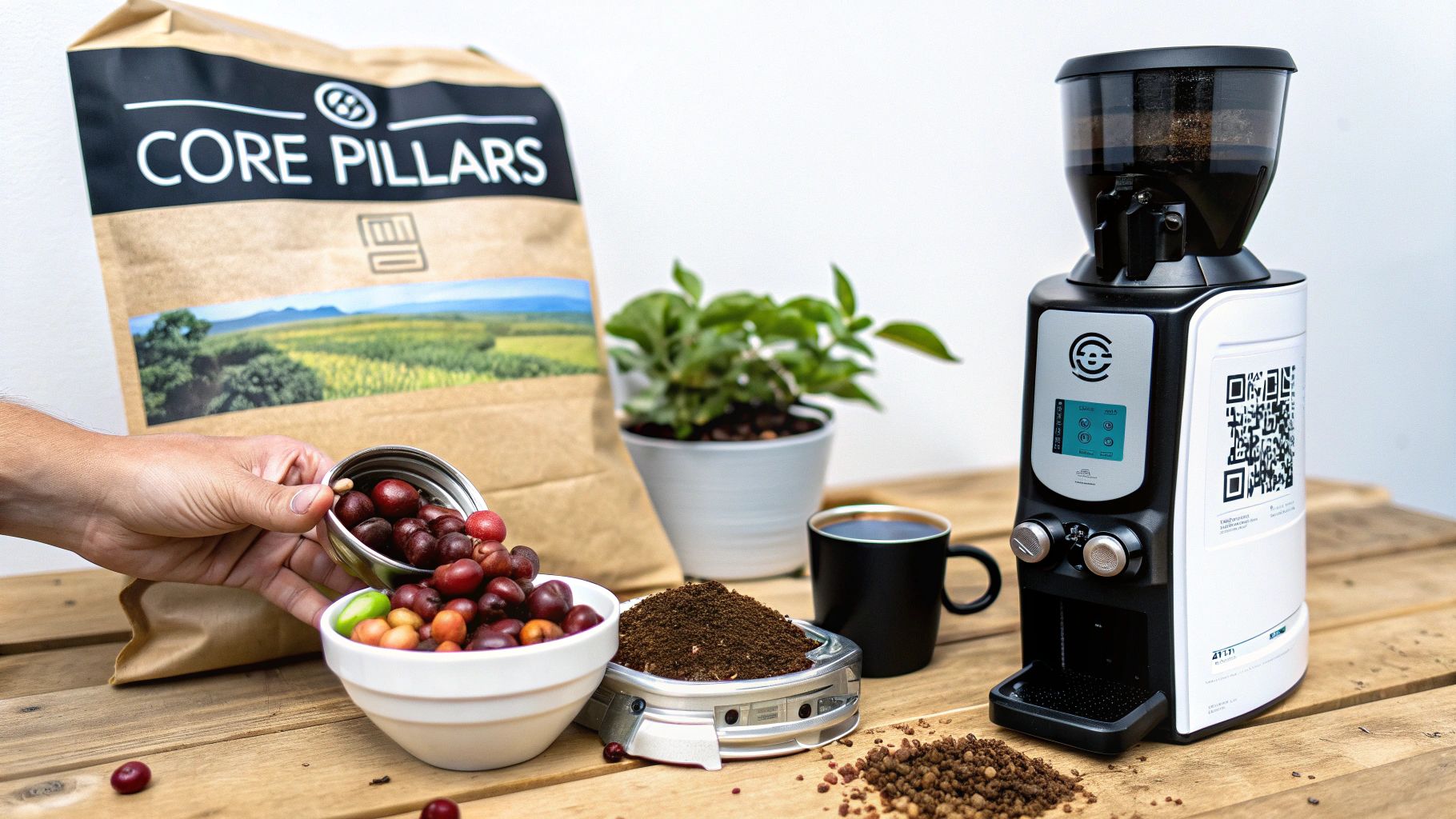
The 4th wave isn’t just a philosophy; it’s a tangible movement built on a few core, interconnected ideas. These principles are what truly separate a fourth-wave coffee from a third-wave one with clever marketing. They represent a deep shift in how we grow, process, roast, brew, and even think about coffee.
Think of these pillars less like a checklist and more like the DNA of the movement. Each one strengthens the others, creating a cycle where science elevates ethics and transparency empowers everyone from the farmer to the coffee drinker. It's a structure that demands more from everyone involved, from the person tending the coffee cherries to the barista dialing in your shot.
Let's dig into the four foundational pillars that really define what 4th wave coffee is all about.
Pillar 1: Scientific Precision in Every Step
The artistic touch of the third wave has been supercharged with the repeatable accuracy you’d expect from a science lab. The goal isn't just to make a great-tasting cup of coffee; it's to make a great-tasting cup that can be perfectly replicated every single time, backed by hard data. This obsession with precision touches every stage of the coffee's journey.
Baristas are now using tools that were once confined to laboratories. Take the refractometer—it uses light to measure the Total Dissolved Solids (TDS) in brewed coffee, giving a precise number for its strength and extraction. This turns brewing from educated guesswork into a calculated science.
This scientific mindset shows up everywhere:
Data-Driven Roasting: Roasters use advanced software to map and control temperature curves with second-by-second accuracy, making sure every batch perfectly hits the intended flavor profile.
Particle Size Analysis: Top-tier grinders are now so consistent they can produce a specific distribution of coffee grounds, measured in microns, to get the absolute best extraction for any brew method.
Water Chemistry Control: Cafés meticulously filter and re-mineralize their water to hit a specific chemical composition (TDS, pH, hardness) that makes the coffee shine.
This isn't about replacing the human element. It's about giving the roaster and barista the information they need to consistently unlock a coffee's full potential. For anyone wanting to bring this control home, understanding your brewing equipment is the first, most crucial step.
Pillar 2: Radical and Verifiable Transparency
Fourth-wave coffee blows past vague "ethically sourced" labels and demands proof. Transparency is no longer a marketing buzzword; it's a non-negotiable standard that you can actually verify. It’s about creating a clear, unbroken line of sight from your cup all the way back to the specific plot of land where the coffee grew.
A perfect example is the widespread use of QR codes on coffee bags. A quick scan with your phone can pull up a wealth of information:
The farmer's name and a bit about their farm.
The exact coffee varietal (like Gesha, Typica, or Bourbon).
The farm’s altitude and unique micro-climate.
The specific processing method used (e.g., anaerobic honey, carbonic maceration).
A price breakdown, showing exactly how much the farmer was paid.
In the fourth wave, transparency is about accountability. It replaces feel-good stories with auditable data, ensuring that claims of ethical sourcing can be proven and that value is distributed fairly across the supply chain.
This level of detail turns a bag of coffee from a simple commodity into a documented piece of agricultural art, complete with its own story and provenance.
Pillar 3: Producer-Centric Sourcing Models
While the third wave introduced "direct trade," the fourth wave is working to perfect it by shifting the power dynamic. The farmer is no longer seen as just a supplier; they're a vital partner and a skilled artisan whose expertise is celebrated and, more importantly, compensated properly. This is all about building equitable, long-term relationships that are more collaborative than transactional.
Instead of just paying a premium over the commodity market price, roasters work hand-in-hand with producers. They might collaborate on experimental processing lots, invest in farm infrastructure, or share data to help improve crop quality and climate resilience. This creates a powerful feedback loop where roasters get access to truly unique coffees and producers gain financial stability and the resources to keep innovating.
This approach acknowledges that the work done at the farm—in cultivation and processing—is just as critical to the final flavor as the roaster's skill. This is especially important for regions with a deep history, like Yemen, where reviving ancient Mokha traditions relies entirely on empowering the farmers who are the keepers of that legacy.
Pillar 4: The Advanced Sensory Experience
Ultimately, the fourth wave is about pushing the boundaries of flavor itself. By marrying scientific precision with producer-led innovation, this movement is unlocking sensory profiles in coffee that were once unimaginable. This is largely driven by experimental processing methods happening right at the farm.
Think of it like winemaking. Just as different fermentation techniques can dramatically alter a grape's flavor, methods like anaerobic and carbonic maceration are being applied to coffee cherries.
During anaerobic fermentation, coffee cherries are fermented in a sealed, oxygen-free tank. This controlled process slows everything down and encourages the development of unique acids and aromatic compounds. The result is often wild, funky, and intensely fruity flavors like ripe strawberry, cinnamon, or even tropical punch. These experimental lots are challenging our very definition of what coffee can taste like, creating an exciting new frontier for coffee lovers to explore.
How the 4th Wave Is Reshaping the Coffee Business
For anyone running a coffee shop or a roastery today, the 4th wave isn't just a trend—it's a whole new playbook for how we do business. This goes so much deeper than just brewing techniques. We're talking about a fundamental shift in everything from menu design and staff training to the very equipment we invest in and the relationships we build with farmers. It's a model that’s all about depth over breadth and telling real, verifiable stories instead of just leaning on generic marketing.
The most obvious change for customers is right there on the menu. The days of a mile-long list of syrupy lattes and anonymous house blends are fading. In their place, you’ll find a thoughtfully curated, often rotating, selection of single-origin micro-lots. Every single coffee is there for a reason, chosen for its unique backstory and its journey from a specific farmer or cooperative.
This turns the menu from a simple price list into a conversation starter. The goal is to showcase the distinct terroir, the processing methods, and the story that makes each coffee special, inviting people to explore a world of flavor they might not have known existed.
Training a New Breed of Coffee Professional
This whole model hinges on having a team that truly knows their stuff. Barista training in a 4th wave shop is a world away from just learning to pull shots and steam milk. It’s a deep dive into the science of coffee, with a huge emphasis on sensory skills and a real understanding of the entire seed-to-cup journey.
A modern coffee pro needs to be able to:
Talk About Flavor: They have to do more than just say a coffee is "good." They need to describe the subtle notes of cherry, jasmine, or caramel and explain how the bean's varietal, altitude, or processing created those flavors.
Understand the Science: Concepts like Total Dissolved Solids (TDS) and extraction percentages are no longer just for coffee nerds. They're essential tools for dialing in each coffee to reveal its absolute best.
Be a Storyteller: A huge part of the job is connecting the customer to the coffee's origin—sharing the farmer's name, the history of the farm, and the unique path it took to end up in their cup.
This isn't just a service job anymore; it's a craft. It requires a real investment in ongoing education, turning baristas into genuine coffee experts who can guide customers and elevate their entire experience.
Investing in Precision Equipment
To support these skilled professionals, you need equipment built for one thing: precision. The 4th wave toolkit is all about controlling every possible variable, which allows baristas to brew an incredible cup of coffee and then do it again, perfectly, every single time.
Key investments usually include:
Single-Dose Grinders: These grinders all but eliminate waste and stale grounds, allowing for incredibly precise, on-demand grinding for each cup to ensure you’re getting the freshest coffee possible.
Pressure-Profiling Espresso Machines: Top-tier machines give baristas the power to manipulate the pressure during extraction, essentially unlocking different layers of flavor from the very same coffee bean.
Advanced Water Filtration: You can't make great coffee with bad water. Specialized systems create the ideal mineral composition, stripping out the bad stuff and adding what’s needed to make the coffee’s natural flavors pop.
This obsession with precision isn't just for show. It's a core operational belief. When you can control the variables with the right gear, you can guarantee that every single cup of that expensive, high-quality micro-lot is served exactly as the roaster and the farmer dreamed it would be.
Forging Deeper Supplier Partnerships
Maybe the biggest change of all is in how roasters and cafés work with their suppliers. The old way of just placing an order for green coffee is being replaced by deep, collaborative partnerships. Roasters are now working directly with producers, often flying out to the farms to collaborate on experimental processing lots and build real, lasting relationships.
This direct connection builds an incredible amount of trust and ensures everyone is on the same page, working toward a shared vision of quality and sustainability. For coffee shop owners, figuring out how to build a profitable coffee shop menu in this new world means communicating the value behind these partnerships and the higher prices that come with them.
When customers understand that their purchase is supporting a more equitable, innovative, and transparent supply chain, they're more than willing to invest in a truly exceptional coffee. This collaborative spirit is what really powers the entire 4th wave movement.
The Future of Coffee Innovation and Consumer Trends
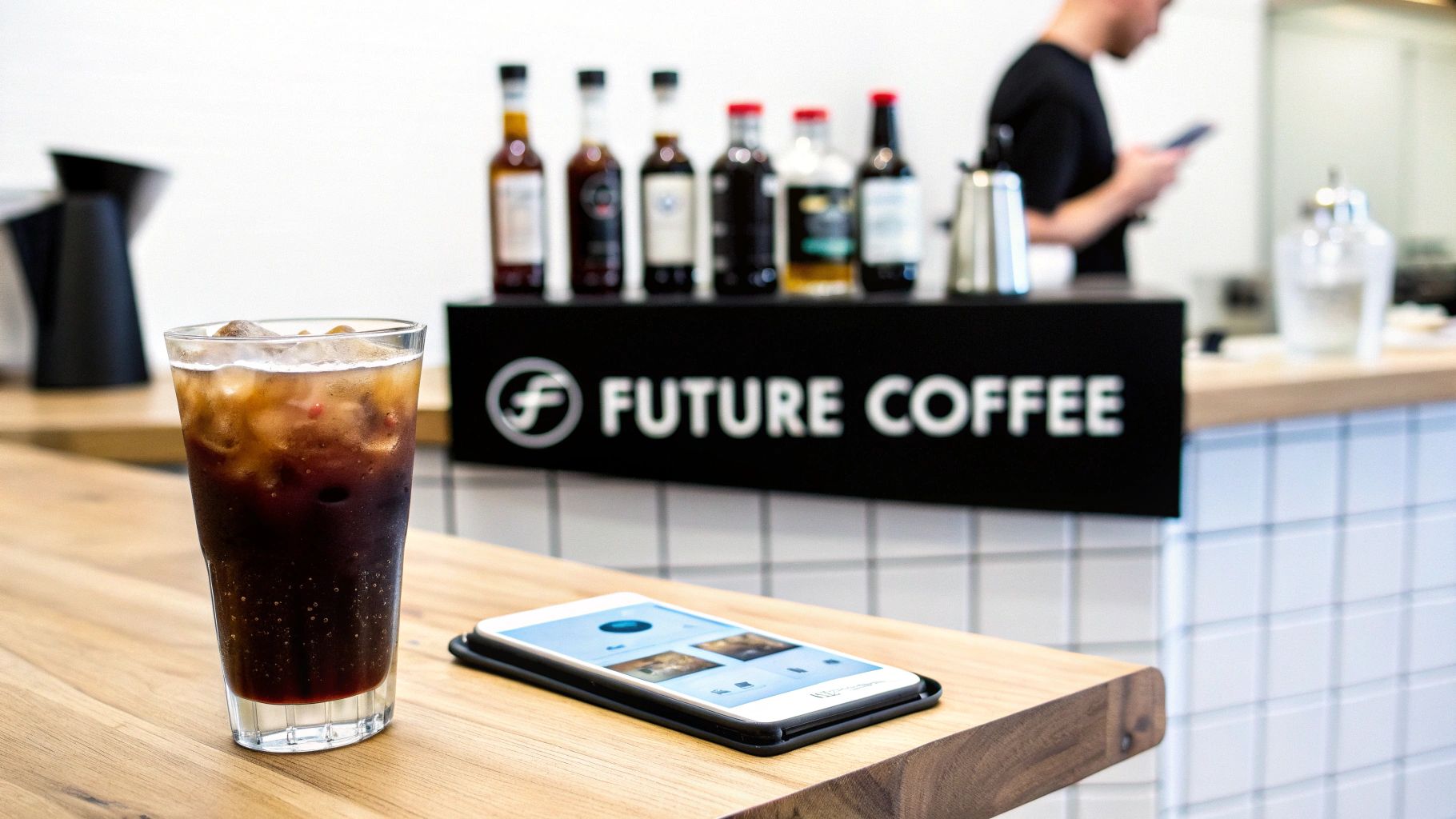
The scientific rigor and radical transparency of 4th wave coffee aren't just changing how we buy beans—they're completely reimagining the drinks we see on café menus. This isn't just a minor update; it's a full-blown creative movement. Roasters and baristas are now encouraged to experiment with new textures, temperatures, and ingredients, moving far beyond traditional hot coffee.
One of the most profound shifts has been the rise of cold coffee as a serious discipline. It's no longer the sad, watered-down afterthought made from yesterday's hot brew. Today, premium cold coffee receives the same meticulous attention as a perfectly pulled espresso, designed from the ground up to highlight the delicate notes of a single-origin bean.
The New Science of Cold Coffee
Forget your standard iced latte. The 4th wave approach to cold coffee is all about precision extraction. The goal is to produce a smoother, sweeter, and far more complex flavor profile, sidestepping the harsh bitterness and acidity that often plague rapidly cooled hot coffee. It's an obsession with quality that's unlocking entirely new sensory experiences.
Three key innovations are really driving this trend:
Advanced Cold Brew: This is the art of steeping coarsely ground coffee in cold water for an extended time, often 12 to 24 hours. Top-tier cafés now obsess over every variable—water chemistry, grind size, and steeping temperature—to produce incredibly smooth, low-acid concentrates that form a perfect base for all sorts of signature drinks.
Flash-Chilled Coffee: With this technique, coffee is brewed hot directly over ice. The sudden temperature drop acts like a flash-freeze for flavor, instantly locking in the volatile aromatic compounds that would otherwise evaporate. What you get is a bright, vibrant, and incredibly expressive cup that tastes just as the roaster intended.
Nitrogen Infusion: This is where things get really interesting. By infusing cold brew with nitrogen gas, you create a drink with a rich, velvety texture and a beautiful, cascading head, much like a Guinness. This "nitro cold brew" completely changes the mouthfeel of coffee, offering a dairy-free creaminess that's as stunning to watch as it is to drink.
A New Generation of Coffee Drinkers
This explosion in beverage creativity lines up perfectly with what younger consumers, especially Gen Z, are looking for. They want customization, visual flair, and new experiences—all things that a modern cold coffee menu delivers in spades. It’s no surprise that cold, functional, and Instagram-worthy drinks are some of the fastest-growing products in the industry.
The numbers back this up. For instance, over 60% of Gen Z consumers ordered cold drinks in the first half of 2022. That preference, combined with social media's power to turn a unique drink into a viral sensation, has brands investing heavily in cold extraction tech and ingredients like nitrogen and specialty plant-based milks. You can dig deeper into the fourth wave's impact on coffee brands to see just how much these trends are shaking up the market.
This shift isn't just about temperature; it’s about transformation. The modern coffee menu is becoming a playground for flavor and texture, where a single-origin bean can be expressed in a dozen different ways.
The Rise of Functional Coffee
Beyond just temperature and texture, the 4th wave mindset is giving rise to another major trend: functional coffee. As people become more health-conscious, they're starting to look for drinks that do more than just deliver a caffeine kick. This has opened the door for integrating wellness-focused ingredients directly into coffee.
These "functional" additions range from adaptogens like ashwagandha for stress support to collagen for skin health or MCT oil for sustained energy. By blending the daily ritual of coffee with the benefits of supplements, cafés are creating entirely new products that fit into a holistic lifestyle. It's a clear signal of where the market is headed—toward drinks that are not only delicious and ethically produced but also actively contribute to our well-being.
Got Questions About 4th Wave Coffee? We've Got Answers.
As the coffee world continues to evolve, the "fourth wave" brings a new set of ideas and language with it. It’s a fascinating shift, but it’s also easy to get tangled up in the terminology and wonder what it all really means for the coffee in your cup.
Let's cut through the noise. Here are some straightforward answers to the questions we hear most often about this exciting new chapter in coffee.
Is 4th Wave Coffee Just a Nicer Way of Saying "More Expensive"?
It's true that you'll see a higher price tag, but it’s not just for the sake of being expensive. The cost reflects a completely different set of values—one built on deep scientific understanding, verifiable ethics, and real producer partnership.
Think of it like this: the third wave taught us to appreciate quality, like a well-made local craft beer. The 4th wave coffee is more like a limited-release, barrel-aged ale from a master brewer. The extra cost isn't arbitrary; it covers the rare ingredients, the meticulous process, and the specialized expertise behind it.
That higher price on a bag of fourth-wave beans is directly funding:
Real Living Wages: Paying farmers based on their actual cost of production, not the whims of the commodity market. This gives them stability and a chance to thrive.
Farm-Level Innovation: Funding complex, labor-intensive processing methods like anaerobic fermentation. These experiments are what unlock those truly mind-blowing flavor profiles.
Precision Technology: Covering the cost of advanced roasting and brewing tools that bring a scientific level of consistency and control to the craft.
So, you’re not just paying for a better-tasting coffee. You’re investing in a more equitable and sustainable future for the entire industry.
Do I Need a Bunch of Fancy Gadgets to Enjoy It?
Not at all. While you can certainly go down the rabbit hole of high-tech gear, the heart of the fourth wave is the coffee itself—its quality, its story, its transparency. You don't need a lab-grade setup to enjoy it at home.
The single best thing you can buy is a quality burr grinder. Nothing impacts your brew more than a consistent grind size. It's the foundation for everything else.
The real fourth wave experience is about appreciating an incredible, transparently sourced coffee. Starting with exceptional beans is the most important step; the right equipment simply helps you do them justice.
Armed with a good grinder, you can pull amazing flavors from simple brewers like a V60, an AeroPress, or even a classic French press. The trick is to learn the variables—grind size, water temperature, time—and how to adjust them to bring out the best in each coffee.
How Can I Spot a Real 4th Wave Café?
Telling a true 4th wave café from the rest comes down to two things: radical transparency and a producer-first focus. They move past vague marketing terms and give you the real, verifiable details behind every bean.
When you're checking out a new shop or roaster, here’s what to look for:
Are the Details Ultra-Specific? A fourth wave menu or bag won't just say "Ethiopia." It will tell you the farmer's name, the specific coffee varietal (like Gesha or Bourbon), the farm's exact altitude, and the precise processing method used. Granular data is the name of the game.
Can the Baristas Tell the Story? The team is your best resource. A true 4th wave barista can speak with passion and knowledge about what makes a particular coffee unique. They should be able to explain the tasting notes, the farmer's story, and why they're so excited to be serving it.
Is the Menu Focused and Intentional? Look for a smaller, carefully curated menu of single-origin coffees that rotates frequently. This shows a commitment to sourcing and showcasing unique micro-lots instead of offering a generic, one-size-fits-all selection.
A genuine 4th wave business isn't afraid to share every detail, because that foundation of honesty and direct partnership is what their entire model is built on.
At AQEEK Coffee, we live and breathe these principles. We are blending the legendary heritage of Yemeni Mokha with the scientific precision and radical transparency that define the fourth wave. Whether you're an entrepreneur dreaming of opening your own café or a seasoned owner ready to elevate your offerings, we have the expertise to make it happen. Explore our consulting and roasting services to start your journey at https://aqeek.com.
