

The usual advice says a café should chase what customers can see first. Add a flavored cap. Add a bright topping. Add cold frothed milk because it photographs well on iced coffee. That advice sounds practical, but it skips the harder question. What remains of the drink, and of the café, once the foam settles?
Cold foam is a clever technique. It is also a fragile one. Even the most useful guides admit that a key unanswered question is whether cold frothed milk performs better than hot foam in iced drinks over real service time, because most how-to articles don't measure stability, dilution, or how quickly texture collapses after the drink is served, as noted in this discussion of cold milk frothing in real service conditions. For an owner opening a first shop, that gap matters more than another seasonal topping idea.
A stronger café identity starts deeper than surface texture. It starts with origin, ritual, and a story customers can taste. That is where Yemeni coffee changes the conversation. It shifts a menu away from trend dependence and toward lineage, and it aligns with the kind of transparency and product meaning discussed in AQEEK's perspective on fourth wave coffee.
The Trend Trap and the Timeless Brew
A barista sets down two iced drinks. One wears a thick, flavored foam cap. The other looks simpler, darker, older somehow. A customer reaches first for the dramatic one, takes a photo, sips, and stirs after the layers begin to separate. Then they try the second drink and pause longer. That second pause is what most café operators should care about.
The cost of building around the top layer
Cold frothed milk exists for a reason. It is a cold-air foam, not steamed milk, and its practical advantage is thermal. Because it isn't heated, it can sit on top of cold beverages without immediate melting, which is one reason it became such a common topping on iced lattes and cold brew, as described in this explanation of what cold foam is and how it works. It can also be produced quickly, often in about 15 to 20 seconds, which makes it appealing in a busy service setting.
That still doesn't answer the larger business question. Is a visible topping the same thing as a memorable coffee program? Often it isn't. A café built around add-ons has to keep inventing the next add-on.
Operational question: If the most marketable part of the drink is also the least durable part of the experience, the menu may be working against the brand.
Owners feel this in quiet ways:
Training pressure: Staff can learn a cold foam routine quickly, but they also have to reproduce it consistently through rushes, handoffs, and takeout orders.
Menu drift: Once toppings become the attraction, coffee itself can slide into the background.
Brand blur: Any shop can copy a foam flavor. Very few can copy a coffee heritage that customers can connect to.
What customers remember after the ice melts
The most durable cafés tend to sell more than drinks. They sell orientation. A person walks in and knows where they are. The menu, the aroma, the vessel, the language, and the service all tell the same story.
Yemeni coffee offers exactly that kind of anchor. It doesn't reject modern café craft. It puts it in proportion. Foam can still appear on a menu. Iced drinks can still sell. But they stop being the identity of the business.
That is the difference between a café that follows the market's latest visual habit and one that creates a destination. The first asks, “What can we add on top?” The second asks, “What are we willing to stand for?”
From the Port of Mokha The World's First Specialty Coffee
Long before café boards listed vanilla cold foam and brown sugar variations, merchants watched ships leave the Yemeni coast carrying one of the world's most desired goods. The port was Mokha. The product was coffee. Not coffee as an anonymous commodity, but coffee known for place.
Caravans moved through mountain terrain. Porters handled sacks grown in difficult highland conditions. Traders and drinkers learned to associate Yemen with distinction, not interchangeability. That was the beginning of a truth modern specialty coffee sometimes rediscovers as if it were new: origin matters.
A name that traveled farther than the ship
The word Mokha did not survive because it was fashionable. It survived because the coffee did. People remembered the port because they remembered what passed through it.
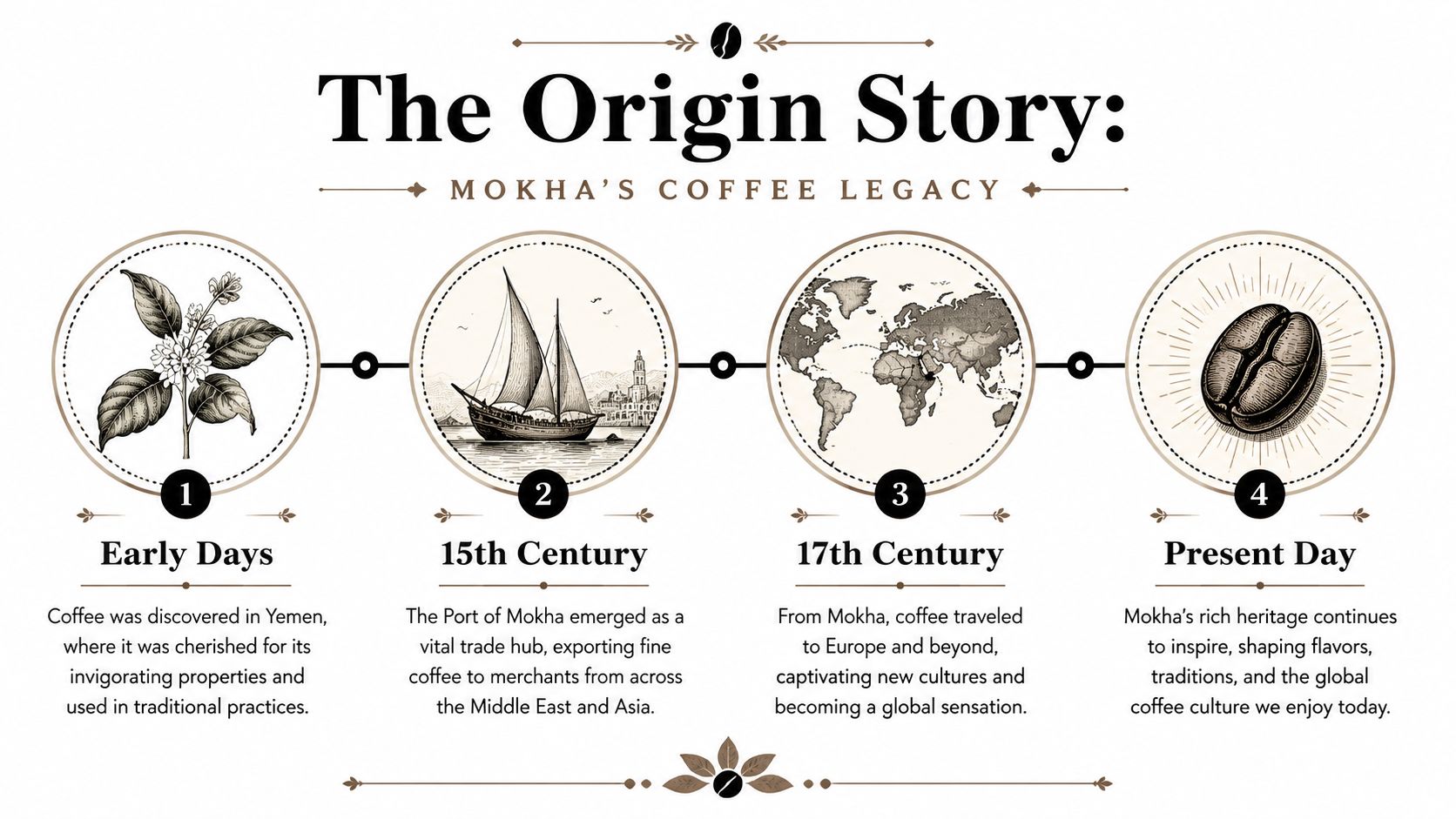
In today's language, people might call that a premium origin story. In older terms, it was reputation earned cup by cup, shipment by shipment. Yemen's place in coffee history wasn't decorative background. It was foundational.
Anyone building a café around Yemeni coffee is not borrowing prestige from elsewhere. They are returning to one of the deepest roots in the trade itself. That history comes alive in AQEEK's own telling of Yemeni coffee through history, flavor, and culture.
Why Yemen belongs in the specialty conversation
Modern coffee professionals use terms like terroir, heirloom varietals, traceability, and sensory complexity. Those ideas fit Yemen naturally. They are not foreign labels pasted onto the country after the fact.
Consider the contrast:
Modern café language | Yemeni coffee reality |
|---|---|
Origin-driven menu | Coffee long identified by Mokha and regional character |
Distinct flavor profile | Coffee valued for singular cup identity, not sameness |
Story-rich sourcing | A trade history tied to place, route, and ritual |
Premium positioning | A legacy built on rarity, recognition, and memory |
That is why it makes sense to call Yemeni coffee the world's first specialty coffee in spirit. Not because the modern industry used that phrase centuries ago, but because the market already treated it as something singular.
Coffee didn't become special when cafés learned to describe it better. It was special when drinkers first learned that one place could produce a cup unlike any other.
The older coffeehouse lesson
The first European coffeehouses did not grow around novelty toppings. They grew around the drink itself and the social world around it. Yemen's coffee reached beyond its own borders and helped shape that habit.
For a modern owner, that history carries a practical lesson. If your menu begins with a product whose identity comes from a place, a people, and a long memory, you start with depth. If it begins with a topping trend, you start with decoration.
Decoration can sell. Depth can endure.
Aqeeq The Cultural Heartstone of Yemeni Coffee
In Yemen, value is often carried in objects that hold memory. An agate stone can do that. A cup of coffee can do it too. Both are small enough to hold in the hand, and both can carry more meaning than their size suggests.
The word Aqeeq evokes Yemeni agate, a stone associated with authenticity, rootedness, and enduring worth. That symbolism matters because Yemeni coffee has lived through pressure of its own: distance, scarcity, upheaval, migration, and revival. A stone formed over time becomes a fitting metaphor for a coffee tradition shaped by the same patience.
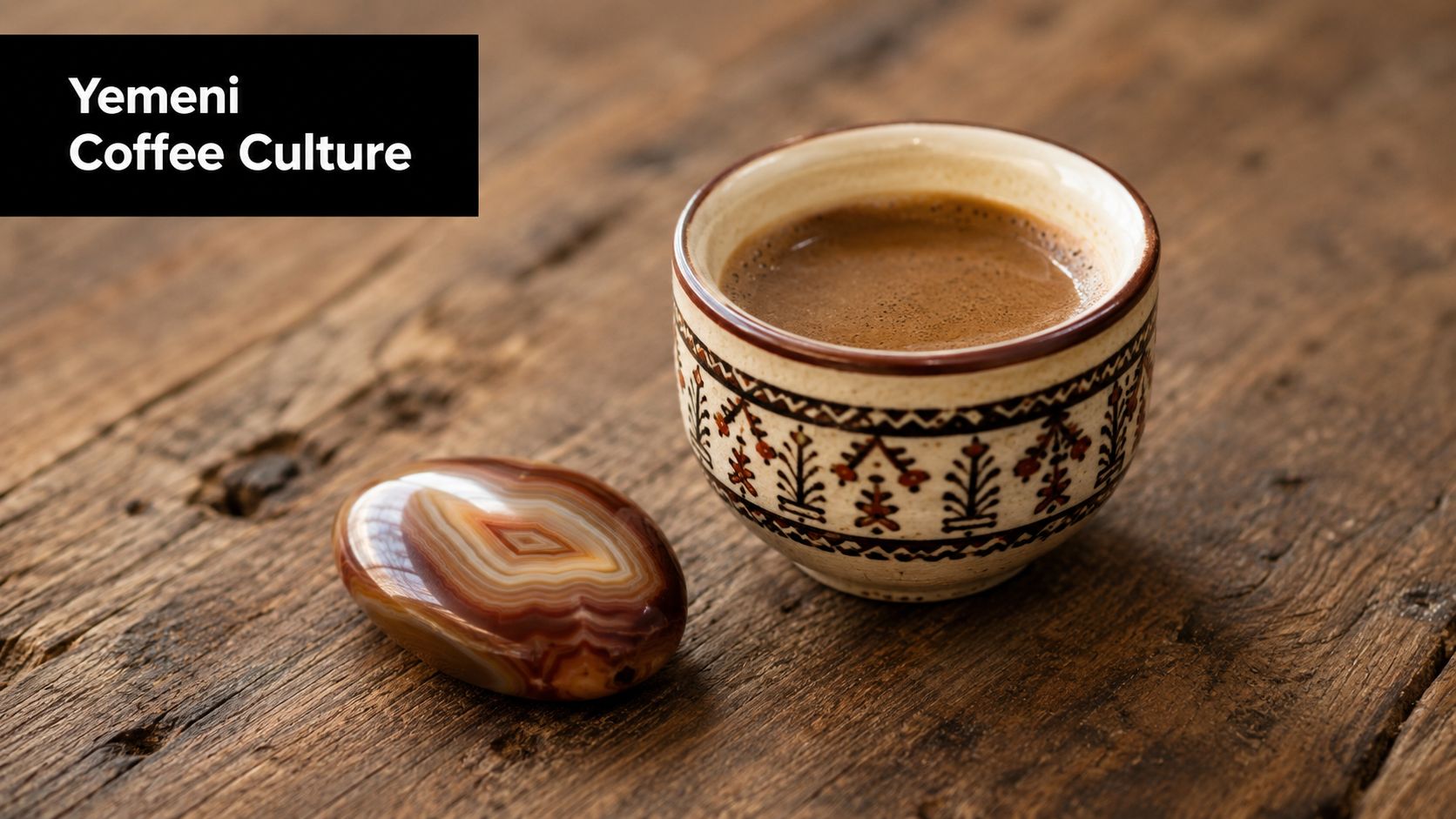
Pressure creates distinction
An agate stone is not valuable because it is loud. It is valuable because it is unmistakable. Patterns form under conditions that cannot be rushed. Yemeni coffee works the same way in the imagination of a serious café operator.
A menu built on heritage behaves differently from a menu built on novelty:
It gives staff language: Baristas can explain where the drink comes from, not just what syrup goes into it.
It gives customers memory: People remember a preparation tied to culture more easily than a rotating flavor cap.
It gives the brand a center: The café becomes identifiable before the first sip is finished.
A brand name can either decorate or declare
Some coffee brands choose names that sound current. Others choose names that bind product and identity together. Aqeeq belongs to the second category.
That matters in a market crowded with interchangeable aesthetics. Minimalist logos, neutral interiors, and a few cold foam drinks can make one shop resemble another in a week. Heritage can't be duplicated that easily. You can imitate the look of a trend. You can't imitate inheritance with the same force.
Brand lesson: When the name itself carries cultural weight, every bag, menu, and cup starts speaking before staff say a word.
There is also a strategic point here. Authenticity is often treated as a soft idea, useful for storytelling but secondary to operations. In practice, authenticity can sharpen operations because it narrows the menu to what belongs, what teaches well, and what the shop can stand behind without pretending.
Why this matters to the customer in line
Most customers won't walk in asking for a lecture on Yemeni symbolism. They don't need one. They need signals that the shop knows who it is.
They notice when a menu feels assembled from internet trends. They notice when a menu feels authored. The difference shows up in details: the names of drinks, the confidence of the recommendation, the way a traditional cup is presented, the reason a certain preparation remains on the board while others come and go.
Aqeeq, as a cultural symbol, turns coffee from a generic product into a declared inheritance. That is not nostalgia. It is positioning.
The AQEEK Renaissance Reviving a Legend for Modern Cafés
A founder signs a lease. The room is empty except for rough walls, a few taped floor marks, and the fear every first operator knows well. What should the bar look like? What belongs on the opening menu? Which equipment should be purchased first, and which mistakes will stay expensive for years?
A system is needed for heritage. Story alone doesn't build a functioning café.
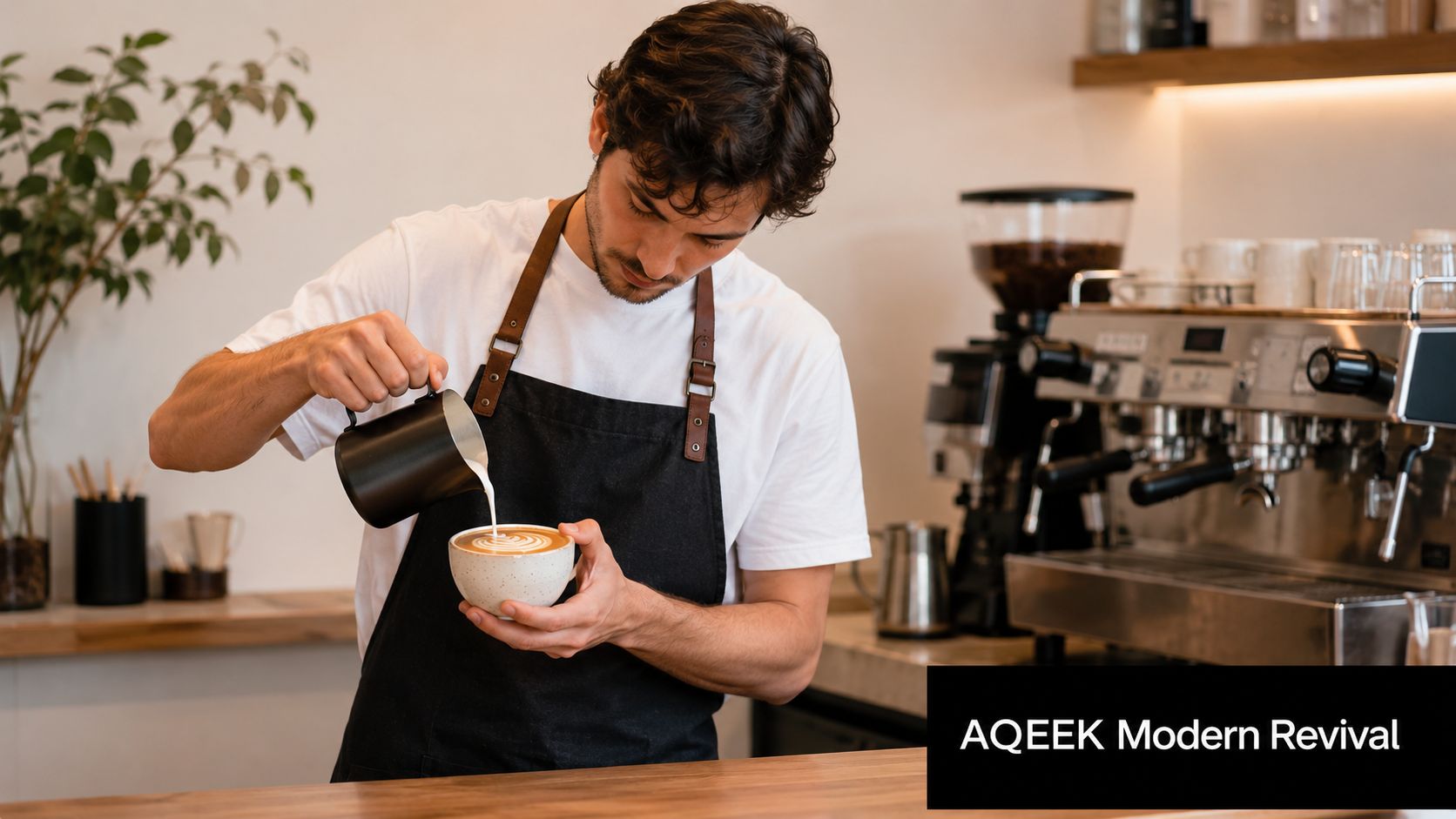
The old craft and the modern bar
Cold foam is a useful example of modern standardization. A repeatable workflow for cold foam is straightforward: start with milk from refrigeration, fill a container only about one-quarter full, and aerate for roughly 15 to 30 seconds, according to this practical guide on making cold foam with a milk frother. That kind of precision suits training manuals and rush-hour consistency.
Traditional Yemeni coffee lives differently. It is more sensory, more inherited, more dependent on smell, timing, roast expression, and serving context. A café that wants to bring those drinks into a contemporary shop has to translate tradition without flattening it.
That translation is where consulting becomes relevant. In that context, AQEEK Coffee is one option for operators who want support with barista training, menu development, equipment sourcing, workflow design, and a Yemeni coffee identity inside a modern café model.
What revival looks like in practice
Revival is not just importing a name or adding “Mokha” to a wall graphic. It requires disciplined decisions on the floor.
A working café has to answer questions like these:
How will staff move? A beautiful concept fails fast if the espresso station, handoff point, and support tools fight each other.
How will signature drinks be taught? Heritage drinks can't rely on one gifted employee's memory.
How will quality stay visible? A shop has to define standards for extraction, milk work, hospitality, and service pacing.
Those questions become more important, not less, when a café carries a cultural mission. If the operation is sloppy, the story loses force.
Why entrepreneurs need both lineage and discipline
A lot of first-time owners think they must choose between an emotionally rich concept and a commercially disciplined one. They don't. Yemeni coffee is strongest when both arrive together.
Consider the contrast below:
Café built on trend alone | Café built on heritage with systems |
|---|---|
Easy to imitate | Harder to copy convincingly |
Fast initial attention | Deeper long-term identity |
Menu can drift quickly | Menu has a clear center |
Staff sell features | Staff can share meaning |
That is what a renaissance looks like at shop level. Not a museum. Not a theme. A living café where a historic coffee tradition enters modern retail with standards, recipes, training, and confidence.
Building a Signature Menu Beyond the Cold Foam Cap
An owner planning a menu often starts at the wrong end. They ask what looks current. A better question is what earns repeat orders after the first impression fades.
Cold frothed milk deserves a place in that conversation because it shows how technical decisions shape customer experience. It also shows the limit of technique when there is no larger narrative around it.
What cold foam teaches the operator
Scientific frothing tests show that cold whole milk can increase its volume by two-thirds in 20 seconds, and that temperature, fat, and protein all affect foam structure, as shown in Dr Helen Czerski's milk frothing demonstration. That matters for menu development because a café is not just choosing flavors. It is choosing texture, yield, stability, and how a drink behaves after handoff.
The same science creates practical design questions:
Which milk performs predictably? Dairy and non-dairy products won't behave the same, especially in cold applications.
What kind of foam fits the drink? A lighter cap can look appealing at first but may separate awkwardly.
How long should the drink still taste intentional? A takeout iced drink needs to survive more than the moment it leaves the bar.
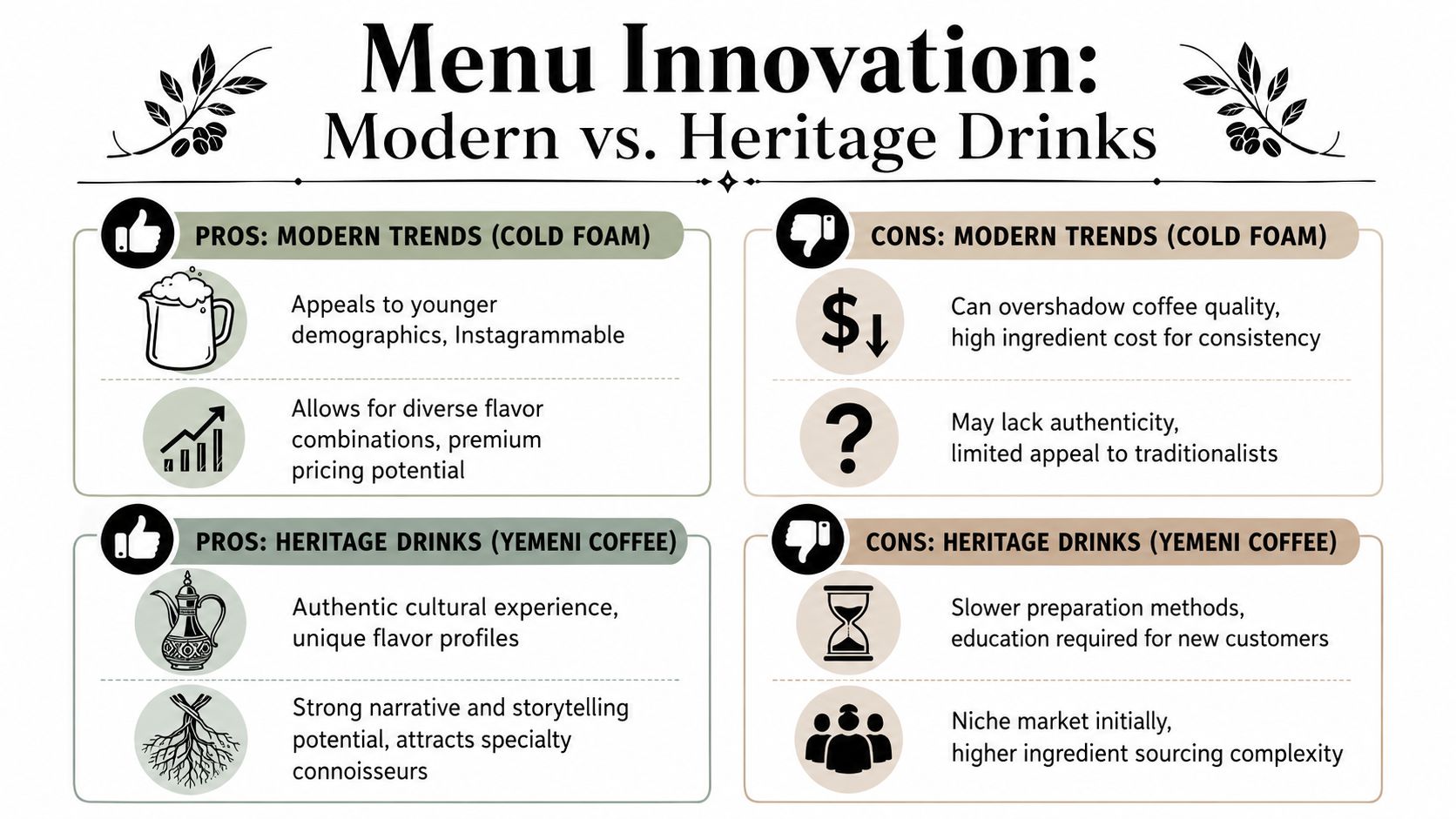
Two menu paths, two business models
A menu heavy with cold foam drinks can be commercially useful. It gives room for visual variety and layered customization. But it also pulls the café toward a familiar trap: drinks become interchangeable except for topping and syrup.
A heritage-driven Yemeni menu works differently. Drinks such as qishr or qahwa invite the customer into a tradition rather than a modification system. The menu becomes less about stacking options and more about presenting a worldview.
Here is the strategic comparison in plain terms:
If you lead with modern foam drinks | If you lead with Yemeni heritage drinks |
|---|---|
You sell novelty and format | You sell origin and meaning |
Customers may buy what looks new | Customers may return for what feels distinct |
Training centers on repeatable technique | Training joins technique with cultural explanation |
Competitors can mimic quickly | Competitors struggle to reproduce legitimacy |
A topping can differentiate a drink for a week. A cultural preparation can differentiate a café for years.
How to use both without letting one erase the other
The smartest menu doesn't have to reject contemporary drinks. It just has to place them in the right order of importance.
A good framework looks like this:
Center the core: Put Yemeni coffee and its traditional preparations at the heart of the menu identity.
Use modern formats selectively: Offer iced drinks and cold foam where they support the program, not where they distract from it.
Teach through naming: Let menu language carry place and preparation, not just flavor cues.
Design signature drinks with intention: AQEEK's approach to creating Yemeni signature coffee drinks reflects this broader idea of building beverages that feel authored rather than assembled.
The result is a menu that can still function in a modern café economy while resisting sameness. That is what owners should want. Not a board full of options, but a board that tells customers why this shop exists.
Turn Coffee into Culture with AQEEK
A café can sell drinks all day and still fail to become memorable. The ones people talk about later usually offer more than efficiency. They offer a point of view.
That is the essential lesson hidden inside the cold foam conversation. Technique matters. Workflow matters. Ingredient behavior matters. But none of that answers the deepest business question on its own: why should this shop exist instead of the one down the street?
A practical way to build from heritage
If you are opening or repositioning a café, start with choices that compound rather than scatter.
Choose a center, not a trend. Let Yemeni coffee define the shop's identity before secondary menu ideas crowd it out.
Build operations around that center. Training, bar flow, drink specs, and service language should all reinforce the same concept.
Use modern techniques carefully. Cold frothed milk can be useful on selected drinks, but it shouldn't become the soul of the menu.
Teach staff the story behind the cup. Customers remember drinks more clearly when baristas can explain what makes them culturally and sensorially distinct.
The durable advantage
Most cafés can copy a flavor combination in days. Few can build a business around a genuine coffee lineage and present it with operational clarity. That is why heritage works as strategy, not just atmosphere.
Yemeni coffee gives a café founder something rare. It provides deep history, recognizable identity, and a reason for customers to care beyond convenience. When that is paired with training, menu discipline, and thoughtful execution, a coffee shop stops behaving like a commodity retailer. It becomes a cultural place.
If your menu can be copied overnight, your differentiation is thin. If your menu is rooted in a living tradition, imitation gets much harder.
The strongest café concepts don't ask customers to admire the foam and move on. They invite them into a story older than the trend cycle and more durable than the latest visual gimmick.
If you want to build a café around Yemeni coffee with stronger training, clearer menu identity, and practical operational support, explore AQEEK Coffee. Their work connects Mokha heritage to modern shop design, barista development, and signature beverage strategy so your concept can function as both a business and a cultural landmark.
